


The situation
A European mid-cap fund was two years into owning a building insulation manufacturer. EUR 300M in revenue, EUR 50M EBITDA, 800 employees across Europe. Healthy business with a growing backlog and an accelerating renovation market.
The fund had a refinancing window opening in six months. They wanted sustainability-linked loan terms that would cut their margin by 15-20 basis points on EUR 350M of senior debt. They also had LPs asking pointed questions about sustainability across the portfolio. And they were starting to think about exit: in two to three years, the buyer's DD team would look for sustainability credentials. The company had none to show.
No GHG baseline. The company could not state its own carbon footprint in tonnes. No SBTi commitment, while direct competitors had already validated theirs. Product impact claims ("saves up to 80% heating energy") sitting in marketing brochures with no third-party verification. No quantified link between sustainability and EBITDA. And a transition risk assessment that scored 5 out of 5: no decarbonisation plan, 15% renewable energy, zero committed capital expenditure on emissions reduction.
The fund's question: what is sustainability actually worth in this company, and what should we do about it?
What we delivered
Two things: a sustainability value creation report and an Excel model.
The report covered: baseline assessment against industry benchmarks (covering 9,000+ PE-backed companies across 320 GPs), competitive positioning against five direct peers, regulatory demand mapping for eight building regulations that affect customer behaviour, and a bottom-up value bridge with three scenarios across five years.
The Excel model put numbers on it. Three scenarios (conservative, base, optimistic), each internally consistent. Five-year P&L projections. Sensitivity analysis on exit multiples, EBITDA growth rates, and renovation market penetration. A KPI tracking framework with four metrics ready for SLL structuring. Over 100 assumptions documented with sources and confidence levels.
Timeline: ten working days from engagement to final deliverable. The analysis itself took under 48 hours. The rest was interviews with the fund's sustainability team, data requests to the portfolio company, and alignment with the CFO on what numbers the board would find credible.
The bottleneck turned out to be getting the right people in the room, not the analysis itself.
From what we've seen, this is the pattern across mid-market PE. The funds know sustainability matters and the portfolio companies have the raw material, but what's missing is someone who connects the two with numbers that survive scrutiny, fast enough to fit a board cycle.
The avoided emissions story
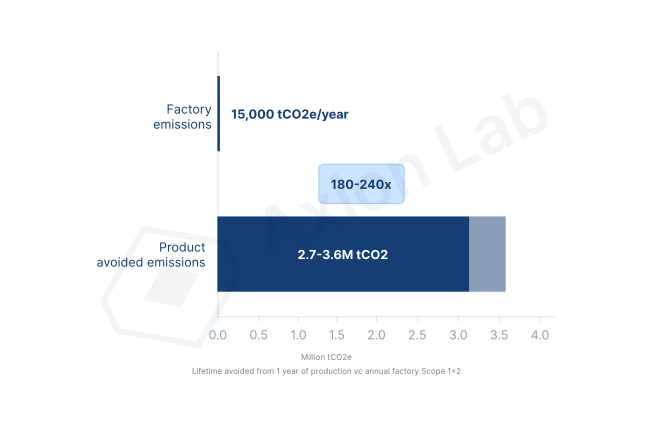
The company's products avoid roughly 180 to 240 times more CO₂ than its manufacturing operations produce. That isn't a rounding error; it's the entire equity story.
The factory emits approximately 15,000 tonnes of CO₂ equivalent per year (Scope 1 and 2, benchmarked against sector peers). The company produces around 7.5 million square metres of insulation per year. Every square metre installed saves roughly 12 to 16 kilograms of CO₂ per year from reduced heating and cooling energy. A building's insulation lasts 30 years. Lifetime avoided emissions from a single year of production: 2.7 to 3.6 million tonnes of CO₂.
Divide that by the factory's 15,000 tonnes of annual production emissions. You get a ratio between 180x and 240x.
The company didn't know this number before we calculated it. They had marketing claims about energy savings per square metre, but they didn't have a figure that a lender, LP, or exit buyer could put in a model. And they didn't have the third-party verification (LCA per ISO 14040/14044) that converts a marketing claim into an auditable data point.
That verification is the best-returning part of the programme: EUR 80-150K converts "we believe our products save energy" into "here is an independently verified number showing our products avoid 200 times our operational footprint."
Climate Impact Meets Financial Value
Avoided Emissions Ratio
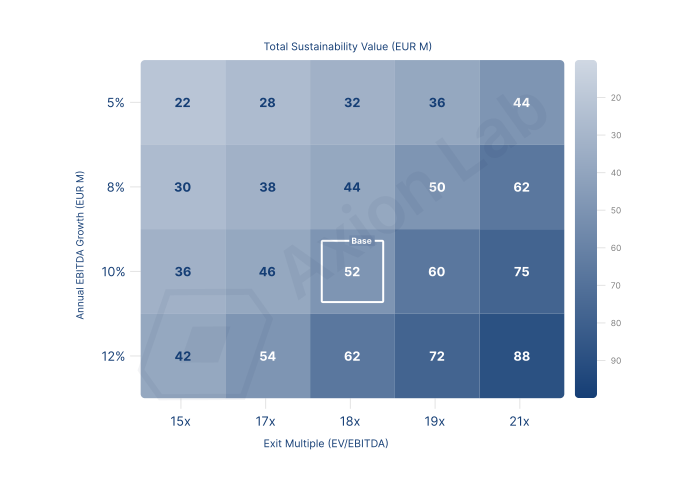
Total Sustainability Value (EUR M)
The value bridge
Three scenarios, each internally consistent.
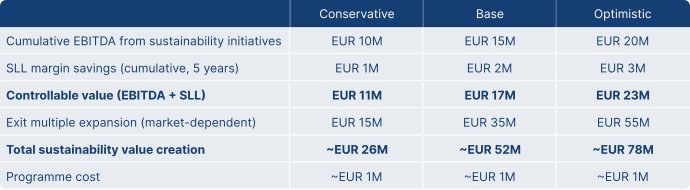
In plain words: the EBITDA and SLL layers are what the company controls. They return EUR 11-23M on a EUR 1M programme through direct P&L impact alone. The multiple expansion is upside that depends on the exit market. Even if buyers give zero premium for sustainability credentials, the programme returns EUR 11-23M on a EUR 1M spend. If they do, and the data from BCG, EY, and Deloitte says they will, the total reaches EUR 25-80M depending on the scenario.
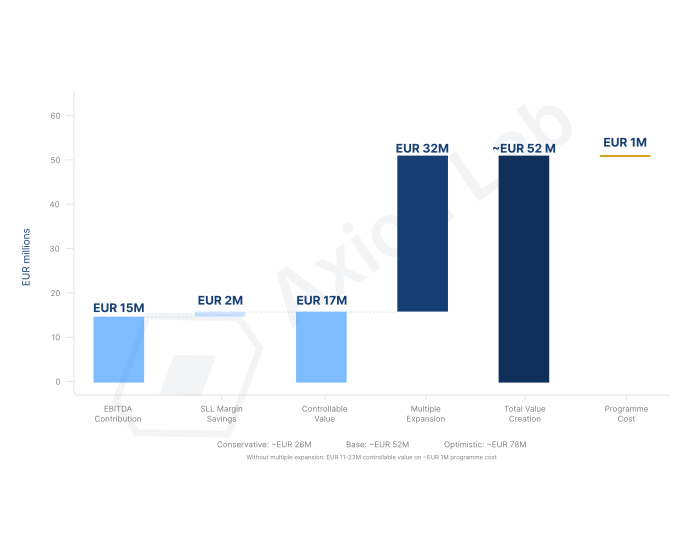
Where does the EBITDA come from? A green premium on verified thermal performance claims (3-5% on ESG-sensitive contracts), renovation market acceleration from the EPBD wave (the EU requires member states to renovate 16% of worst-performing non-residential buildings by 2030 and 26% by 2033), aftermarket capture from a competitor recently acquired by a financial buyer with no sector experience, and operational energy savings inside the company's own plants.
The SLL savings are structured around four KPIs: EcoVadis score, carbon intensity, recycled content share, and renovation revenue share. Each KPI carries a 5 basis point margin ratchet on EUR 350M of senior debt. At full attainment (all four met): 20 basis points of margin reduction, EUR 700,000 per year in savings. Before the programme, all four KPIs were below target, triggering a flat penalty of 5 basis points when all are missed. The swing from penalty to full savings is 25 basis points per year. The ramp is realistic: one KPI met in Year 2 (EUR 175,000 savings), two to three by Year 3 (EUR 350-525,000), all four by Year 5.
The multiple expansion layer is the one we can't control and won't pretend otherwise. EY-Parthenon and EBS found a correlation between ESG profiles and fund-level IRR: PE funds with AAA ratings earn 7.8 percentage points more than BBB-rated funds (2023, based on RepRisk data). That's a fund-level stat, not a guarantee for any single portfolio company. What we can say: a company that goes to market with SBTi validation, EcoVadis Gold, and independently verified avoided emissions of 200x its operational footprint gets a different conversation with buyers than one that cannot state its own carbon footprint. Whether that conversation is worth 0.3x or 1.0x of exit EBITDA depends on the buyer pool at the time.
Programme cost: approximately EUR 1M over five years, covering GHG inventory, SBTi target development, product verification, and a sustainability coordinator. We expected the data to be the hard part. It wasn't. The analysis ran in under 48 hours; the alignment conversations with three different stakeholders took the rest of the ten. By Year 3, SLL savings alone (EUR 350-525,000 per year) exceed annual programme spend of roughly EUR 200,000, so the programme pays for itself before a single euro of EBITDA materialises.
Carlyle coined the phrase "The EBITDA of ESG" in 2023. GPs estimate their sustainability efforts improve realised EBITDA by 4% to 7% over the hold period (BCG, Sustainability in Private Markets, 2025, based on data from 9,000+ portfolio companies across 320 GPs). PE deals now need 10-12% annual EBITDA growth to hit return targets, up from 5% a decade ago (Bain, Global PE Report, 2026). Sustainability moves the EBITDA line and the exit multiple at the same time. Not many levers do that.
Four priorities for Year 1
We gave the fund a sequenced roadmap: four actions, ordered by what each one unblocks.
1. GHG inventory (3-6 months, EUR 30-50K based on typical market rates for mid-cap European manufacturers). The single most blocking gap. Without absolute emissions data, you cannot set SBTi targets, activate the carbon intensity SLL KPI, benchmark against sector peers, or answer the question every LP is now asking.
2. SBTi commitment and product impact verification (combined Year 1 investment of EUR 100-180K). The SBTi commitment letter is free to submit, with target development costing EUR 15-30K separately and 18 months to validation. Product claim verification (LCA per ISO 14040/14044 for three to four product lines, EUR 80-150K) converts the 180-240x avoided emissions ratio from a management estimate to an auditable number. We combined these because they share the same underlying data: a verified GHG inventory feeds both the SBTi pathway and the product LCA baseline.
3. SLL structuring (pre-refinancing). Four KPIs, all measurable within the company's existing reporting infrastructure. At full attainment, saves EUR 700,000 per year on EUR 350M of debt. Partially funds the rest of the programme.
4. Renovation market strategy (internal, no incremental cost). The EPBD renovation wave is creating demand. The company needs a targeted positioning plan for two to three new European markets to capture it. This turns regulatory tailwind into revenue.
70% of PE firms rank value creation as a top-three driver for ESG activities (PwC, Global PE Responsible Investment Survey, 2023). Everyone agrees sustainability matters. What most funds haven't done is put a number on it for each specific portfolio company.
What the fund can do now
Four things that were not possible before this engagement:
Negotiate SLL terms with lenders. Four quantified KPIs, each with a baseline, target, and measurement methodology. The refinancing conversation moves from "we are working on sustainability" to "here are the specific margin ratchets we are targeting, backed by a five-year roadmap."
Brief the portfolio company board. A funded sustainability programme with a P&L impact model that the CFO helped build. Not a slide deck about ESG trends. A five-year model with three scenarios, sensitivity analysis, and a sequenced implementation plan.
Report to LPs. Benchmarked sustainability data for this portfolio company, positioned against 9,000+ peers. The LP who asks "what are you doing on sustainability?" gets a specific, quantified answer instead of a general commitment.
Prepare the exit narrative early. The sustainability story starts compounding in Year 2, not Year 4. By the time the fund runs a process, the company has SBTi validation, verified product claims, and two to three years of tracked KPI improvement. The exit data room includes the numbers, not just the narrative.
Ten working days is how long it takes to go from "we should look at sustainability" to a board-ready value creation plan with an Excel model. We built the map and handed it over; what happens next is the fund's call.
How we work
Public data analysis: sustainability reports, annual reviews, regulatory filings. Industry benchmarking against 9,000+ PE-backed companies across 320 GPs. Bottom-up value quantification with 100+ documented assumptions, each flagged by confidence level and management validation requirement. Competitive intelligence across five to six direct peers. Regulatory demand mapping for eight to ten regulations assessed for customer impact. All estimates are directional until validated with management. Analysis based on data available as of Q1 2026.
Details have been altered to protect client confidentiality. The sector, scale, and specific figures have been adjusted.

