

AI is transforming how private equity firms handle ESG (Environmental, Social, and Governance) data, making compliance with strict EU regulations like CSRD (Corporate Sustainability Reporting Directive) and SFDR (Sustainable Finance Disclosure Regulation) more manageable. These frameworks require robust, audit-ready disclosures, which can be challenging due to fragmented data sources and increasing demands for traceability and assurance.
Key takeaways:
- CSRD & SFDR compliance: Firms must provide detailed ESG data, backed by third-party assurance, and ensure data traceability to meet stringent audit requirements.
- AI’s role: Automates data collection, ensures traceability, flags anomalies, and aligns data to regulatory standards, reducing manual errors and saving time.
- Cost implications: ESG audits under CSRD can cost £100,000–£200,000 per £10 million in revenue annually. AI helps mitigate these costs by enabling continuous, reliable data management.
- Investment lifecycle: AI supports ESG due diligence pre-deal, during transactions, and post-deal, ensuring compliance and improving financial outcomes.
AI simplifies ESG reporting while maintaining accuracy, but human oversight remains essential to ensure reliability and avoid automation bias. Platforms like Axion Lab combine AI efficiency with expert judgement, helping private equity firms stay ahead of evolving regulations.
Regulatory Requirements: CSRD and SFDR at a Glance
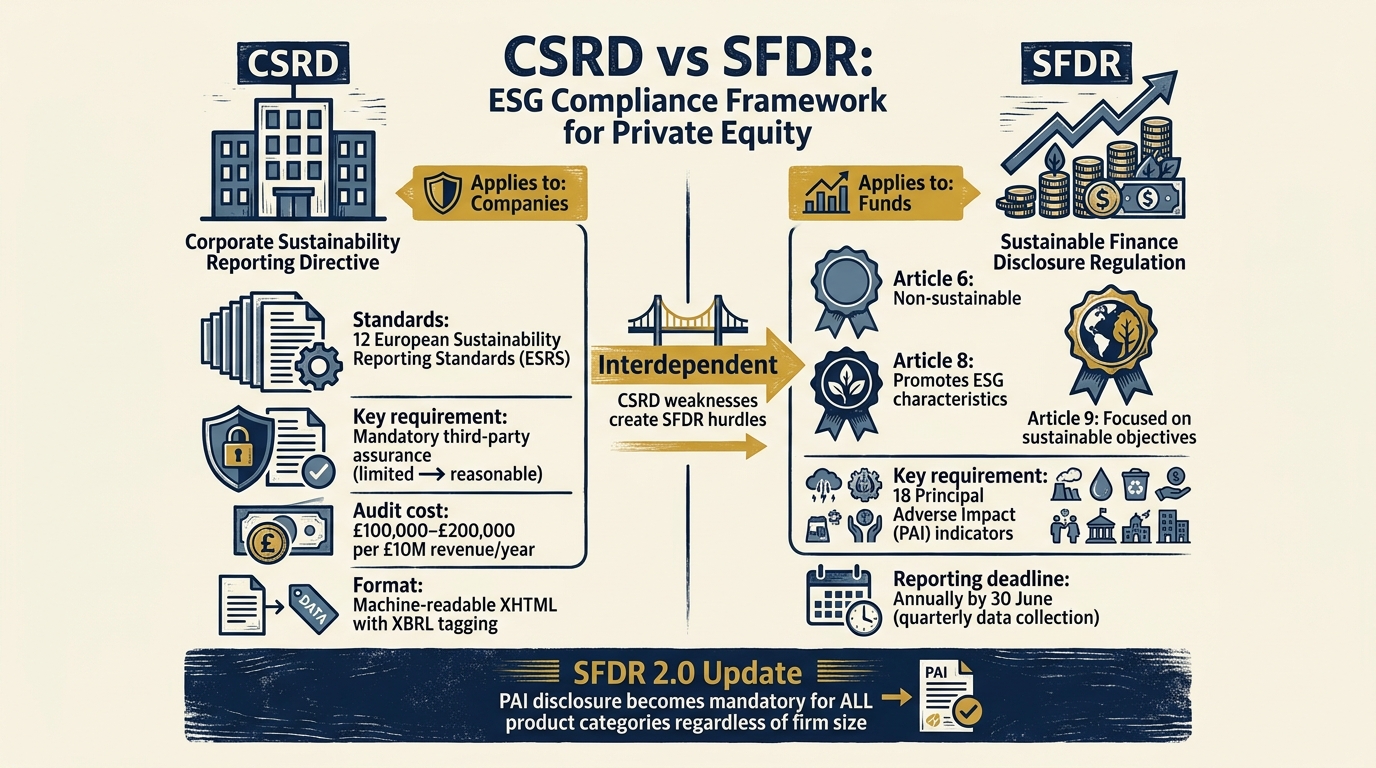
CSRD vs SFDR: ESG Compliance Framework for Private Equity
Private equity firms now navigate two interconnected regulatory frameworks. The Corporate Sustainability Reporting Directive (CSRD) focuses on companies, requiring them to disclose information across 12 European Sustainability Reporting Standards (ESRS) that cover environmental, social, and governance (ESG) topics 8. Meanwhile, the Sustainable Finance Disclosure Regulation (SFDR) applies to funds, classifying products into three categories: Article 6 (non-sustainable), Article 8 (promoting ESG characteristics), or Article 9 (focused on sustainable objectives) 7. CSRD forms the basis for SFDR compliance - weaknesses in CSRD disclosures can create hurdles when meeting SFDR obligations. Let’s delve into how mandatory assurance and meticulous data traceability ensure adherence to CSRD.
"The era of voluntary sustainability narratives has ended, replaced by mandatory, audited, and machine-readable disclosures that demand rigorous data governance." - IIENSTITU 7
Mandatory Assurance and Data Traceability
One major change under CSRD is the introduction of mandatory third-party assurance for sustainability data - previously a requirement only for financial statements 48. Initially, this will involve limited assurance, but the goal is to move towards reasonable assurance, comparable to a full financial audit. For firms, the cost of limited assurance is estimated to range from £100,000 to £200,000 per £10 million in revenue, depending on operational complexity 4.
Auditors will now trace every reported figure back to its source, requiring firms to establish clear data lineage. This includes tracking data from raw inputs to final disclosures, with strict ownership protocols, version control, and immutable audit trails. Additionally, CSRD reports are shifting from static PDFs to machine-readable XHTML formats with XBRL tagging. This digital transformation allows for automated data verification by regulators and investors 28. Together, these measures ensure that data remains audit-ready and transparent at all times.
Principal Adverse Impact Indicators under SFDR
The rigorous assurance standards under CSRD naturally extend to ESG metrics, particularly Principal Adverse Impact (PAI) indicators required by SFDR. SFDR mandates that financial market participants move beyond generic sustainability claims, instead providing measurable performance data through PAI indicators like carbon footprint and board gender diversity 57. Large firms with over 500 employees must disclose 18 PAIs across environmental, social, sovereign, and real estate categories 5.
Private equity firms often depend on portfolio company data to calculate these indicators. However, many portfolio companies are not yet CSRD-compliant. Deloitte highlights that when direct data isn’t available, firms must make reasonable efforts to gather figures through engagement with investee companies, third-party sources, or by applying reasonable assumptions 5. Under the proposed SFDR 2.0 framework, PAI disclosure will become mandatory for all product categories, regardless of firm size. Standardised indicators, outlined in delegated acts, aim to reduce inconsistencies 9. These reports must be published annually by 30 June, based on data collected at the end of each quarter 5.
sbb-itb-6ca8558
How AI Improves ESG Data Traceability and Auditability
AI ensures that every ESG data point remains traceable and unalterable, aligning with CSRD and SFDR regulations.
AI-Driven Data Ingestion and Standardisation
ESG data often comes in a mix of formats - PDFs, scanned documents, Excel sheets, and even emails. Each source has its own structure, which can lead to inconsistencies. AI tools step in to automate the extraction of key data points without needing manual templates or custom training 11. Once the data is extracted, machine learning models map the figures to the appropriate regulatory frameworks, such as SFDR's PAI indicators or CSRD's ESRS data points 2511.
This process centralises ESG data into version-controlled systems, treating it with the same level of scrutiny as financial records 2. As CSRD pushes firms towards digital, machine-readable formats like XBRL, AI-powered pipelines offer an efficient way to stay compliant. This automated mapping also creates a solid foundation for reliable audit trails.
Source-Linked Evidence and Audit Trails
One standout feature of AI-driven ESG analysis is its ability to link metrics back to their original sources. Each figure is tied directly to its source document, including page, line, and context details 1112. This means auditors can easily verify data instead of relying on assumptions.
"With Model Context Protocol, outputs are citation-linked and traceable to identifiable transcripts. Every surfaced risk can be defended in investment committee and compliance contexts." - Third Bridge 12
This system reduces the errors often seen in generic AI outputs. By limiting itself to verified, proprietary datasets, grounded AI ensures outputs are both accurate and defensible under regulatory scrutiny. This is especially critical for private equity firms preparing for CSRD's mandatory assurance requirements. Additionally, AI continually monitors data quality, flagging discrepancies as they arise.
Anomaly Detection and Data Validation
Data collection is rarely perfect, and errors are inevitable. AI helps by identifying issues early - before the audit stage. For example, a supplier’s sustainability report might contradict their ESG questionnaire, or mismatched units could distort figures. AI automatically flags these inconsistencies for human review 13. Machine learning models also compare new data against historical trends and industry benchmarks, catching outliers in areas like energy use or emissions 2. Each data point is assigned a confidence score, with low-confidence entries escalated for further scrutiny 13.
"Catching these issues during collection rather than during audit is significantly less painful." - Artificio 13
This proactive approach transforms ESG reporting. Instead of scrambling to fix gaps before an audit, firms can run continuous gap analyses throughout the year. This allows them to align current disclosures with CSRD and SFDR requirements in real time, addressing missing PAI indicators as they arise 43.
AI in ESG Due Diligence Across the Investment Lifecycle
AI is reshaping ESG due diligence at every stage of the investment process, aligning with CSRD and SFDR requirements.
Pre-Deal Screening and Red-Flag Analysis
AI dramatically reduces the time needed to generate structured ESG intelligence, transforming a process that once took 10–20 hours into just minutes 12. This efficiency is a game-changer for early-stage screening, where AI identifies red flags - deal-breaking issues - and yellow flags, which might impact valuation multiples. It also compresses commercial and ESG due diligence timelines from three weeks to just five days 1016.
AI’s ability to perform cross-document reasoning is particularly valuable. By comparing a company’s public sustainability claims with its internal data, it can detect potential greenwashing before it affects deal value 15.
"One of the most critical tasks in 2026 ESG due diligence is identifying greenwashing. This occurs when a target's public sustainability narrative is not supported by its internal documentation." - Plausity 15
Additionally, AI automates assessments for CSRD readiness, covering areas like double materiality and third-party assurance. It also determines whether a target qualifies for Article 8 or Article 9 fund classifications under SFDR 15. This streamlined process extends into formal due diligence, enhancing data extraction and verification.
Buy-Side and Vendor ESG Due Diligence
During formal due diligence, the sheer volume of documents - ranging from VDR files to operational records - makes manual review unfeasible. AI steps in by extracting ESG-relevant data from these unstructured sources, converting it into queryable datasets that align with SFDR and CSRD disclosure needs 14.
The table below highlights how AI validates ESG claims by cross-referencing them with internal sources, uncovering potential red flags:
| ESG Claim Category | Verification Source | Potential Red Flag |
|---|---|---|
| Emissions Reductions | Utility bills, logistics contracts | Claims decrease while fuel/energy spend increases |
| Supply Chain Ethics | Supplier audits, procurement terms | Missing clauses for high-risk jurisdiction suppliers |
| Employee Wellbeing | HR records, litigation logs | High turnover in departments praised for culture |
| Governance Integrity | Board minutes, policy version history | Policies created only weeks before the DD process |
(Source: Plausity 15)
Each finding is directly linked to its source, ensuring a robust and defensible audit trail 16.
"The edge is not automation. It is faster, defensible conviction in competitive environments." - Third Bridge 12
AI’s role doesn’t stop at deal closure; it continues to add value by ensuring compliance and supporting value creation.
Post-Deal Monitoring and Value Creation
After the deal closes, maintaining audit-ready ESG data becomes essential for compliance and maximising value. Under CSRD and SFDR, portfolio companies must meet ongoing disclosure requirements, which demand consistent, auditable data collection throughout the holding period. AI facilitates this by extracting ESG metrics from primary sources and conducting real-time gap analyses against regulatory standards 414.
The financial implications are significant. Annual auditing costs for CSRD "limited assurance" range between £100,000 and £200,000 per year for every £10 million in revenue 4. Early and systematic data collection is far more cost-effective than addressing compliance gaps closer to exit. Beyond regulatory compliance, advanced ESG practices can boost IRR by as much as 8 percentage points compared to competitors 14. This makes post-deal sustainability tracking not just a regulatory necessity but a strategic priority.
"ESG integration in private equity is not sustainability theatre: it's risk mitigation backed by operational evidence that institutional investors now demand." - Abhishek Bhanushali, S45 14
As Sergei Maslennikov, Co-founder of Axion Lab, explains: "The result is systematic mispricing: overpaying for bad deals or walking away from good ones too early." 10. AI-driven monitoring ensures ESG data remains accurate, up-to-date, and audit-ready across the entire investment lifecycle.
Governance and Controls in AI-Enabled ESG Data Processes
AI can simplify ESG data collection and improve traceability, but without strong governance structures, trust from auditors, regulators, and investors could falter. While AI helps make ESG disclosures more transparent and audit-ready, effective governance ensures their reliability.
Model Governance and Documentation
The EU AI Act, set to take effect in August 2026, mandates that firms using AI in critical reporting contexts maintain detailed documentation. This includes outlining use cases, identifying limitations, and keeping change logs for every AI model deployed 71. For private equity, this is particularly important, as ESG data directly impacts CSRD disclosures and SFDR product classifications.
To meet these requirements, companies must adopt practices like immutable audit trails and automated data lineage tracking for AI outputs. This ensures that ESG disclosures align with CSRD and SFDR standards and can withstand scrutiny during audits. Think of it as applying SOX-level internal controls to sustainability data, where automated validation flags anomalies before auditors even step in.
Human Oversight and Expert Review
AI may speed up ESG analysis, but it cannot replace the need for human expertise. A major risk is automation bias - blindly accepting AI outputs without proper scrutiny. This becomes especially problematic when AI-generated narratives or emissions scores are used in regulated disclosures.
"AI offers a practical way to manage regulatory complexity at scale, shifting effort from repetitive validation to expert judgement." - PwC 3
Sustainability, finance, and strategy professionals play a crucial role in reviewing AI outputs. Their oversight helps counter automation bias and ensures model decisions align with CSRD assurance standards, adding a layer of trust to the process.
Data Privacy and Security
AI systems handling ESG data often work with sensitive information - ranging from HR records and supplier contracts to board minutes and financial details. GDPR and other data privacy regulations make it clear: the design of AI systems is just as important as the insights they produce, particularly when it comes to meeting CSRD disclosure requirements.
To safeguard this data, companies should adhere to security standards like SOC 2 Type II, ISO 27001, and ISO 42001 certifications 1. Additionally, organisations must ensure AI providers do not use private equity deal data to train public models. This should be confirmed contractually before deploying any AI solution 1.
"AI outputs are only as trustworthy as the data and controls beneath them, and organisations that delay building these foundations risk being left behind." 2
Axion Lab: AI-Powered ESG Analysis for Private Equity

Axion Lab is bringing a fresh approach to ESG analysis in private equity, specifically tailored for the EU and UK markets. This AI-driven platform focuses on two main services: Sustainability Due Diligence and Sustainability Value Creation. Both are built to meet the rigorous requirements of frameworks like CSRD and SFDR, ensuring compliance and audit readiness.
One of Axion Lab's standout features is its evidence traceability. This allows auditors and investment committees to trace any data point back to its original source. It’s a crucial function for meeting CSRD's traceability and audit standards. Currently, over 15 private market firms across the EU and UK are beta testing the platform 10.
Sustainability Due Diligence: Early Insights That Matter
When it comes to due diligence, Axion Lab takes a proactive approach. It categorises ESG findings into three groups:
- Red flags: Critical deal breakers.
- Yellow flags: Areas with potential for adding value.
- Green flags: Key performance drivers.
This classification happens right after documents are uploaded, meaning ESG insights are available early in the process. These findings can shape deal pricing and influence discussions with Investment Committees, rather than being treated as a late-stage formality. As one associate at a global technology private equity fund remarked:
"Advisors write 10 things on the page but you really want to focus on two and go deeper. A lot of pages you just end up doing on your own. AI might be a good option in this case." 10
Sustainability Value Creation: Linking ESG to Financial Outcomes
Axion Lab doesn’t stop at due diligence. Its Sustainability Value Creation service ties ESG improvements directly to financial metrics. For instance, achieving specific KPIs like reducing carbon intensity or earning an EcoVadis Gold rating can lead to measurable financial benefits, such as a 5 basis point margin improvement on sustainability-linked loans. This direct link between sustainability and financial performance strengthens the platform's focus on audit readiness.
Built-in Governance and Compliance
The platform also ensures robust governance. Deliverables require sign-off from senior sustainability partners, and Axion Lab adheres to GDPR and the EU AI Act, with zero data retention on client documents. Its commitment to compliance and evolving analytical accuracy makes it a reliable tool for ESG data management. Over time, the platform's accuracy improves as it processes more deals, reflecting the ongoing need for precision in this space 10.
Conclusion: AI and the Future of ESG Data in Private Equity
ESG reporting is shifting gears. What was once about narrative disclosures is now evolving into fully audited frameworks, demanding the same precision and scrutiny as financial statements. With the CSRD expected to affect around 50,000 businesses across the EU 13, and SFDR 2.0 introducing stricter product classifications, private equity firms are no longer dealing with a one-time compliance task. Instead, they face an ongoing challenge.
This is where AI steps in to ease the load. By automating processes like data ingestion and creating source-linked audit trails, AI turns ESG data collection from a last-minute rush into a dependable, continuous operation. As KPMG aptly put it:
"AI is rapidly moving from experimentation to expectation, and sustainability reporting will be no exception." 2
Yet, while AI simplifies compliance, it doesn’t replace human expertise. The best results come from blending AI's efficiency with the nuanced judgement of professionals. Platforms like Axion Lab demonstrate how this combination - AI paired with expert oversight - can ensure ESG disclosures are audit-ready. As Taylor Root highlighted:
"technology does not eliminate the need for experienced compliance professionals. Instead, it changes the nature of the role." 6
For private equity firms, the takeaway is clear: build audit readiness into your processes from the start. Make sure every piece of data is traceable to its source. Preparing now, rather than scrambling to retrofit later, is the key to staying ahead of increasingly stringent regulations.