
AI is transforming private equity portfolio monitoring from periodic reviews to continuous, data-driven oversight. By processing vast amounts of unstructured data in real-time, firms can detect financial risks early, optimise decision-making, and improve operational efficiency. Here’s what you need to know:
- Real-time insights: AI replaces outdated quarterly reporting cycles with continuous tracking, identifying risks such as margin erosion or covenant breaches before they escalate.
- Predictive analytics: Tools forecast potential issues, like cash flow problems or supplier risks, months in advance, enabling early interventions.
- Efficiency gains: Automating data aggregation and reporting reduces analyst workloads by up to 60%, freeing time for strategic tasks.
- Cross-portfolio value: AI integrates operational and financial data, uncovering cost-saving opportunities, cross-selling potential, and performance benchmarks across companies.
- Investor expectations: 47% of Limited Partners now evaluate AI use as a key factor in fundraising, making adoption a competitive necessity.
AI-driven monitoring not only saves time but also delivers measurable financial benefits, such as safeguarding 2–5% of EBITDA and boosting portfolio returns. With tools like Axion Lab offering secure, tailored solutions, private equity firms can stay ahead in an increasingly competitive environment.
Real-Time Portfolio Monitoring with AI
Continuous Tracking and Issue Detection
The traditional quarterly reporting cycle often leaves room for significant oversight gaps. By the time a portfolio company's financials are included in a board pack, problems like declining margins or cash flow issues might have already been developing for weeks. AI addresses this delay by introducing a continuous, real-time intelligence layer 12.
Modern AI systems use OCR (Optical Character Recognition) and document parsing to quickly transform unstructured data into structured datasets - often within minutes 126. These systems can also integrate directly with portfolio company ERP or CRM systems, allowing general partners to monitor specific metrics - such as rising Customer Acquisition Costs (CAC) or increasing churn - on an ongoing basis rather than waiting for periodic updates 46.
AI excels at identifying subtle anomalies - like margin erosion, shifts in working capital, or covenant changes - that could signal emerging challenges 12. These "yellow flags", such as a dwindling cash runway or changes in disclosure language, can be spotted early, often before they escalate into more serious breaches 126. For instance, real-time monitoring of margins can safeguard 2–5% of portfolio EBITDA through early intervention 4.
Some leading firms demonstrate how continuous data analysis can revolutionise portfolio oversight. Blackstone's "Pattern Recognition" platform aggregates operational and market signals across its portfolio of over 70 companies, enabling the early identification of margin shifts and sentiment changes - well ahead of traditional reporting cycles 46. Similarly, EQT's "Motherbrain" platform, operational since 2018, processes over 140,000 data points to deliver continuous insights into both potential acquisitions and the performance of existing portfolio companies 5.
This continuous tracking ensures that decision-making can happen immediately when anomalies are detected.
Faster Decision-Making with Real-Time Data
Building on its ability to detect issues continuously, AI also enables faster, more responsive decision-making. Traditional monitoring methods often delay actionable insights by 30–60 days. In contrast, AI provides near-instant data, allowing general partners to act before minor issues grow into major problems 14. For example, if AI flags a CAC increase of over 30% or a cash runway dropping below six months, action can be taken immediately - rather than discovering the problem weeks later in a board meeting 4.
AI-driven data extraction has dramatically reduced the time required for monthly financial reporting. What used to take 40 hours can now be accomplished in just 4 hours, saving mid-market firms over 400 analyst hours per quarter. This frees up analysts to focus on more strategic tasks 5. With 84% of fund managers reporting longer holding periods 6, having continuous visibility is becoming crucial for maintaining value creation throughout extended ownership cycles.
"AI transforms portfolio monitoring from quarterly snapshots to continuous analysis, enabling immediate detection of risks and opportunities across all portfolio companies." – Blueflame AI 1
Implementing these capabilities requires significant infrastructure, but it's achievable. Firms need centralised data platforms with standardised schemas, secure environments to meet LP due diligence requirements, and integrated human oversight to ensure AI supports decision-making rather than replacing it 246. The competitive stakes are high: 47% of Limited Partners now actively assess how general partners leverage AI as a differentiator during fundraising 6.
sbb-itb-6ca8558
Predictive Analytics for Risk Identification
AI Models for Early Risk Detection
Predictive analytics takes risk management to the next level by forecasting potential issues before they arise. Unlike real-time monitoring, which identifies risks as they happen, predictive analytics anticipates problems in advance, offering a proactive approach to portfolio oversight.
AI models achieve this by analysing historical financial data, monthly KPI reports, and board materials, standardising the information to detect patterns that deviate from expectations 76. These models pull from a variety of data sources. For example, natural language processing (NLP) and sentiment analysis extract qualitative risk indicators from CFO commentary and audit memos, helping to flag potential management or workplace instability 67. Meanwhile, external signals like news coverage, regulatory filings, and social media sentiment are continuously tracked. This allows AI to project leverage ratios and interest coverage trends, identifying potential covenant breaches 60–90 days before they might occur 547.
Another powerful tool is cross-asset correlation mapping, which uncovers hidden links within a portfolio. For instance, it can highlight situations where multiple companies rely on the same struggling tier-two supplier or share overlapping customer bases. This insight reveals risks that could ripple across the portfolio, exceeding the capabilities of conventional monitoring systems 7.
A practical example of these capabilities emerged in 2026 when a $2.8 billion private credit firm used predictive analytics to detect a decline in EBITDA for a healthcare services investment six weeks before the quarterly reports. This early warning saved the firm an estimated $4.2 million in equity. As the firm's CIO remarked:
"We were driving with a 6‐week‐old GPS" 7.
These predictive tools are already proving their worth, as demonstrated by the following case studies.
Case Studies of AI-Driven Risk Predictions
Real-world examples illustrate how predictive analytics delivers measurable benefits across industries.
In 2023, a multinational metal manufacturer collaborated with Deloitte to deploy an AI-powered predictive model that identified machinery vibration spikes. The system automatically adjusted machine speeds, achieving full adoption within the first month. This led to a 4% reduction in cycle time and annual savings projected at $6.5 million 10.
In the healthcare sector, a national provider worked with Alvarez & Marsal to implement an unsupervised machine learning system. This programme segmented 800,000 members into five distinct groups, uncovering four new revenue opportunities with a combined annual impact of $130 million. The model also flagged at-risk accounts 90 days earlier than traditional methods 109.
Retail giant Target, under the leadership of Chief Supply Chain Officer Gretchen McCarthy, used AI-driven forecasting and supplier optimisation to streamline its inventory processes. By improving demand forecasting and enhancing visibility into inventory flows, the company reduced its inventory by approximately $2 billion. This initiative was supported by major shareholders like Vanguard, State Street, and BlackRock 10.
These examples highlight how predictive analytics is transforming industries like manufacturing, healthcare, and retail, delivering tangible benefits and reshaping traditional practices.
Automation in Reporting and Compliance
Automated Data Aggregation and Dashboards
AI is reshaping how private equity firms handle portfolio data, making collection and organisation far more efficient. Modern AI platforms connect seamlessly to systems like ERPs, CRMs, and HR platforms using APIs, SFTP, or even email parsing 8. This eliminates much of the manual reconciliation work that used to take up 30–40% of reporting time.
These platforms also simplify financial normalisation by aligning different accounting standards and mapping diverse charts of accounts into a unified format 8. Using natural language processing (NLP), AI can create concise updates for Limited Partners (LPs) that explain metric variances in context 7. This makes it easier to compare performance across portfolio companies, even when older financial systems are still in use. For instance, in early 2026, a £3.5 billion private equity firm introduced an AI-powered dashboard that allowed them to address 90% of LP queries in under two hours - a task that previously took over 400 analyst hours each quarter 6.
These advancements significantly cut down reporting times and improve overall efficiency.
Reducing Reporting Cycle Times
The time savings achieved through AI are impressive. Reporting overheads have been slashed by 40–60%, with some firms seeing reductions as high as 80%. Tasks like preparing board packs, which once took weeks, can now be completed in hours or days 8.
Take Pharos Capital Group as an example. In 2025, this fund, managing approximately £740 million, used the Ontra AI platform to digitise over 30 side-letter terms per fund. During an SEC examination, they managed to compile the necessary provisions in just 15 minutes per fund - a process that previously took days - saving about 40 hours on that single request 10. Similarly, Sentinel Capital Partners adopted AI-driven contract automation to handle over 600 NDAs annually. This cut the review time per document by 80%, saving an estimated 1,200 hours of manual work each year 10.
AI has also shifted compliance monitoring from a reactive to a proactive approach. It now automates calculations like leverage ratios and interest coverage, flagging potential breaches weeks before quarterly tests 8. Moreover, it monitors regulatory changes across jurisdictions - from SEC requirements to GDPR - and provides tailored compliance recommendations as rules evolve 12. With the EU AI Act’s high-risk requirements coming into force on 2nd August 2026, and penalties reaching up to €35 million or 7% of global turnover, this kind of automated oversight is becoming indispensable 3. By adopting these tools, firms can maintain constant portfolio oversight while significantly reducing regulatory risks.
AI for Cross-Portfolio Value Creation
AI is reshaping how firms create value across portfolios by combining real-time data with predictive insights, bringing operational and financial information together like never before.
Integrating Operational and Financial Data
AI allows companies to break down the silos between operational and financial data, enabling a more cohesive approach to value creation. By continuously pulling data from systems like general ledgers, CRM tools, HRIS, and operational platforms through APIs and automated feeds, AI eliminates the outdated quarterly batch processes that used to dominate the industry 8.
One of AI's strengths is its ability to standardise diverse accounting data. It can harmonise different accounting standards, such as ASC 606 or cash accounting, and translate varied charts of accounts into a single, unified taxonomy 811. This makes cross-portfolio comparisons much more effective. For example, firms can now easily compare metrics like revenue per employee or SG&A costs across different companies, helping them identify outliers and uncover best practices. Take Cengage Group, an Apollo portfolio company, which implemented eight AI-driven projects in 2023. These initiatives reduced content production costs by 40% and improved lead generation efficiency by 15–20% 10.
AI also excels at uncovering patterns through cross-portfolio benchmarking. It identifies shared challenges, such as overlapping supply chain issues, customer concentration risks, or similar price elasticity behaviours 101213. This insight paves the way for strategies like aggregated procurement or shared operational improvements. By integrating CRM data across portfolio companies, AI can even pinpoint cross-selling opportunities and refine demand generation through customer behaviour analysis 121314. These capabilities complement the continuous monitoring of individual companies by enabling broader, strategic enhancements across the portfolio.
This unified view of data sets the stage for proactive operational improvements.
AI-Driven Oversight and Optimisation
AI is transforming portfolio oversight from a backward-looking process to one that is proactive and forward-thinking. Machine learning models monitor key indicators - like pipeline velocity, shifts in customer acquisition costs, or changes in accounts receivable ageing - that often signal financial trouble as much as 90 days in advance 8. This early detection gives firms the chance to act before issues escalate.
Dr. Leigh Coney, Founder of WorkWise Solutions, captures the shift perfectly:
"AI replaces the quarterly spreadsheet snapshot with continuous, real-time intelligence across the entire portfolio, turning retrospective reporting into forward-looking monitoring."
– Dr. Leigh Coney 8
The benefits of this proactive approach are clear. In February 2026, SkyChefs, an Aurelius portfolio company, used AI sensors to optimise inflight menus. This initiative boosted meal profitability, cut costs by 25%, and enhanced customer satisfaction 14. Similarly, Brookfield deployed AI bots to manage routine repair calls for its Enercare and HomeServe customers. The result? A 15–20% reduction in call times and a 25% increase in sales, upgrades, and customer retention 10.
The financial impact of AI-driven intelligence is significant. It can improve MOIC (Multiple on Invested Capital) by 0.3–0.5×, turning a £100 million exit into an additional £30–50 million in gains 6. Moreover, firms using AI for portfolio monitoring report cost reductions of 15–30% in targeted operational processes 5. With 92% of private equity professionals acknowledging AI's influence on portfolio valuation 15, it's clear that AI has evolved from being a cost-saving tool to a critical driver of strategic value creation.
Axion Lab's AI Solutions for Private Equity
Axion Lab is reshaping how private equity firms handle portfolio monitoring and predictive analytics. By offering tailored AI solutions, the platform transforms fragmented data into actionable insights, delivering analysis in minutes - far quicker than the traditional weekly updates Investment Committees often rely on 16.
Domain-Specific AI Frameworks
Axion Lab's AI operates across various specialised areas, including legal, financial, sustainability, and operational domains. The system identifies critical "deal-changing" flags, categorised as:
- Red flags: Potential deal-breakers.
- Yellow flags: Factors that could impact valuation multiples.
- Green flags: Elements that align with target IRRs.
Using this approach, Axion Lab analyses key documents such as SPA drafts, financial models, ESG assessments, and IT infrastructure reviews. This enables firms to uncover material risks and hidden opportunities that might otherwise go unnoticed 16.
For example, in April 2026, Axion Lab's Sustainability Value Creation project for a European mid-cap insulation manufacturer produced a board-ready plan in just ten working days. The initiative, which required a €1 million investment, is projected to generate an impressive €26–78 million in value 17.
Currently, the platform is in beta testing with over 15 private market firms managing $600 billion in assets under management (AUM) across the EU and UK. A Global Tech PE fund Associate shared their perspective:
"Advisors write 10 things on the page but you really want to focus on two and go deeper. A lot of pages you just end up doing on your own. AI might be a good option in this case" 16.
This capability to provide precise, tailored analysis is bolstered by robust security measures, ensuring the confidentiality of sensitive data.
Security and Compliance Standards
Axion Lab prioritises security with enterprise-grade measures, including end-to-end encryption, GDPR compliance, zero data retention, and a strict policy of not using client data for training. The platform also holds SOC Type I certification and adheres to the EU AI Act, addressing the regulatory demands of European private equity firms 16.
This security-first approach is particularly crucial, as 95% of AI pilots in private markets fail to deliver measurable results due to issues with data infrastructure and trust 17. Axion Lab's commitment to compliance and confidentiality ensures that its solutions not only meet but exceed industry expectations.
Traditional vs AI-Driven Portfolio Monitoring
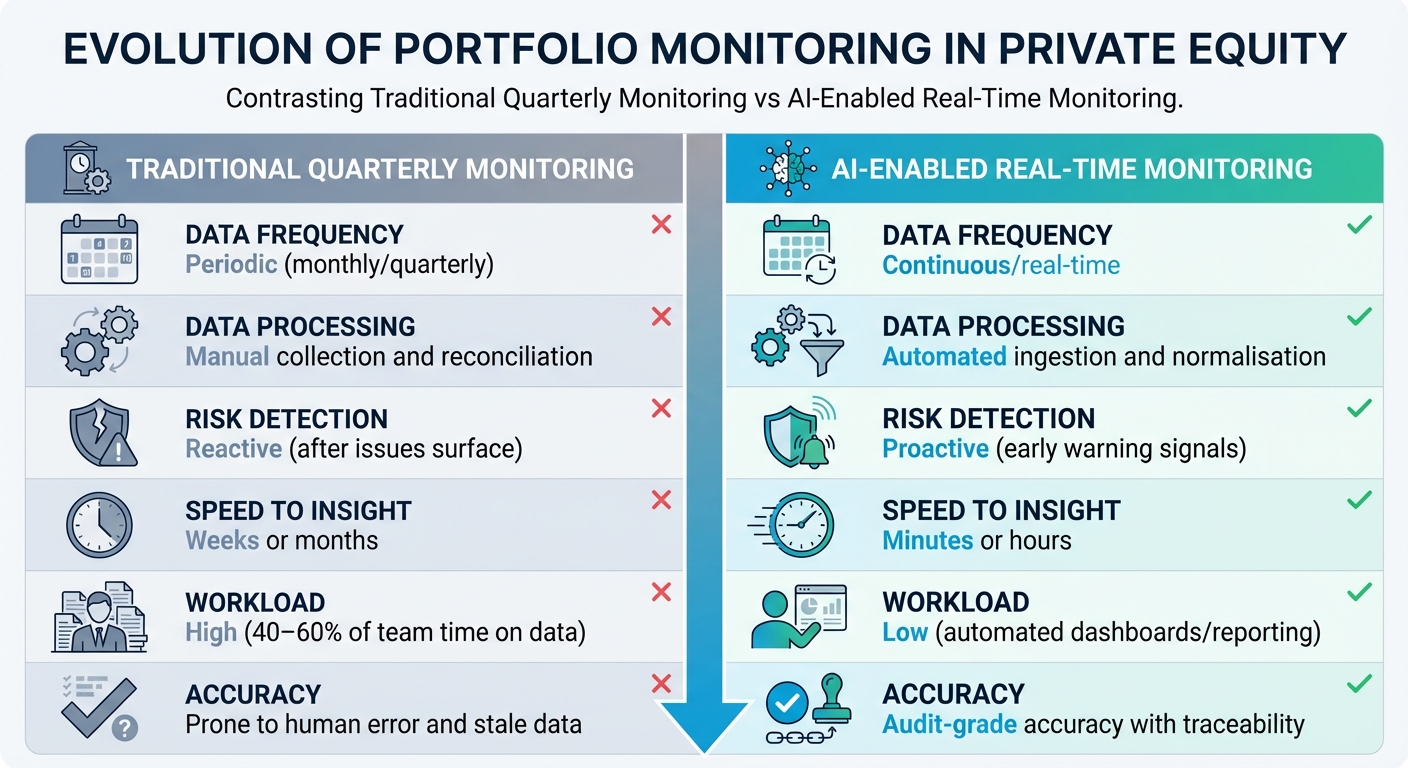
Traditional vs AI-Driven Portfolio Monitoring in Private Equity
The shift from traditional reporting to AI-driven real-time monitoring is reshaping how private equity firms manage their investments. Traditional methods often rely on outdated data - sometimes weeks or months old - by the time it reaches Investment Committees. In contrast, AI systems provide continuous, real-time insights across the portfolio 8. This difference is crucial, especially as 84% of fund managers report extending holding periods for portfolio companies, making early issue identification more critical than ever 12.
Manual methods are time-consuming, with teams dedicating the first two weeks of every quarter to reconcile data manually 8. AI, on the other hand, automates and standardises data from various sources almost instantly. The time saved is striking: firms using AI report a 40% to 60% reduction in reporting overhead, which translates to over 400 analyst hours saved per quarter for a mid-sized firm 8.
But the real game-changer lies in risk detection. Traditional methods react to problems after they’ve already developed, while AI leverages pattern recognition to detect warning signs - like shifts in pipeline velocity or rising customer acquisition costs - months in advance 8. As Dr Leigh Coney explains:
"By the time you see a problem [with traditional methods], the problem is already three months advanced. AI portfolio monitoring changes the cadence from quarterly to continuous" 18.
This shift from reactive to predictive monitoring is especially valuable in today’s challenging market conditions. For instance, buyout distributions dropped to just 11% of NAV in 2025 - the lowest level in over a decade - forcing firms to identify risks and opportunities sooner than quarterly updates allow 8. AI also enables teams to analyse historical data at scale, comparing current performance with past cycles across the entire portfolio. This level of analysis is nearly impossible when working with siloed, manual spreadsheets 1. By identifying risks early, AI supports more informed decision-making and facilitates strategic value creation.
Here’s a breakdown of the key differences between these two approaches:
Comparison Table: Traditional vs AI Approaches
| Feature | Traditional Quarterly Monitoring | AI-Enabled Real-Time Monitoring |
|---|---|---|
| Data Frequency | Periodic (monthly/quarterly) | Continuous/real-time 8 |
| Data Processing | Manual collection and reconciliation | Automated ingestion and normalisation 8 |
| Risk Detection | Reactive (after issues surface) | Proactive (early warning signals) 12 |
| Speed to Insight | Weeks or months | Minutes or hours 9 |
| Workload | High (40–60% of team time on data) | Low (automated dashboards/reporting) 8 |
| Accuracy | Prone to human error and stale data | Audit-grade accuracy with traceability 8 |
Conclusion
AI has become essential for staying competitive, transforming quarterly updates into continuous, real-time insights that protect and enhance portfolio value. With buyout distributions hitting historic lows and holding periods stretching longer, having tools for early issue detection can make the difference between timely action and a costly write-down 82.
The numbers back it up: firms using AI-driven monitoring have seen reporting overheads drop by 40–60% 8, saving more than 400 analyst hours per quarter 6. On top of that, advanced portfolio insights can boost MOIC by 0.3–0.5× - equating to £30–50 million on a £100 million exit 6. For every £1 invested in AI, firms can achieve an EBITDA increase of 2–4× by the time of exit 4.
Limited Partners are taking notice too. Nearly half (47%) are now actively evaluating GP AI adoption as a key factor during fundraising 6. As Mittu Sridhara from Clayton, Dubilier & Rice aptly states, AI "is no longer optional... it's something you must get right because someone else will" 1.
Specialised solutions are stepping up to meet these demands. Axion Lab's AI tools, for example, transition firms from reactive reporting to proactive intelligence. These solutions cover a wide range of areas, including legal, commercial, financial, sustainability, operational, and digital due diligence. With SOC Type I certification, GDPR compliance, and no data retention, firms can adopt AI confidently while safeguarding Material Non-Public Information.

