

In private equity, due diligence has become harder and faster-paced. Firms now review 80 deals for every investment, with exclusivity windows halving from 60 to 30 days. Data rooms hold thousands of documents, and 75% of leaders say deals are increasingly complex. AI is helping solve this by processing large datasets quickly and consistently, while humans focus on nuanced judgement like management credibility and deal strategy.
AI can cut manual document review time by 70%, boost productivity by 60%, and ensure 100% document coverage. Key use cases include:
- Document Review: AI organises and extracts key data from thousands of documents in minutes.
- Risk Scoring: AI flags risks like legal clauses and compliance issues, while humans validate their relevance.
- Collaborative Workflows: Centralised dashboards keep distributed teams aligned.
- Deal Sourcing: AI scans markets and identifies opportunities faster.
- Compliance Checks: AI reviews contracts and external records for red flags.
- Financial Analysis: AI benchmarks targets against peers and identifies financial trends.
- Portfolio Monitoring: AI tracks performance and risks post-deal.
While AI handles repetitive tasks, humans bring judgement and context to decisions. This hybrid approach enables faster, more informed deal-making, shifting focus from data processing to decision-making.
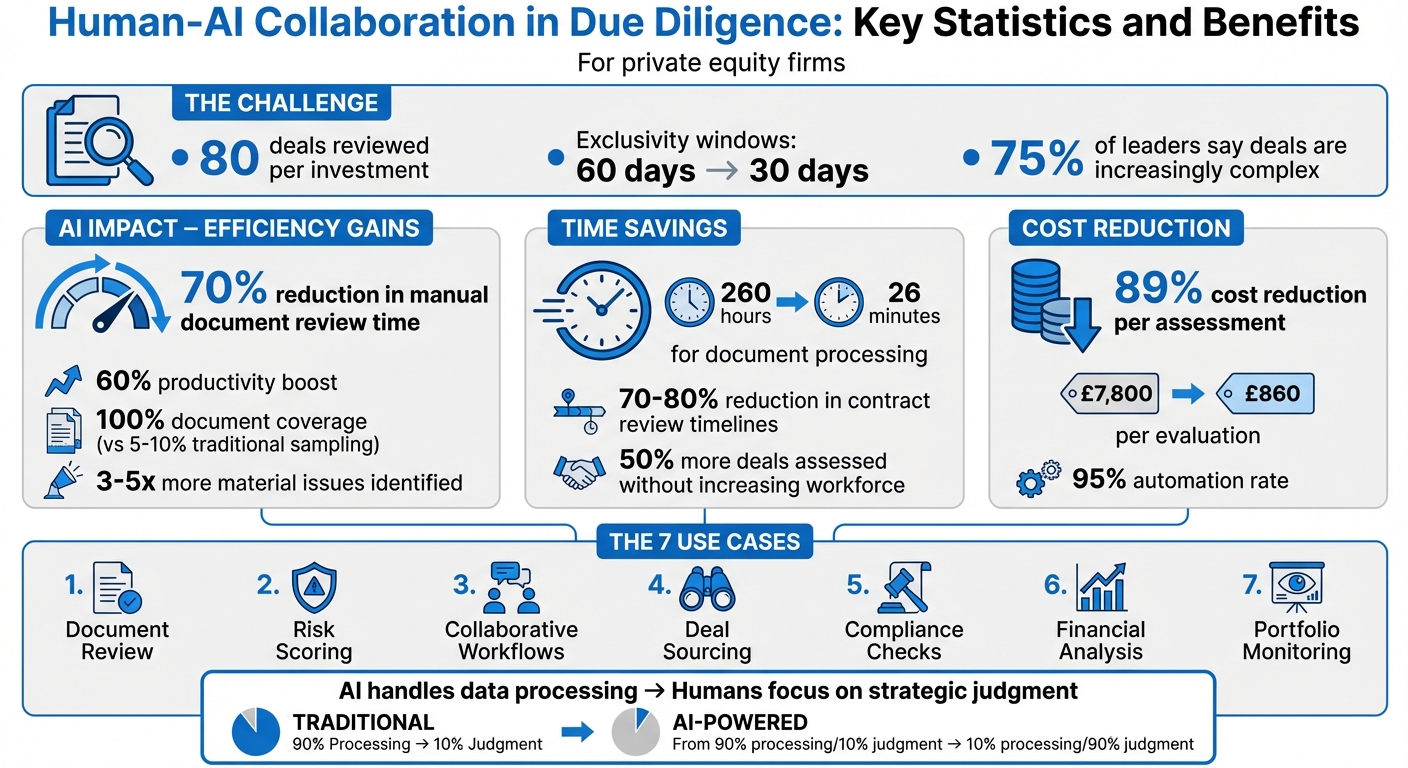
Human-AI Collaboration in Due Diligence: Key Statistics and Benefits
How AI Agents Automate PE Due Diligence | V7 Go, Eurazeo & Moonfare
sbb-itb-6ca8558
1. Document Review and Data Extraction
Modern due diligence data rooms often house thousands of documents - contracts, financial statements, HR records, legal agreements - all scattered across disorganised virtual folders. Sorting through this maze manually can take weeks, increasing the risk of missing critical issues hidden within the clutter. AI systems now streamline this process by automatically classifying and organising these document troves with over 99% accuracy. Files are tagged by category - legal, financial, HR - and the most relevant items are prioritised for review 5. This structured organisation paves the way for faster and more efficient data extraction.
AI tools can process vast numbers of documents, extracting key terms, performance metrics, and clauses like change-of-control provisions, non-compete agreements, and liability caps. These unstructured texts are then transformed into structured formats, such as CSV or Excel files 6. For example, in late 2024, Centerline Business Services adopted the V7 Go platform to automate the analysis of complex financial statements and due diligence documents. Within just one month, the firm reported a 35% boost in productivity by shifting from manual data entry to a strategic review approach 4.
"The key differentiator with V7 is its ability to understand complex documents with detailed charts and tables. We have seen nothing that compares to the accuracy we get." – Trey Heath, CEO 4
AI's Role in Enhancing Speed and Accuracy
AI significantly accelerates the due diligence process, reducing what used to take 260 hours of manual work to just 26 minutes 5. Firms leveraging AI-powered due diligence questionnaire solutions report automation rates of 95%, with costs per assessment plummeting by 89% - from around £7,800 to £860 per evaluation 5. Unlike traditional manual reviews that typically cover only 5–10% of contracts, AI ensures 100% document coverage, identifying 3–5 times more material issues than sampling methods 7. Advanced systems employ Retrieval-Augmented Generation (RAG) technology, which provides direct citations for every extracted data point, linking it back to the exact page and paragraph in the source document 6.
Human Expertise in Contextual Validation
While AI excels at recognising patterns and extracting data, human expertise remains crucial for contextual validation. AI cannot make investment judgements, such as determining whether an asset is worth acquiring at a specific price 2. Human reviewers step in to interpret ambiguous language, evaluate the significance of identified issues within the context of a specific deal, and assess management credibility 6. To ensure accuracy, firms should mandate evidence-based claims with direct citations and require human oversight for high-severity red flags 6. This balanced approach combines the speed of automation with the nuanced judgement of human experts, leading to more thorough and reliable due diligence.
Impact on Due Diligence Outcomes
This hybrid strategy delivers tangible improvements: contract review timelines and costs drop by 70–80%, and firms can assess 50% more deals without increasing their workforce 75. AI shifts due diligence from being a laborious checklist exercise to a tool for strategic decision-making, enabling deal teams to influence pricing and deal narratives earlier in the process 1. This evolution allows teams to move from spending 90% of their time on data processing to focusing 90% on strategic judgement - shifting their attention from reading to deciding 56.
2. Risk Scoring with Human Validation
Once documents have been extracted, the next challenge is identifying material risks. By leveraging precise data extraction, AI takes on the task of quantifying risks, making decision-making more efficient. Unlike traditional manual reviews, which typically sample only 5–10% of data rooms, AI systems review 100% of the data. Using semantic analysis, they interpret complex legal language rather than simply matching keywords 7. This allows AI to flag risks such as EBITDA adjustments, change-of-control provisions, litigation exposure, and ESG controversies, assigning each a confidence score 8. By standardising this process, AI removes the subjective bias that often arises when multiple human reviewers interpret the same deal differently.
AI's Role in Speed and Accuracy
AI prioritises risks by identifying critical red flags, enabling human experts to focus on the most pressing issues 27. By early 2026, 86% of organisations had already incorporated generative AI into their M&A workflows, with 83% investing over £1 million in technology for their deal teams 2. Compared to traditional sampling methods, AI-driven processes uncover 3–5 times more material issues in risk scoring, particularly when assessing risk severity and compliance exposure 7. These improvements are especially valuable as exclusivity periods have shrunk from 60 days to 30 days or less 2.
Human Expertise in Contextual Validation
While AI is excellent at recognising patterns, it cannot make final investment decisions 2. For example, a risk flagged by AI might be technically accurate but strategically irrelevant, depending on the specific deal thesis or industry context 7. This is where human-AI collaboration comes into play. Human experts bring a nuanced perspective, evaluating "soft" risks that AI cannot quantify - such as management credibility, team dynamics, or an intuitive sense that something feels off during negotiations 2. Low-confidence findings from AI are routed to human specialists for validation 5.
"AI surfaces information efficiently, but the judgment call - whether this is a good investment at this price - remains fundamentally human. AI can tell you what experts said; it cannot tell you whether to believe them." – InsightAgent Team 2
Transforming Due Diligence
This hybrid approach changes how deal teams allocate their time. Instead of spending 90% of their effort on manual data processing, teams can shift their focus to strategic judgement and building relationships 5. The early identification of risks also shapes price negotiations and the narratives presented to Investment Committees before final decisions are made 17. Due diligence transitions from being a laborious checklist exercise to becoming a strategic tool that not only identifies risks but evaluates their relevance to a particular transaction.
Next, we’ll explore how AI supports collaborative workflows across distributed teams.
3. Collaborative Workflows Across Distributed Teams
Modern due diligence has evolved far beyond the days of everyone sitting in a single room. Today, distributed teams - spanning legal, financial, and sector-specific experts - often work across multiple locations and time zones. This setup introduces a key challenge: insights can become fragmented across various workstreams, leading to incomplete or disjointed investment narratives for Investment Committees 1. AI-powered platforms are stepping in to solve this, offering centralised dashboards that pull data from multiple sources like PDFs, Excel sheets, and Confidential Information Memorandums. These platforms create a unified "source of truth", ensuring no critical risks or opportunities slip through the cracks between deal teams 610.
AI's Role in Enhancing Speed and Accuracy
AI tools play a pivotal role in maintaining consistency across distributed teams. By standardising reporting formats and templates, these tools ensure data is consistent and reconcilable across all workstreams 1011. Multi-agent systems take this a step further, breaking down complex due diligence tasks and routing them to the appropriate specialists, whether in legal, financial, or HR domains 6. This process happens in real time - when new documents are added to virtual data rooms, AI-powered "living memos" automatically update relevant sections, keeping everyone on the same page with the latest findings 13. Built-in citations make it easy for team members to instantly validate the information 16.
Human Expertise in Contextual Validation
While AI excels at sifting through massive amounts of data, it doesn’t replace human judgement. As noted by the American Bar Association in Formal Opinion 512, generative AI lacks the ability to fully grasp the meaning or context of the text it generates 12. This is why human oversight remains essential. Effective workflows incorporate "human-in-the-loop" checkpoints at key stages - such as initial screening, findings review, and final Investment Committee evaluations. These checkpoints ensure that AI handles the groundwork, while humans focus on assessing relevance and accuracy 13.
One Associate at a Global Tech PE fund highlighted the importance of this balance:
"Advisors write 10 things on the page but you really want to focus on two and go deeper. A lot of pages you just end up doing on your own. AI might be a good option in this case" 1.
This hybrid approach ensures that while AI boosts efficiency, strategic judgement remains firmly in human hands.
Impact on Due Diligence Outcomes
The results speak for themselves. AI can significantly shorten due diligence timelines, turning months of work into just weeks. Companies that embed AI into their M&A workflows report productivity improvements ranging from 35% to 85% for specific diligence tasks 2. Beyond speed, AI also reduces "analyst variance" by standardising screening criteria and scorecards. This ensures that analysts evaluate similar data points consistently, no matter where they are 13. Teams can then shift their focus - spending less time on manual processing and more time on strategic analysis, flipping the traditional 90% processing/10% judgement ratio to 10% processing/90% analysis 5.
Platforms like Axion Lab's AI-powered due diligence tools showcase how blending human expertise with cutting-edge technology can transform fragmented workflows into streamlined, efficient processes that support better decision-making.
4. Deal Sourcing and Screening
Private equity partners dedicate a significant chunk of their time - 30–40% - to sourcing activities. This involves scanning markets, building target lists, and prioritising opportunities 14. Traditionally, this process has leaned heavily on personal networks, manual spreadsheets, and periodic reviews. However, AI is reshaping this landscape by automating the early stages of deal sourcing and enabling constant, real-time sector monitoring.
AI's Role in Speeding Up and Improving Accuracy
AI brings together data from structured sources like databases and unstructured ones such as news articles, social media, job postings, and regulatory filings. This allows it to create comprehensive profiles of potential targets 14. Machine learning models can identify "lookalike" businesses based on criteria like size, growth patterns, and revenue trends. What used to take weeks can now be done in hours, with entire industries mapped across geographies 14. AI systems also provide real-time monitoring, sending alerts about key developments like leadership changes, funding rounds, or regulatory updates that might signal a company is ready for engagement 14.
When Confidential Information Memorandums (CIMs) are received, AI tools step in to extract key metrics, organise them into standardised formats, flag missing data, and even generate initial risk assessments - tasks that would have previously taken days of manual effort 13. A notable example of AI's predictive power came in November 2024, when PitchBook's VC Exit Predictor achieved 74% accuracy in back-tests, correctly forecasting whether companies like Blockchain.com and Revolut would exit via acquisition or IPO 14.
The Essential Role of Human Expertise
While AI is excellent at identifying patterns and anomalies, it falls short when it comes to the subtle nuances that drive investment decisions. Human deal teams bring critical skills to the table - evaluating management credibility, interpreting interpersonal dynamics, and recognising when something feels "off" during initial discussions 2. The final call - whether a deal offers value at a given price - remains firmly a human decision. The most effective workflows harness AI for market-wide scanning and opportunity flagging but rely on human judgement for assessing relationships and making the ultimate investment decision 27. This "human-in-the-loop" approach ensures AI handles the data-heavy tasks, leaving strategic decision-making to people.
Transforming Due Diligence Efficiency
The impact of AI on deal sourcing is hard to ignore. AI can cut the time needed for initial investment analysis by 80% 14. Some firms report 70–80% efficiency gains compared to traditional manual processes 14. In today’s competitive landscape, where deals are often won or lost on "speed to conviction" - the ability to make confident investment decisions quickly - this speed advantage is becoming a game-changer 2. By automating data processing and monitoring, deal teams can shift their focus from administrative tasks to strategic thinking, becoming "judgement providers" rather than "data processors" 24.
Platforms like Axion Lab’s AI-driven due diligence tools highlight how blending automated market scanning with human oversight can turn sourcing into a dynamic, real-time process. This approach not only saves time but also uncovers opportunities that others might overlook. Next, we’ll explore how AI enhances due diligence by identifying compliance risks and potential red flags.
5. Compliance and Red Flag Detection
AI's Role in Speeding Up and Improving Accuracy
Compliance checks have long been a sticking point in due diligence. Traditionally, legal teams might only review 5–10% of documents, hoping to catch critical risks before they escalate. AI has completely changed this dynamic. Instead of sampling, AI systems can process thousands of documents - 10,000 or more - in just a few hours. These tools automatically flag unusual contract terms, change-of-control clauses, non-compete restrictions, and data inconsistencies. Beyond contracts, they search court databases, regulatory filings, and public records to identify pending litigation or enforcement actions. They even trace global supply chains to reveal risks like forced labour or environmental concerns. This level of automation ensures that human reviewers can focus on the flagged issues that matter most.
The Role of Human Expertise in Validation
While AI is excellent at identifying potential risks, it cannot replicate the nuanced judgement needed to decide whether those risks are material. Once AI flags potential compliance issues, human experts step in to evaluate their significance. They consider factors like the deal's strategic goals, the risk appetite of the parties involved, and qualitative aspects such as management credibility - areas where AI falls short.
"AI due diligence does not replace human judgement. It amplifies it by handling the data-intensive analysis that consumes 60 to 70 per cent of a DD team's time" – Dr. Leigh Coney, Founder of WorkWise Solutions 8.
In practice, AI acts as a powerful filter, handling 85–90% of standard documents. This allows professionals to dedicate their time and expertise to the 10–15% of cases that are genuinely complex or unusual.
How AI Impacts Due Diligence Outcomes
By automating document review and anomaly detection, AI-driven compliance tools can slash manual diligence hours by up to 70%. Benchmark studies show productivity improvements ranging from 35% to 85%, with AI identifying three to five times more material issues compared to traditional sampling methods 27.
Platforms like Axion Lab's due diligence tools demonstrate the power of combining automation with human validation. These systems ensure every flagged risk is tied to its source document, making human verification faster and more efficient. Additionally, they maintain enterprise-grade security with features like end-to-end encryption, GDPR compliance, and zero data retention policies.
In today’s fast-paced market, where exclusivity periods have been cut from 60 days to as little as 30, these speed and efficiency gains are becoming indispensable.
6. Financial Analysis and Peer Benchmarking
After identifying compliance risks and potential red flags, the focus of due diligence shifts to in-depth financial analysis and peer comparisons. With standardised data in place, deal teams dig into financial trends and assess how target companies stack up against their competitors.
AI's Role in Speeding Up and Refining Analysis
Financial analysis has traditionally been one of the most time-consuming parts of due diligence. Teams would spend weeks manually pulling data from years of financial statements, scanned documents, and inconsistent spreadsheets. AI has revolutionised this process by automating data extraction and consolidation, enabling the rapid identification of trends across multiple reporting periods. Instead of relying on high-level summaries, AI delves into transaction-level data, uncovering revenue anomalies, margin shifts, and cash-flow issues that might slip through during manual reviews 3.
AI tools also automatically flag discrepancies - like mismatches between profit and loss statements and their supporting schedules. Additionally, portfolio intelligence platforms combine internal performance data with external market insights, allowing deal teams to benchmark target companies against sector norms and peer groups in real time 263. By aggregating market signals, AI provides instant comparisons with industry peers, offering sharper strategic insights.
The efficiency gains from these technologies are significant. Advanced AI platforms have helped firms cut down on manual data entry and focus their efforts on strategic analysis. Reports show that these tools have made financial analysis faster and less labour-intensive, allowing teams to work smarter 4.
The Importance of Human Expertise in Validation
While AI excels at processing large datasets and spotting patterns, it lacks the nuanced judgement needed for investment decisions. Human experts play a critical role in contextual validation - interpreting ambiguous language, evaluating management credibility, and ultimately deciding whether a target company is worth pursuing at a given price 26.
Peer benchmarking, in particular, often requires human insight to interpret unpublished regulatory nuances or industry-specific dependencies that AI might overlook. Professionals also need to verify AI-generated results for accuracy, addressing potential "hallucinations" where the system might invent data or fail to reconcile conflicting information. Implementing robust verification protocols is crucial to avoid costly mistakes that could emerge after a deal closes.
Transforming Due Diligence Outcomes
The combination of AI automation and human oversight has transformed due diligence processes. AI can reduce manual hours by up to 70% through automated document analysis and benchmarking 2. For specific tasks, productivity gains range from 35% to 85% 2, which is particularly valuable as exclusivity periods have shrunk from 60 days to 30 days or less. This compressed timeline forces deal teams to reach investment decisions much faster 2.
Platforms like Axion Lab’s due diligence tools illustrate how domain-specific AI frameworks can uncover deeper financial risks without compromising security. These systems ensure accuracy by requiring traceable citations for every extracted figure and integrating human checkpoints for critical financial validations 64. This approach enables teams to shift their focus from exhaustive reviews to addressing key red and yellow flags - issues that could either derail deals or impact valuation multiples 14. By blending fast automation with human judgement, deal teams can validate financial forecasts and peer comparisons more effectively.
7. Portfolio Monitoring and Integration Risk Assessment
After a deal is closed, the real work begins. Continuous monitoring and integration are essential for protecting and growing investments. While traditional due diligence often viewed the deal as the endpoint, modern portfolio management demands ongoing oversight of performance, finances, and emerging risks. AI has completely reshaped how firms approach this phase, ensuring that investments are safeguarded well beyond the deal's closure.
How AI Improves Monitoring Speed and Accuracy
AI transforms portfolio monitoring into an always-on process. Advanced portfolio intelligence platforms combine internal performance data with external signals to forecast changes in revenue, churn rates, customer lifetime value, and margin trends 213. Instead of relying on quarterly updates, deal teams can now receive real-time alerts about performance shifts, supply chain issues, or financial discrepancies 313. This approach builds on earlier due diligence processes, where AI insights are paired with human validation.
AI also reviews contracts to identify clauses that could influence long-term exposure. These include change-of-control restrictions, termination rights, and most-favoured-nation clauses that might trigger renegotiations or customer churn after the deal closes 313. Additionally, AI creates a "living memo" that updates automatically as new documents are added, ensuring consistency in risk-related language 13.
The Need for Human Expertise in Validation
While AI is excellent at identifying patterns and synthesising data, it can't replace human judgement. Assessing management credibility, team dynamics, or recognising subtle red flags during integration still requires human expertise 2. For example, a clause flagged as high-risk by AI might not align with the specific goals of the deal or integration plan, making human input critical 7.
Post-deal integration also involves coordinating contractual obligations and managing vendor relationships - tasks that AI can assist with but not handle entirely. AI provides the data, but humans use these insights to speed up synergy realisation and avoid "Day 1" surprises 715. This collaboration between AI and human expertise, established during due diligence, continues to add value after the investment. It also ensures that firms don't overly rely on AI, which can sometimes misinterpret complex legal terms 12.
The Broader Impact on Due Diligence
AI-powered monitoring significantly reduces manual workloads, cutting processing times by 60–70% and lowering compliance errors by up to 40% 815. These efficiency gains are crucial as firms move from reactive reviews to integrated systems that support decisions throughout the investment lifecycle 313.
Platforms like Axion Lab’s due diligence tools highlight how domain-specific AI can provide comprehensive portfolio visibility while maintaining high security standards - especially important when dealing with sensitive, non-public information across multiple companies 113. By standardising risk language and linking outputs to evidence, these systems make it easier to compare portfolio companies and identify vulnerabilities before they affect valuations 13. Combining AI with human oversight ensures that investments remain resilient and adaptable throughout their lifecycle.
Implementation and Governance Considerations
Deploying AI in due diligence requires more than just technical expertise - it calls for a well-defined governance framework. Firms need to set up clear protocols that outline who reviews AI-generated outputs, how sensitive data is safeguarded, and the steps to take when the system raises a red flag. These frameworks must also prioritise stringent data security.
Data security is non-negotiable. Firms working with Material Non-Public Information (MNPI) must adopt practices like zero data retention and comply with regulations such as the EU AI Act, GDPR, and SOC Type I/II standards. Keeping proprietary data separate from public training sets is equally critical 16. For instance, Axion Lab’s due diligence tools incorporate end-to-end encryption and zero data retention policies. This ensures a secure environment while still providing a clear view of portfolio data 1.
Human validation plays a key role in keeping AI in check. High-severity risks, crucial financial figures, or unclear contract clauses flagged by the system must always undergo human review before they influence investment decisions 67.
"The moment a diligence claim can't be traced back to a source page, it becomes a liability rather than leverage" 6.
To further enhance reliability, multi-agent architectures can be employed. These systems include Verifier agents that cross-check the work of Extraction agents, reducing errors and ensuring that outputs are backed by evidence 6. Combined with human oversight, this layered approach ensures that flagged issues are thoroughly examined.
Defining roles within the governance framework is equally important. While partners can provide high-level sponsorship to prioritise AI initiatives, operational control should rest with Associates and VPs. Starting small - such as piloting AI for extracting contract terms from key vendor agreements - allows firms to refine their approach before rolling it out on a larger scale 6. This phased strategy is essential, especially given that nearly 95% of generative AI pilots fail due to the gap between marketing hype and practical execution 9.
Consistency across teams can be achieved through standardised playbooks. These playbooks should include risk thresholds, clause taxonomies, and output templates, aligning AI’s analysis with the firm’s broader investment strategy 6. A cautionary tale comes from Builder.ai, which collapsed in 2025 with £29 million in frozen assets. Investigations revealed that what was marketed as AI-driven work had actually been completed by 700 human developers - a clear case of "AI washing" that led to regulatory scrutiny 9. This highlights the necessity of thorough technical validation and strategic oversight.
Conclusion
The seven use cases highlight how this collaboration model blends AI's data-crunching capabilities with human strategic thinking. Human-AI collaboration is transforming due diligence in private markets by merging AI's processing power with the nuanced judgement of seasoned deal teams. Instead of the traditional approach of sampling just 5–10% of documents, new systems now review 100% of contracts and deal documents. This shift has shortened review timelines from weeks to mere days 7. As a result, firms can enter negotiations with complete visibility much earlier, turning what was once an overwhelming amount of information into a faster path to decisive action.
Organisations have consistently reported measurable efficiency improvements 27. These results reinforce the value of this shift 4. With industry-wide adoption already in motion, AI integration has progressed from being a novel experiment to a core necessity 2.
"Analytical skills and market knowledge remain crucial. But decision-making today is defined by efficiency, coherence, and right use of information." - Sergei Maslennikov, Co-founder, Axion Lab 1
The key to success lies in understanding AI's role. AI excels in document intelligence - processing thousands of pages, extracting critical terms, and identifying anomalies. However, humans are indispensable for strategic intelligence: evaluating management credibility, crafting creative deal terms, and determining whether an investment aligns with the right price. While AI efficiently brings critical information to the surface, the ultimate investment decisions rest on human expertise.
Firms that combine AI's thorough data analysis with strong human oversight and well-defined governance frameworks are setting a higher standard for due diligence. This approach enables quicker, better-informed decisions in private markets. As exclusivity periods shrink and deal structures grow more complex, integrating AI's comprehensive analysis with human expertise is no longer just a competitive edge - it’s becoming the benchmark for rigorous due diligence in the industry. Together, this partnership is redefining how due diligence is conducted in private markets.


