

AI is transforming how private market firms spot risks during due diligence. It scans massive datasets, analyses trends, and flags issues like customer concentration, market saturation, and pricing pressures - all in hours instead of weeks. This reduces errors by up to 80% and helps firms focus on risks that truly impact deal value. Key benefits include:
- Faster due diligence: AI cuts document review time by 70%.
- Risk scoring: Highlights red flags (e.g., high customer concentration), yellow flags (e.g., margin volatility), and green flags (e.g., operational improvements).
- Market insights: Tracks competitor moves, macro trends, and customer behaviour in real time.
- Actionable outcomes: AI links findings to source documents, ensuring transparency and better decision-making.
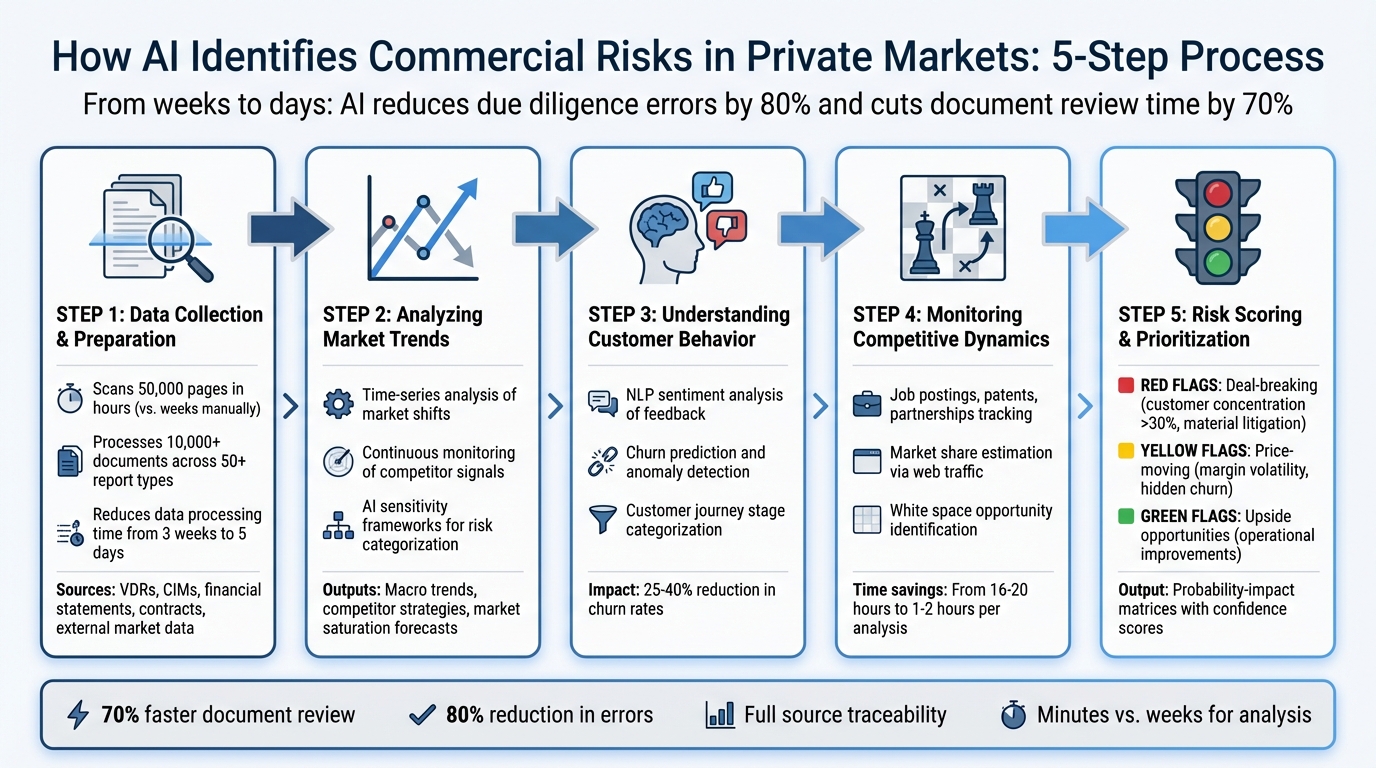
5-Step AI Commercial Risk Analysis Process for Private Markets
How AI Is Replacing 100-Hour Due Diligence (Claude 4.6, Private Equity, and Emblem)
sbb-itb-6ca8558
Step 1: Data Collection and Preparation
The backbone of AI-powered commercial risk analysis lies in its ability to rapidly ingest and process vast amounts of data from Virtual Data Rooms (VDRs). These platforms can scan and index a data room containing 50,000 pages within hours - a task that would take human analysts weeks to complete 5. This process involves pulling in a variety of documents such as Confidential Information Memoranda (CIMs), financial statements, legal contracts, board minutes, and regulatory filings. Using Optical Character Recognition (OCR), the system handles both structured data (like Excel spreadsheets) and unstructured data (such as PDFs, emails, and images) 25.
In addition to internal deal room data, AI collects external market intelligence from sources like government statistics, industry reports, public company filings, job postings, patent applications, and even web traffic analytics 5. To put this into perspective, while a mid-market transaction in 2026 typically involves 500 to 2,000 documents, AI can efficiently process over 10,000 documents spanning more than 50 report types in a fraction of the time needed for manual review 72.
Gathering Data from Multiple Sources
AI platforms excel at automatically classifying and tagging documents - whether they are CIMs, financial statements, or legal contracts - creating a structured and searchable knowledge base 5. They go further by performing cross-document triangulation, where data from management accounts, audited financials, and customer contracts is cross-referenced in real time to uncover inconsistencies 7. This parallel processing capability allows legal, financial, and commercial teams to work simultaneously, bypassing the traditional sequential workflows 3.
Modern AI systems ensure source traceability by hyperlinking every extracted data point back to its original document, page, and paragraph within the virtual data room. This guarantees full auditability and ensures no risks are overlooked, thanks to comprehensive document coverage 73. This streamlined process sets the stage for deeper market trend analysis in the next phase.
Natural Language Processing for Multilingual Data
Natural Language Processing (NLP) plays a crucial role in cleaning and standardising multilingual, industry-specific texts. For example, AI can map terms like "Direct Costs" and "COGS" to a standardised chart of accounts, ensuring consistent comparisons across financial data 5. For global transactions, multilingual NLP scans news articles, NGO reports, and social media in different languages, often providing risk alerts days or weeks ahead of traditional English-language sources 8.
Additionally, the technology extracts key clauses, financial terms, and risk indicators from thousands of foreign-language contracts and reports, transforming them into a unified, structured format for analysis 92. Considering that manual data processing typically consumes 60–70% of the time spent on due diligence, AI-augmented workflows can cut this timeline from three weeks to just five days 57. With the data now harmonised and standardised, the focus shifts to generating actionable insights.
Step 2: Analysing Market Trends
After processing standardised data from Step 1, AI takes the next step by analysing market trends. It does this by examining time-series data to uncover long-term shifts that could impact a company's growth trajectory 5. Unlike static industry reports that quickly become outdated, AI continuously monitors external signals - such as analyst research, competitor announcements, news stories, and social media sentiment. This constant stream of updates offers a dynamic view of competitive landscapes and potential market risks 2. Through this "outside-in" approach, AI simplifies complex data into clear narratives about macro trends and competitor strategies 2.
On a more granular level, AI dives into transaction-level financial data, customer concentration trends, churn rates, and margin fluctuations. This helps to uncover any signs of revenue manipulation or operational inconsistencies 2. For example, investors are now using "AI sensitivity frameworks" to categorise companies into groups like probable beneficiaries, those facing incremental changes, and those at high risk of disruption. This method sharpens risk assessments, particularly in software industries where AI-powered workflows are challenging traditional seat-based pricing models 6. Phil Huber, Head of Portfolio Solutions at Cliffwater, explains:
AI is more likely to widen dispersion within software than eliminate the category. Some companies will face pressure, while others are likely to thrive and strengthen their competitive position 6.
Identifying Macro and Microeconomic Trends
AI employs a dual approach to identify trends. On one hand, it uses government statistics, regulatory filings, and public company data to create top-down market sizing models. On the other, it tracks digital footprint signals like web traffic, job postings, and patent applications to predict where competitors might be focusing their investments 5. This combination helps uncover both broad industry trends and specific vulnerabilities within individual companies. And since AI is constantly monitoring these indicators, it can spot emerging patterns in real time - long before they appear in traditional reports.
Machine learning tools take it a step further by monitoring hiring trends and online activity to flag potential disruptions 5. For instance, a sudden surge in engineering job postings at a competitor could hint at a forthcoming product launch that might threaten the target company's market share. By merging these external signals with internal transaction data, AI paints a full picture of both macroeconomic pressures and detailed operational risks. These insights are invaluable for understanding market saturation and identifying growth opportunities.
Forecasting Market Saturation and Growth Opportunities
Once macro and micro trends are identified, predictive analytics step in to forecast future scenarios. By blending historical data with external market factors, AI projects revenue growth, margin stability, and downside risks, helping to verify or challenge a company's growth expectations 2. For example, it can flag risks like diminishing returns on marketing efforts or subtle declines in major account activity - both of which could signal potential revenue challenges 3. These early alerts enable investors to test "best-case" scenarios against multi-layered forecasts that factor in variables like cost inflation and customer churn 2.
AI also uncovers growth opportunities by combining bottom-up market sizing (TAM, SAM, SOM) with revenue breakdowns and customer data. It then cross-references these figures with top-down sources like government statistics and web analytics 5. This dual-layered validation not only challenges broker-provided market size estimates but also highlights underserved market segments. With AI tools cutting document review time by up to 70%, deal teams can shift their focus from tedious data processing to more strategic analysis 2.
Step 3: Understanding Customer Behaviour
After mapping market trends, the next step focuses on how customers interact with products and services. This involves analysing unstructured data like customer feedback, social media posts, and support tickets. AI uses this information to gauge sentiment, identify early dissatisfaction signals, and track subtle shifts in preferences. Unlike traditional surveys that provide occasional snapshots, AI offers continuous monitoring, completing the picture alongside market and competitive analysis.
Machine learning models take this a step further by categorising customers into different journey stages based on their predicted lifetime value and likelihood of churn. For instance, a customer tagged as a "Champion" might move to a "Rescue" status if their engagement drops - like reduced logins or less interaction with features. This predictive approach turns retention strategies from reactive to proactive. Studies suggest that AI-powered customer success tools can cut churn rates by 25–40%, a critical advantage considering that retaining a customer costs significantly less than acquiring a new one - five to seven times less, in fact 1213.
Sentiment Analysis and Customer Feedback
AI leverages Natural Language Processing (NLP) to dig into the emotions behind customer communications. By examining patterns in feedback, support tickets, and social media, it can uncover rising frustration levels that might signal impending churn 13. These tools often pick up on trends that human analysts might miss, such as repeated complaints about a specific feature or subtle shifts in tone across customer interactions 10. These insights are crucial for gauging satisfaction and predicting how customers might react to new products or strategic changes.
Detecting Anomalies in Purchase Patterns
AI doesn’t stop at sentiment - it also analyses statistical anomalies in purchasing behaviour. Sudden changes in buying habits can indicate potential risks, and AI employs techniques like the Interquartile Range (IQR) for irregular data, Z-Score methods for standardised data, and Isolation Forest for complex datasets to spot these anomalies 11. Often, multiple methods are combined to ensure thorough detection and minimise false positives 11.
Rather than just focusing on absolute numbers, AI tracks usage trends over time. For instance, a drop in logins from 40 to 20 could highlight a potential issue 13. Rolling statistics, like calculating z-scores over a 20-day window, help distinguish between normal fluctuations and actual problems 11. As Axion aptly puts it:
The ability to detect and interpret these anomalies separates reactive investors from proactive ones 11.
For private equity firms, missing these early warning signs can lead to mispriced assets and distorted internal rates of return.
Step 4: Monitoring Competitive Dynamics
After mapping customer behaviour, the next step is to keep a close eye on competitors - particularly their actions and potential future moves. AI goes beyond surface-level insights like press releases or marketing campaigns. Instead, it digs into deeper signals, such as job postings, patent applications, and partnership news, to uncover strategic intentions 14. For instance, a surge in hiring for machine learning roles might indicate an upcoming shift in technology focus, which could be more telling than a corporate blog post. Similarly, sudden changes in leadership or hiring trends can point to expansion plans or a shift in market strategy 145.
AI also analyses trends in pricing, product features, and coordinated strategies across competitors 14. When multiple rivals introduce similar features in a short time frame, it often signals that these features are becoming standard rather than unique selling points. Recognising these patterns helps investors assess whether a company's competitive edge is sustainable or at risk of being eroded. As the AITasker Team aptly states:
Watch what they do, not what they say. A competitor's job postings, patent filings, and partnership announcements often reveal strategic direction more reliably than their press releases. 14
This kind of real-time intelligence sets the stage for a deeper understanding of competitive positioning.
Competitive Positioning and Market Share Analysis
AI creates a comprehensive picture of competitive positioning by combining data on web traffic, pricing models, product updates, and revenue estimates 5. Tools designed for market intelligence can estimate market share by analysing patterns in website traffic and transaction databases, providing insights into which players are gaining momentum and which are falling behind. Tasks that once required 16–20 hours of manual effort can now be completed in just 1–2 hours with AI-powered tools 15.
AI also identifies "white space" opportunities - areas of the market that are underserved or overlooked by competitors 14. By analysing customer reviews across multiple companies, the technology spots recurring complaints that signal potential gaps in the market. For example, if several competitors are criticised for overly complex onboarding processes, a business offering a streamlined alternative could gain a real edge.
Identifying Emerging Competitors
AI excels at spotting new entrants to the market by monitoring "Pattern Drift" - a noticeable shift in public signals like pricing strategies, customer review trends, and search activity that hint at market changes before they become obvious 17. Rather than treating all signals equally, AI prioritises those with higher strategic value. Indicators such as hiring trends, changes in documentation, and policy updates often provide more accurate predictions than social media chatter 17.
Another powerful tool is "Disclosure Delta Analysis", which identifies inconsistencies between what a company publicly claims and what its actual operations suggest 17. For example, if a competitor markets itself as ready for enterprise clients but only offers onboarding documentation for small teams, this discrepancy could highlight a strategic gap or an upcoming pivot. In real-world scenarios, such misalignments have led to significant challenges for businesses 16.
Step 5: Risk Scoring and Prioritisation
Once insights are gathered, AI steps in to transform them into clear, data-driven risk scores. These scores reflect both the likelihood and impact of potential risks, replacing subjective judgement with objective metrics. Factors like financial exposure, legal challenges, and the relevance of each risk to the deal are all considered 3. This process lays the groundwork for a structured approach to prioritising risks.
Creating Probability-Impact Matrices
AI evaluates risks by assigning values for their likelihood and impact. These two factors are then multiplied to produce an overall risk score, which is visually represented on a matrix - often a 5×5 grid or heatmap with colour-coded zones 18. For example, a business heavily reliant on just three clients for over 30% of its revenue would score high on both likelihood and impact, placing it in the "red zone" as a potential deal-breaker 3.
What makes AI so effective here is its ability to connect the dots across multiple sources of information. For instance, a change-of-control clause hidden in a legal document might be flagged as a revenue risk for the commercial team. This cross-document reasoning ensures that no major risks are overlooked. Once the risks are scored, they are divided into actionable tiers.
Categorising Risks for Actionable Decision-Making
Building on earlier analyses of the market, customers, and competitors, AI classifies risks into tiers, helping decision-makers take targeted action.
- Red flags: These are critical issues, such as material litigation or undisclosed debt, that could potentially derail the deal.
- Yellow flags: These indicate risks that might warrant adjustments to the valuation, like hidden churn patterns or fluctuating margins.
- Green flags: These represent opportunities for improvement, such as operational inefficiencies or untapped market potential, which could be addressed after the deal closes 13.
This tiered system ensures that senior advisors can focus on the most pressing concerns rather than getting caught up in less significant details.
| Risk Category | Impact Level | Typical Examples | Actionable Outcome |
|---|---|---|---|
| High (Red Flag) | Critical / Deal-Breaking | High customer concentration (>30%), material litigation, undisclosed debt | Walk away from the deal or renegotiate terms significantly |
| Medium (Yellow Flag) | Material / Price-Moving | Hidden churn patterns, margin volatility, technical debt | Adjust valuation or include specific indemnities in the SPA |
| Low (Green Flag) | Operational / Upside | Minor operational inefficiencies, untapped market segments | Include in a post-close value creation plan |
AI also assigns confidence scores to each risk, distinguishing between verified data and areas that need further investigation. This allows deal leads to focus their Q&A efforts on resolving uncertainties rather than revisiting already confirmed details 3.
Using Axion Lab for Commercial Risk Analysis
Private market firms need tools that provide insights early enough to impact deal terms effectively. Axion Lab steps in with AI-powered due diligence that reshapes how GPs, management companies, and advisories approach commercial risk analysis. By building on the risk scoring methods mentioned earlier, it enables actionable decisions right from the start of deal negotiations.
AI-Powered Due Diligence Tools
Axion Lab uses structured frameworks tailored to the detailed requirements of private market transactions. Its Agentic Diligence Engine leverages more than 20 AI agents to automate essential tasks, such as stress-testing financial models, examining bank statements, and conducting background checks 4. These capabilities expand on the earlier-discussed risk analysis methods. Each finding is linked directly to its source, ensuring full transparency and auditability - a crucial feature for Investment Committee presentations 1.
Currently, over 15 private market firms, managing a combined £480 billion in assets, are using the beta version of Axion Lab. The platform has been shown to cut diligence errors by 80% and save over 120 analyst hours each month. It also prioritises security, with zero data retention, exclusion of client data from model training, and compliance with GDPR, the EU AI Act, and SOC Type I standards 14. Sergei Maslennikov, Co-founder of Axion Lab, highlights its impact:
Decision-making today is defined by efficiency, coherence, and right use of information 1.
Improving Decision-Making with Actionable Insights
Axion Lab doesn’t just stop at risk scoring - it takes the next step by turning insights into actionable outcomes. Its three-step workflow simplifies the process: upload essential documents (like financial models, VDD reports, or cap tables), receive automated analyses that highlight key risks and opportunities, and get results in minutes 1. This speed allows firms to identify deal changers during negotiations instead of discovering critical risks post-signing. As noted earlier, this empowers firms to adjust deals proactively 1.
The platform also supports customisation through bespoke playbooks, enabling firms to align risk analysis with their specific investment strategies 4. An Associate at a Global Tech PE fund remarked:
Advisors write 10 things on the page but you really want to focus on two and go deeper. Many pages require manual review. AI might be a good option in this case 1.
Conclusion: AI-Driven Risk Management in Private Markets
Spotting commercial risks in private markets is no longer reliant on slow, manual reviews. AI changes the game by analysing multiple data streams at once - covering everything from market trends and customer behaviour to competitive positioning. On top of that, it can process entire data rooms to identify every potential risk indicator 25. This approach moves away from subjective adviser judgement, introducing a materiality scoring system that flags risks as red, yellow, or green. This way, deal teams can zero in on the factors that truly affect valuations 13.
AI-powered commercial due diligence doesn’t just improve accuracy - it speeds up the process dramatically. What used to take 3–4 weeks can now be completed in just 5–7 days, with some analyses ready in mere minutes. This allows firms to shape price negotiations and deal terms early on, rather than treating due diligence as a last-minute formality 31. Additionally, AI ensures findings are fully traceable, providing transparency for Investment Committees and limited partners 13.
AI also tackles the overwhelming volume of information that traditional methods often produce. Teams can end up "over-informed yet uncertain", drowning in data while missing critical risks like customer concentration or hidden churn patterns 12. By processing all available data and predicting key risk factors - such as market saturation, churn likelihood, and downside scenarios - AI eliminates these blind spots 25.
Another major benefit? AI can cut the time spent on document review by an average of 70 per cent. This frees up professionals to focus on strategic decisions and creating value, instead of getting bogged down in routine data processing 25. Dr Leigh Coney, Founder of WorkWise Solutions, puts it well:
AI due diligence does not replace human judgement. It amplifies it by handling the data-intensive analysis that consumes 60 to 70 per cent of a DD team's time. 5


