

AI is now a key driver in private equity (PE), alongside financial engineering and operational improvements. By 2026, 88% of PE firms had adopted generative AI, transforming processes like due diligence, deal sourcing, and financial modelling. Here’s a quick breakdown:
- Faster Due Diligence: AI reduces timelines from 6-8 weeks to as little as a few days by analysing documents for risks and trends.
- Revenue Growth: AI-powered pricing and sales strategies double return on invested capital (ROIC) and improve sales productivity by 15%.
- Cost Savings: Automating processes like accounts payable cuts costs by 40%, while predictive tools safeguard 2–5% of EBITDA.
- Better Deal Sourcing: AI identifies 195 relevant companies in the time it takes an analyst to review one, increasing qualified opportunities by 50%.
- Improved Financial Modelling: Real-time monitoring and predictive insights protect portfolio value and optimise exit timing.
Challenges include poor data quality, resistance to change, and regulatory hurdles like the EU AI Act (effective August 2026). Success depends on integrating AI into workflows, prioritising high-impact use cases, and ensuring transparency in outputs. Firms leading in AI adoption achieve up to 4x EBITDA gains per £1 invested.
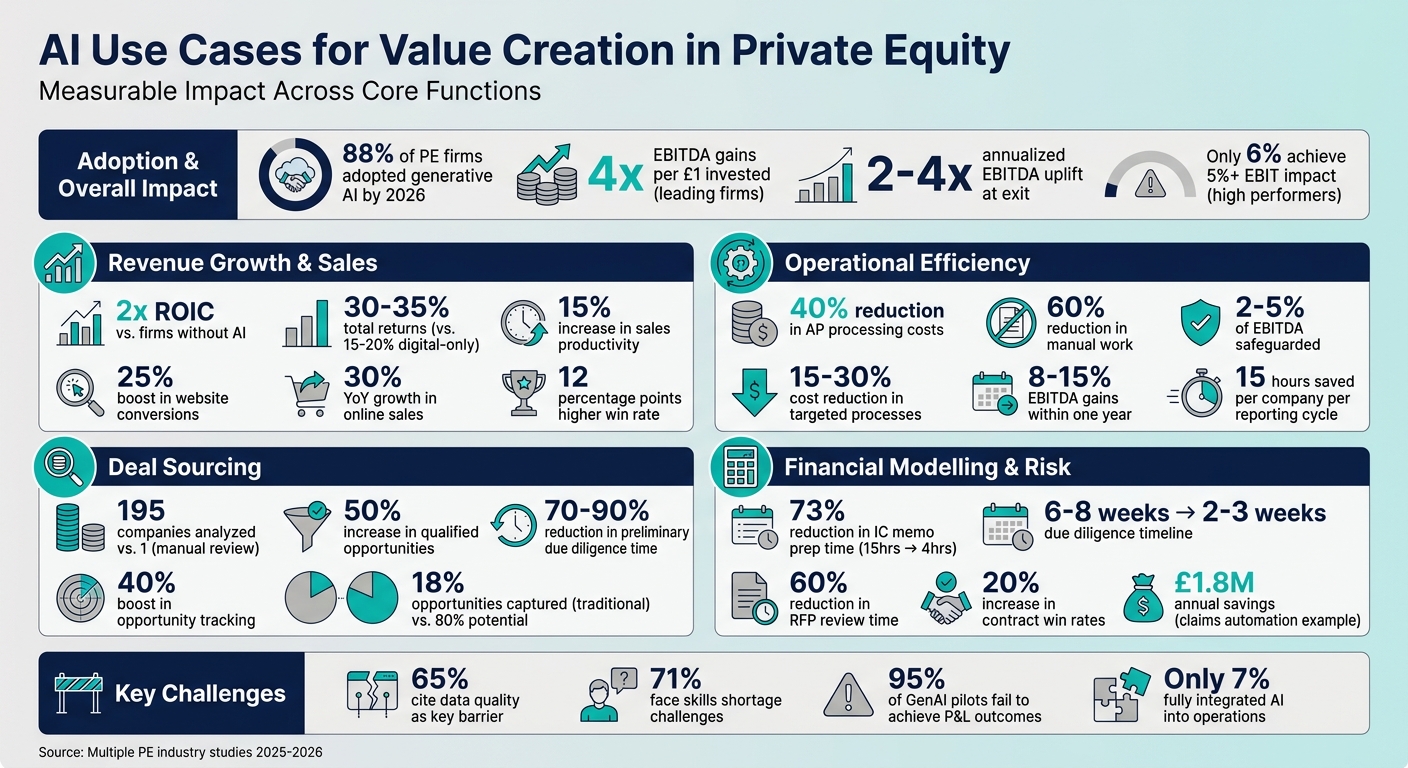
AI Impact on Private Equity: Key Statistics and ROI Metrics
1. Revenue Growth and Sales Acceleration
Impact on Value Creation
Private equity-backed companies that integrate AI into their commercial operations see almost double the return on invested capital (ROIC) compared to those that don’t 12. The numbers speak for themselves: when AI is layered on top of strong digital foundations, total returns can climb to 30%-35%, compared to the 15%-20% typically achieved through digital initiatives alone 12. Vista Equity Partners predicts that AI's influence on software company performance could elevate the traditional "Rule of 40" benchmark - revenue growth plus margin - to 50%-60% 3.
This accelerated growth is largely driven by AI-powered pricing and sales strategies, as detailed below.
Specific AI Applications
AI reshapes revenue strategies by streamlining three key pricing phases: strategy, setting, and deal closure.
- In pricing strategy, AI enables companies to monitor markets and model predictive responses, allowing them to adjust offerings proactively 8.
- For price setting, machine learning analyses historical data to uncover patterns in supply, demand, and customer willingness to pay, resulting in more precise pricing structures 8.
- During deal finalisation, AI tools offer negotiation advice and analyse contracts to minimise discount leakage 8.
"The shift towards AI-enhanced pricing isn't just an upgrade to existing systems but rather a fundamental rethinking of this most basic business activity." - Bain & Company 8
Sales teams also gain from AI-driven copilots that provide live deal insights and develop pricing-focused "sales plays" for frontline representatives 8. Natural language tools make it easier for commercial teams to directly query price management systems, enabling more confident, data-backed decisions 8. Notably, companies in the top quartile for revenue growth are twice as likely to use generative AI in sales and marketing compared to slower-growing competitors 8.
Measurable Outcomes
The impact of AI on sales and revenue is clear through real-world results:
- A B2B distribution company that integrated Salesforce with AI-enabled lead scoring saw a 15% increase in sales productivity and shortened its sales cycle 1.
- A mid-sized neo bank upgraded its marketing technology with AI, achieving a 25% boost in website conversions within three weeks 1.
- A PE-backed apparel company launched a direct-to-consumer channel with advanced digital tools, driving 30% year-over-year growth in online sales 1.
Additionally, companies leveraging data insights report a 12 percentage point higher win rate on deals compared to those without such tools 8. Sales teams equipped with data insights are also nearly twice as likely to confidently implement price increases 8.
Implementation Challenges
Despite the clear advantages of AI, its adoption isn’t without hurdles. Currently, fewer than 15% of firms track the direct EBIT or revenue impact of their AI initiatives 11. Resistance from sales teams, who fear losing control over discounts, and a "trust deficit", where only one-third of employees trust their employers to act in their best interest when introducing new technologies, remain significant barriers 811.
Data quality is another critical factor - 65% of private equity firms identify data readiness as a key challenge for AI implementation 3. To succeed, companies need to rethink workflows entirely and prioritise a few high-impact use cases, such as lead scoring or dynamic pricing 810.
sbb-itb-6ca8558
2. Operational Efficiency and Cost Reduction
Impact on Value Creation
AI has become a key player in driving value creation alongside financial engineering and operational improvements 3. When implemented effectively, AI can significantly boost operational performance. For instance, targeted AI deployments can deliver an EBITDA uplift of 2–4 times per £1 invested by the time of exit. Additionally, real-time margin monitoring helps safeguard 2–5% of portfolio EBITDA by enabling early interventions 5. Within just one year, these deployments can lead to EBITDA gains of 8–15% 16.
However, execution is crucial. Firms that fundamentally rethink roles and operating models to integrate AI see measurable results. Conversely, simply adopting AI tools without adjusting workflows often results in minimal impact on profit and loss (P&L) 2. Alarmingly, 95% of generative AI pilots fail to achieve measurable P&L outcomes due to insufficient operational readiness 5. This highlights the importance of aligning AI initiatives with broader operational strategies to achieve meaningful cost savings and efficiency gains.
Specific AI Applications
AI offers a range of applications that streamline operations and reduce costs, particularly in back-office functions:
- Accounts Payable Automation: Intelligent automation extracts data from invoices, cutting down manual work and speeding up processing times.
- Contract and Spend Analytics: AI analyses customer and supplier portfolios to identify pricing irregularities, potential churn, and renegotiation opportunities 5.
- Predictive Maintenance: In logistics and manufacturing, sensor data is analysed to predict equipment failures, reducing downtime and maintenance expenses 9.
- Demand Forecasting: AI predicts demand at the SKU level, optimising procurement, inventory management, and logistics 1.
- Portfolio Monitoring Systems: By consolidating data from various ERP, CRM, and HR systems, AI provides real-time insights into key performance indicators. It can detect issues like churn spikes or margin compression early, allowing for timely interventions 13.
Measurable Outcomes
Real-world examples highlight the tangible benefits of AI-driven operational improvements:
- Siemens: In 2025/2026, Siemens automated its global Accounts Payable processes, handling over 1 million invoices. This reduced manual work by 60%, cut processing times from days to hours, and lowered total processing costs by 40% 1.
- SkyChefs: As part of Aurelius’ portfolio, SkyChefs used AI sensors in 2025 to optimise inflight menus. This initiative boosted meal profitability and cut operational costs by 25% 1.
- Large Hospital System: A hospital system automated claims appeals with AI, reallocating staff from manual tasks and saving approximately £1.8 million annually 5.
- Engineering Firm: An engineering firm used AI to prioritise RFP reviews, reducing review time by 60% and increasing contract win rates by 20% 5.
Across the private equity sector, firms using AI-powered portfolio monitoring report cost reductions of 15–30% in targeted processes 13. Automated reporting alone saves 15 hours per company per cycle 16, while AI-driven procurement can achieve 7% savings in indirect spending within just 10 weeks 16.
Implementation Challenges
Despite its potential, implementing AI effectively remains a challenge. Only 7% of private equity and venture capital firms have fully integrated AI into their operations, even though 82% are actively experimenting with it 13. Poor data quality is a major obstacle, with 65% of firms identifying it as a significant barrier 3.
"The risk isn't AI failure. It's premature deployment." – Mohamad Chahine, VCII 9
Success hinges on more than just adopting AI tools; it requires rethinking workflows to integrate AI capabilities seamlessly 16. Firms should prioritise 2–3 high-impact use cases, ensuring clear ownership and targeting specific business challenges 9. Additionally, every AI output must be traceable back to its source documents to maintain transparency and the trust of senior partners and investment committees 5. On average, leading private equity firms invest £1.6 million per portfolio company in AI initiatives. However, the gap continues to grow between firms embedding AI into core workflows and those stuck in endless pilot projects 16.
3. Deal Sourcing and Investment Identification
Impact on Value Creation
Traditional deal sourcing methods only capture around 18% of relevant opportunities, leaving a staggering 80% untapped 19. Private equity partners often spend 30–40% of their time on sourcing activities when relying on these outdated approaches 17. However, with advancements in AI, the process of finding deals and identifying investments is undergoing a major transformation.
AI shifts deal sourcing from a manual and reactive task to a proactive, automated process. By analysing millions of data points at once, AI can pick up on "growth signals" that conventional methods might miss. For instance, it can detect subtle indicators like a company hiring senior engineers or changes in sentiment across industry forums 18. AI-driven systems can boost the number of qualified opportunities entering a firm's pipeline by 50% 18. To put it in perspective, these systems can evaluate 195 relevant companies in the same time it takes a junior analyst to review just one 3. This data-driven approach complements broader AI strategies aimed at improving revenue growth and operational efficiency in private equity.
By 2025, 86% of private equity firms had integrated generative AI into their M&A workflows 7, highlighting the growing importance of AI in sourcing and investment strategies.
Specific AI Applications
AI tools are being deployed in several innovative ways to streamline deal sourcing:
- Relationship intelligence platforms map out a firm’s professional network, helping identify "warm" introduction paths. This increases response rates while reducing reliance on expensive intermediaries 19.
- Predictive scoring models rank potential investment targets by analysing historical deal data, sector growth trends, and alternative signals like hiring patterns or web traffic 1719.
- Natural language processing (NLP) tools scan unstructured data - such as news articles, regulatory filings, and social media - to uncover emerging trends in industries 17.
AI also enables continuous monitoring of key developments like leadership changes, funding rounds, and regulatory updates. Unlike traditional quarterly reviews, these systems provide real-time insights 173. The industry is now moving towards "agentic" systems - AI tools that autonomously monitor markets and execute workflows. These systems go beyond standalone tools, offering always-on intelligence that directly enhances deal pipelines.
Measurable Outcomes
The results of AI integration have already been striking:
- In 2025, Invus Opportunities boosted its centralised opportunity tracking by 40% with Affinity's relationship intelligence platform. The system automatically captured firm-wide communication data, allowing the team to instantly access deal information and uncover valuable introduction paths that were previously missed 19.
- EQT developed "Motherbrain", a proprietary AI platform that consolidates over 140,000 data points to deliver M&A insights. By analysing historical performance and market signals, the platform has expanded EQT's reach far beyond traditional sourcing methods 3.
- PitchBook's "VC Exit Predictor", trained on historical deal data, achieved 74% accuracy in predicting outcomes such as IPOs, acquisitions, or failures for companies like Revolut and Blockchain.com 17.
- Firms using AI have reported a 70–90% reduction in the time needed for preliminary due diligence and document analysis 1819.
Implementation Challenges
Despite its potential, many firms have yet to fully integrate AI into their workflows. PromptPartner highlighted the risks of delaying adoption:
"The firms that deploy in 2026 build proprietary data advantages that compound over every subsequent deal cycle. The ones that wait buy commodity tools in 2028." – PromptPartner 18
To succeed, firms must prioritise data hygiene - cleaning and deduplicating internal datasets such as CRM notes, past deal records, and NDA archives 17. Many leading firms are adopting a hybrid approach, combining established platforms for broad market coverage with custom-built tools for a competitive edge 17. By 2025, about 83% of firms had invested at least £1 million in AI technology for their M&A teams 3. However, success requires more than just purchasing AI tools; it demands a complete rethink of organisational roles and workflows to ensure seamless integration across all deal activities 2.
4. Financial Modelling and Risk Management
AI is reshaping financial modelling in private equity, moving beyond traditional methods to enable continuous, real-time oversight. This transformation enhances decision-making and risk management, offering immediate insights into portfolio performance.
Impact on Value Creation
Traditional financial modelling often relied on quarterly updates, which meant issues were identified only after they had already developed. AI changes this by providing daily monitoring of key performance indicators (KPIs), cash flow, and customer churn. This proactive approach allows teams to identify and address problems before they escalate 46.
The results are striking: 92% of private equity professionals now acknowledge AI's role in portfolio valuation 4. AI also powers scenario planning, simulating hundreds of variables - like interest rate shifts or geopolitical events - to predict potential outcomes. This forward-thinking capability shifts financial modelling from a retrospective activity to a tool for future-focused strategy, helping to protect and grow portfolio value.
Specific AI Applications
AI is being utilised across several key areas of financial modelling and risk management:
- Automated due diligence: AI extracts and standardises financial metrics like EBITDA margins and debt-to-equity ratios from virtual data rooms. This reduces evaluation timelines from 6–8 weeks to just 2–3 weeks 34.
- Fraud detection: Machine learning models flag unusual patterns in financial records, such as revenue recognition or expense reporting anomalies, that might be missed in manual audits 146.
- Dynamic risk scoring: By analysing macroeconomic data, market sentiment, and even non-financial inputs like app usage, AI delivers real-time risk profiles 1420.
- Predictive exit timing: AI identifies optimal windows for divestment by analysing historical transaction data and buyer activity 143.
AI systems, such as those offered by platforms like Axion Lab, take these capabilities further by autonomously monitoring portfolio companies. These tools execute multi-step workflows automatically, delivering continuous insights and reducing manual intervention.
Measurable Outcomes
The benefits of AI in financial modelling are clear, with measurable improvements in efficiency and outcomes:
- Time savings: Investment committee memo preparation time has dropped by 73%, from 15 hours to just 4 hours 5. Automating quarterly reporting saves about 15 hours per portfolio company per cycle, which translates to 1,800 hours annually for firms managing 30 assets 5.
- Financial gains: Real-time margin monitoring protects 2–5% of portfolio EBITDA through early intervention. Additionally, every £1 invested in AI transformation can yield an annualised EBITDA uplift of 2–4x at exit 5.
- Case studies: A hospital system saved £1.8 million annually by automating claims appeals, while an engineering firm reduced RFP review times by 60% and increased contract win rates by 20% 5.
Implementation Challenges
Despite its potential, the success of AI in financial modelling hinges on addressing challenges like data governance and talent shortages. Only 6% of organisations currently achieve a 5% or greater EBIT impact from AI initiatives 7.
Data governance is a major hurdle. AI tools often struggle with complex financial data, requiring firms to focus on cleaning and normalising information. Data security (67%) and quality (65%) are the top barriers to adopting generative AI 5.
Talent shortages further complicate implementation, with 71% of enterprises citing skills gaps as their biggest obstacle 7. As Lampi AI points out:
"AI in PE cannot be a black box. Every output must be reviewable, traceable, and overridable" 5.
To mitigate risks, firms must build traceability infrastructure to ensure every AI output is fully documented and verifiable. This is particularly critical as regulations like the EU AI Act, which enforces strict compliance measures from August 2026, come into effect. Non-compliance could result in penalties of up to €35 million or 7% of global turnover 7.
Ultimately, success requires not just deploying AI tools but also rethinking organisational structures to ensure these tools deliver measurable productivity gains 2.
Pros and Cons
The widespread adoption of AI in private equity (PE) has not yet consistently translated into measurable EBIT improvements. While 88% of organisations worldwide reached enterprise AI adoption by 2025, only 6% are classified as high performers achieving a 5% or greater EBIT impact 7. The challenge lies in pinpointing areas that deliver meaningful returns without misallocating resources.
Building on the earlier use case analyses, this section examines the benefits and challenges of AI applications in PE. Each use case offers its own set of advantages and obstacles. For instance, in deal sourcing and due diligence, AI can identify 195 relevant companies in the same time it takes a junior analyst to evaluate just one 3. Similarly, operational efficiency gains are impressive: Siemens automated its global Accounts Payable (AP) function, processing over 1 million invoices, cutting manual effort by 60%, and reducing processing costs by 40% 1.
However, the hurdles to implementation are equally significant. The primary challenges are often organisational rather than technical. As highlighted by BCG:
"The boardroom, not the server room, emerges as the primary bottleneck to the digital-to-AI transformation" 12.
Key barriers include competing priorities (90%) and unclear ROI (76%) 12, with 71% of enterprises citing skills shortages as their largest challenge 7. In financial modelling, problems such as AI hallucinations during due diligence aren't just minor errors - they represent structural risks that can undermine trust 5.
Regulatory concerns add another layer of complexity. The EU AI Act, set to take effect in August 2026, introduces penalties of up to €35 million or 7% of global turnover, making robust traceability systems a necessity 7. This is especially relevant as 47% of limited partners now monitor how general partners (GPs) adopt AI 7.
The table below summarises how each AI use case balances its impact against the challenges of implementation:
| AI Use Case | Impact | Applications | Outcomes | Implementation Challenges |
|---|---|---|---|---|
| Revenue Growth | High (Top-line) | Predictive lead scoring, dynamic pricing, churn prediction | 15% boost in sales productivity; 30% year-on-year online sales growth 1 | Data quality issues, sales team resistance, legacy CRM integration 1 |
| Operational Efficiency | High (EBITDA) | AP automation, GenAI content creation, supply chain optimisation | Documented operational gains across portfolio companies 71 | Change management, process redesign, high initial setup costs 2 |
| Deal Sourcing | High (Pipeline) | Market signal monitoring, proprietary sourcing platforms | 195x faster target identification; 18-month reduction in sourcing timelines 153 | Data integration challenges, fragmented sources 15 |
| Financial Modelling & Due Diligence | Medium/High (Risk) | VDR document synthesis, red flag detection, automated modelling | 50% reduction in due diligence timelines; 80–95% time savings per document 155 | AI hallucinations, data privacy concerns, reliance on "human-in-the-loop" 75 |
These figures highlight that while AI can deliver substantial improvements, success ultimately hinges on organisational readiness. A striking 95% of generative AI pilots fail to produce measurable P&L benefits 35. Achieving success requires more than deploying new tools - it demands a fundamental rethinking of operating models. This distinction is what sets the 6% of high-performing organisations apart from the rest 27. These insights pave the way for a nuanced evaluation in the conclusion.
Conclusion
AI has now emerged as a critical driver of value creation in private equity, standing alongside financial engineering and operational improvements 3. However, while most firms have adopted AI in some form, only about one-third have managed to scale beyond initial pilot projects 7. The gap lies not in the technology itself, but in how effectively firms integrate it into their operations.
The most successful private equity firms take a measured approach. They start with focused, high-impact projects - such as automating LP reporting or streamlining document processing - that deliver results within months 15. Once these capabilities are established, they move on to a single, transformational initiative that tackles their most pressing strategic challenge. This could involve unifying portfolio data, building advanced market intelligence systems, or automating due diligence processes 15.
"The firms successfully deploying transformational AI typically start with quick wins to build confidence and capability, then selectively pursue one transformational use case that addresses their most significant strategic constraint." – Ben Saunders, Co-Founder of WeBuild-AI 15
This step-by-step strategy mirrors the operational and financial improvements discussed earlier in the article.
The real challenge, however, is not technological but organisational. To ensure AI drives measurable improvements in profit and loss, firms must undergo significant internal transformation. This includes securing leadership support, appointing dedicated AI leaders (84% of large private equity funds now have a Chief AI or Data Officer 5), and investing in less glamorous but essential elements like clean data, tailored workflows, and robust evaluation systems 5.
To address the talent gap and speed up implementation, many firms are turning to external experts who understand both AI and private equity. For instance, Axion Lab offers AI-driven tools for due diligence and tailored support across legal, commercial, financial, and operational functions. These partnerships enable firms to gain actionable insights quickly and improve outcomes throughout the deal cycle.
The focus is no longer on whether to adopt AI, but on how quickly and effectively firms can scale their efforts 7. Research shows that private equity-backed companies with advanced AI capabilities achieve nearly double the return on invested capital compared to those without 12. For every £1 invested in AI transformation, firms see an annualised EBITDA uplift of 2×–4× at exit 5. Firms that view AI as a tool to enhance human decision-making, rather than replace it, are poised to lead the next wave of value creation. By aligning AI initiatives with strategic goals, private equity firms can outperform industry benchmarks and redefine success in the sector.
