

AI is transforming how private equity (PE) firms approach ESG (Environmental, Social, and Governance) factors. By 2026, compliance with strict regulations like SFDR and CSRD is mandatory, and investors demand measurable ESG data tied to financial performance. AI-powered tools now help PE firms analyse ESG risks, verify claims, and link sustainability efforts directly to EBITDA growth, ROI, and IRR, all while meeting regulatory requirements.
Key Insights:
- Regulatory Compliance: AI simplifies adherence to SFDR, CSRD, and other frameworks by linking metrics to specific rules.
- Risk Detection: AI identifies ESG risks faster than manual processes, reducing due diligence time.
- Financial Impact: ESG initiatives, supported by AI, can boost IRR by up to 8 percentage points.
- Efficiency Gains: Tasks like transcript reviews, which used to take hours, are now completed in minutes.
- Exit Strategies: AI helps create data-driven ESG narratives, reducing greenwashing risks and enhancing buyer confidence.
Platforms like Axion Lab combine AI with expert oversight to deliver actionable insights, ensuring PE firms meet investor and regulatory expectations while maximising financial returns.
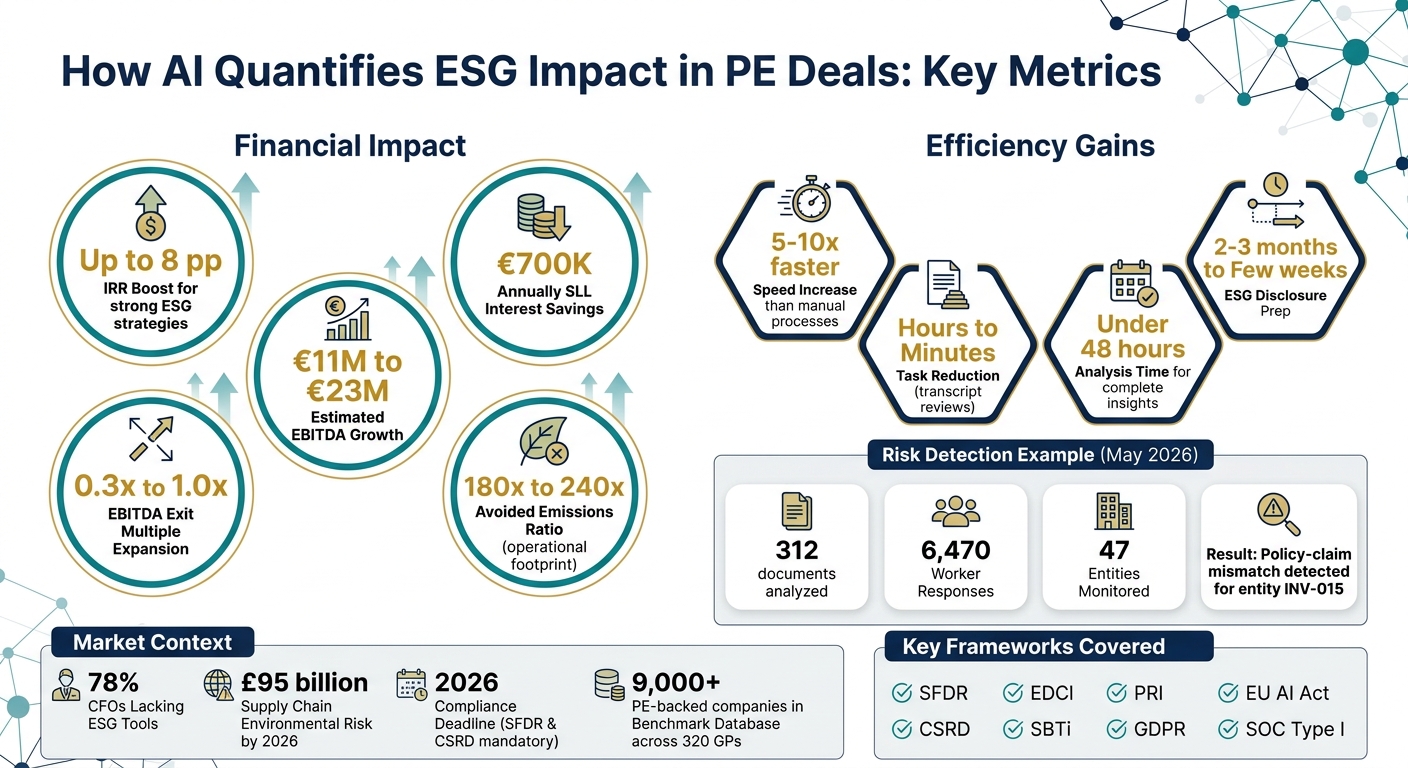
AI-Driven ESG Impact in Private Equity: Key Financial Metrics and Efficiency Gains
AI-Powered ESG Due Diligence in PE Deals
Double Materiality Assessments
Integrating ESG factors into private equity deals is no longer a separate task from financial evaluations. AI now allows these two aspects to be assessed simultaneously, offering a more cohesive view of a target company's performance. By processing unstructured data from Virtual Data Rooms - such as operational records, statutory filings, and financial models - AI transforms this information into searchable datasets 47. This approach helps pinpoint which ESG factors genuinely impact operational performance. For example, water stress might be critical for a manufacturing business, while data privacy takes precedence in the tech sector 7.
AI's ability to perform cross-document analysis enhances due diligence by comparing public sustainability claims against internal data. For instance, it can verify reported energy savings by cross-referencing them with actual utility bills, exposing any greenwashing early in the process. Additionally, every finding is linked to specific source documents, complete with page and paragraph references. This creates an auditable trail, satisfying both regulators and limited partners 67.
"ESG integration isn't a sustainability initiative. It's the capital markets infrastructure that either exists before exit conversations begin or incurs months of remediation when institutional investors start diligence."
– Abhishek Bhanushali, S45 7
Framework Compliance at Scale
With regulations like CSRD, SFDR, and the Corporate Sustainability Due Diligence Directive now fully enforced, non-compliance carries financial penalties 6. AI simplifies compliance by linking company metrics directly to regulatory requirements, correlating data points that would take weeks to process manually 567. What used to be a laborious task can now be completed in hours.
The shift from voluntary ESG reporting to mandatory, evidence-based compliance requires more than just surface-level checks. AI ensures every ESG score is backed by specific references within uploaded documents, creating what regulators call an "effectiveness chain" 5. This approach transforms due diligence into an ongoing process, documenting observations, actions, and outcomes over time. By doing so, AI not only ensures compliance but also speeds up the identification of potential risks.
Faster Red-Flag Detection
AI significantly accelerates the identification of ESG risks, performing at five to ten times the speed of manual processes. Tasks that once took 10–20 hours can now be completed in minutes 4. A striking example of this efficiency was demonstrated in May 2026, when Sopact Sense analysed 312 documents and 6,470 worker-voice responses for Sustainability Fund VII, which oversees 47 entities. The AI flagged a "policy-claim mismatch" for entity INV-015, where a sustainability report claimed zero water incidents, despite audit logs showing two breaches 5.
The focus has shifted from deal-breaking "red flags" to "yellow flags" - issues that may not halt a transaction but could impact exit valuations 4. AI even analyses open-ended worker survey responses to uncover hidden labour risks, such as retaliation, which might not appear in standard disclosures 5. By identifying these risks early in the deal cycle, AI provides insights that can shape price negotiations and Investment Committee discussions before final decisions are made 4.
"Decision-making today is defined by efficiency, coherence, and right use of information."
– Sergei Maslennikov, Co-founder, Axion Lab 4
sbb-itb-6ca8558
Quantifying ESG's Financial Impact with AI
Predictive Modelling for ROI and IRR
AI has reshaped ESG (Environmental, Social, and Governance) from being merely a compliance task into a way to optimise financial performance. By using machine learning, businesses can now predict how ESG initiatives - like energy efficiency projects or supply chain evaluations - impact portfolio returns. Techniques such as ensemble learning and sentiment analysis allow these predictions to be far more precise compared to traditional methods based on fixed rules 2.
The financial advantages are hard to ignore. Private equity funds with strong ESG strategies can achieve Internal Rates of Return (IRR) up to 8 percentage points higher than their peers 7. This advantage arises because AI pinpoints material ESG factors specific to each sector, ensuring investments target the areas that truly affect operational success and regulatory compliance 7.
"AI-enhanced models - particularly those using ensemble learning and sentiment analysis - demonstrate superior performance in forecasting ESG outcomes."
– Future Business Journal 2
AI also pushes ESG claims into the realm of measurable, auditable data. For instance, it cross-checks sustainability reports against operational metrics to uncover inconsistencies - like reporting emissions reductions while fuel costs rise - helping adjust valuations accordingly 1. This data-driven approach ensures ESG outcomes are tied to clear financial insights.
ESG Metrics in Digital P&L Statements
AI has made it possible to translate ESG performance into finance-friendly metrics. It can quantify risks to revenue, impacts on EBITDA, changes in cost of capital, and Net Present Value (NPV). This is a game-changer for CFOs, 78% of whom currently lack the tools to measure ESG-related financial exposure, even as environmental risks in supply chains are expected to reach £95 billion by 2026 8.
Axion Lab for Sustainability Value Creation

Axion Lab's ESG Value Creation Services
Axion Lab leverages AI to quantify the financial impact of sustainability efforts, helping private equity (PE) firms in the EU and UK create measurable value. This AI-native platform offers two primary services: Sustainability Due Diligence (covering red-flag detection, buy-side, and vendor due diligence) and Sustainability Value Creation, which translates ESG initiatives into financial outcomes using proprietary AI tools and structured methodologies.
The platform's value creation service builds a financial "value bridge" that measures impact across three key areas: direct EBITDA growth, savings from Sustainability-Linked Loans (SLLs), and enhanced exit multiples. For example, Axion Lab estimates EBITDA growth of €11 million to €23 million, annual SLL interest savings of €700,000, and multiple expansion of 0.3x to 1.0x EBITDA. Impressively, the AI delivers these insights in under 48 hours, enabling deal teams to adjust pricing strategies and refine Investment Committee presentations in real time. This streamlined process not only supports due diligence but also sharpens capital allocation strategies.
Axion Lab benchmarks its findings against a proprietary database of more than 9,000 PE-backed companies spanning 320 general partners (GPs). Deliverables include a dynamic Excel model featuring five-year profit and loss (P&L) projections, sensitivity analyses, and over 100 assumptions ranked by confidence levels. For sectors where product impact is critical, the platform calculates the ratio of avoided emissions to operational footprint - often achieving ratios of 180x to 240x - helping build a strong equity narrative for exit.
Data Flywheel Effect and Expert Review
Axion Lab's platform becomes more precise with every deal it processes. This "flywheel" effect enhances its ability to identify competitive advantages and refine value-bridge scenarios. The AI processes data and flags risks at a pace five to ten times faster than human analysts, freeing senior experts to concentrate on strategic decision-making. Currently, over 15 private market firms are beta testing the platform.
"The transaction market became harder. Higher competition, more dry powder, more demands from LPs... decision-making today is defined by efficiency, coherence, and right use of information."
– Sergei Maslennikov, Co-founder, Axion Lab 4
Each deliverable undergoes review by a senior sustainability partner, who tailors the findings to the specific deal. The platform identifies "green flags" that enhance internal rate of return (IRR) and "yellow flags" that influence exit multiples, ensuring all claims are backed by source documents through cross-document reasoning. This collaboration between AI and experts ensures that outputs are consistent, traceable, and auditable - qualities essential for Investment Committee presentations and exit due diligence. These efficiencies also bolster Axion Lab's compliance framework.
Framework Compliance and Regulatory Alignment
Axion Lab is fully aligned with key EU and UK regulatory frameworks, including SFDR, CSRD, EDCI, SBTi, PRI, and LP mandates. Unlike generic AI tools, the platform applies structured domain-specific frameworks to provide in-depth analyses that meet stringent regulatory standards. Every ESG assessment is traceable to source documents, offering a solid foundation for exit strategies and investor evaluations.
The platform also prioritises security, with enterprise-grade measures such as end-to-end encryption and zero client data retention. It complies with GDPR, the EU AI Act, and SOC Type I standards, ensuring it meets the mandatory requirements of both CSRD and SFDR. This robust compliance infrastructure further strengthens its role in supporting regulatory and investor expectations.
Tracking ESG Progress and Exit Strategies
Benchmarking ESG Performance
Private equity firms are relying more on AI to set up baseline ESG metrics when acquiring a company and to monitor progress throughout their ownership. The focus is on selecting 5–7 sustainability factors that are most relevant to performance and regulatory risks, rather than relying on generic checklists 7. For instance, manufacturing companies might prioritise metrics like water usage, while sectors with a strong governance focus need to emphasise board independence and related-party transactions 7.
AI simplifies the process by pulling data from various sources - such as statutory filings, operational records, and internal systems - and turning unstructured information into organised, searchable datasets 7. This ongoing intelligence system also keeps track of operator sentiment, regulatory changes, and industry trends during the holding period 3. Furthermore, it links ESG claims directly to their source documents 37, and AI tools can synthesise expert insights and documents, significantly boosting efficiency 3.
New AI models can now translate ESG outcomes into monetary values using methods like eQALY, which support metrics such as Social Return on Investment (SROI) and Impact Multiple on Invested Capital (IMOIC). These metrics allow for comparison across a portfolio 9. While traditional impact assessments cost between £26,000 and £70,000 per company, AI platforms can analyse entire portfolios at a fraction of the price 9. The shift is moving away from relying on sector averages to developing 50–60 tailored impact pathways per company, ensuring data is specific and defensible 9.
These insights not only help track ESG performance but also lay the groundwork for compelling exit strategies.
Building Data-Driven Exit Narratives
By leveraging detailed ESG tracking, AI transforms qualitative ESG stories into measurable data, streamlining the exit due diligence process 7. What used to take 2–3 months to prepare for ESG disclosures can now be done in just a few weeks with AI 7. Each ESG claim in exit documents is tied to its source, reducing the risk of greenwashing and boosting buyer confidence 7.
The key takeaway is that ESG frameworks should be developed during the ownership phase, not left until the exit stage. Addressing sustainability gaps identified during an IPO or exit preparation can be far more costly if left too late 7. AI-driven investment banks are now using "IPO Readiness Scans" to spot ESG issues early, avoiding potential regulatory challenges or investor hesitations 7. By establishing robust, evidence-backed ESG frameworks early on, firms can minimise due diligence hurdles and enhance buyer trust 37.
Conclusion
AI has reshaped how private equity firms handle ESG considerations, moving the focus from broad, qualitative narratives to measurable metrics that directly influence EBITDA and IRR projections. With this shift, deal teams can pinpoint potential risks that might jeopardise an investment or uncover opportunities to boost returns - all before reaching the Investment Committee stage. ESG analysis now plays a key role early in the deal process, influencing pricing and structure rather than being treated as a mere compliance formality.
Specialised AI platforms provide the depth required for private equity-grade analysis. Unlike generic models, platforms like Axion Lab apply structured frameworks tailored to SFDR, CSRD, and LP requirements, helping to uncover hidden risks and value-creation opportunities 4. The financial benefits are clear, from savings on sustainability-linked loan margins to increased valuation multiples at exit.
Axion Lab’s approach illustrates this transformation. Its AI operates at five to ten times the speed of human analysts, while senior sustainability experts ensure the quality of every output. Over time, its data flywheel improves accuracy with each deal analysed. This combination of rapid processing and expert oversight enables firms to develop investment strategies grounded in data, meeting both regulatory demands and commercial goals.
As discussed, integrating AI with regulatory expertise has become essential in today’s market. Firms must embrace AI-driven platforms that quantify sustainability impacts, stay aligned with evolving frameworks, and provide actionable insights to shape investment outcomes. Those who adopt these capabilities now will be better equipped to meet the growing expectations of LPs, navigate complex regulations, and unlock the financial potential of measurable ESG performance.
