

AI is transforming how private equity firms prepare for exits by saving time, cutting costs, and improving outcomes. From speeding up vendor due diligence to identifying optimal timing for sales, AI tools make exit planning more efficient and effective. Here's what you need to know:
- Faster Due Diligence: AI reduces weeks of manual work to hours by automating data organisation, contract analysis, and risk detection.
- Better Timing Decisions: Real-time market analysis and predictive models help pinpoint the best moments to exit.
- Stronger Equity Stories: AI-based insights demonstrate operational improvements, boosting buyer confidence and valuation multiples.
- Sustainability Focus: AI-powered ESG assessments integrate compliance and financial impact into the exit strategy.
Firms using AI in exit planning can expect higher valuation multiples, reduced risks, and smoother transactions. Early adoption, ideally 12–24 months before an exit, is key to maximising these benefits.
Using AI to Speed Up Vendor Due Diligence
Vendor due diligence (VDD) is a critical phase where deals can either thrive or falter. Disorganised data rooms, overlooked clauses, or missing documentation can delay transactions and potentially impact valuations. AI is transforming this process, making it faster and more efficient.
AI for Data Room Organisation and Analysis
Traditionally, setting up a data room has been a laborious task, involving weeks of manual effort - sorting files, checking versions, and tracking down missing documents. AI significantly reduces this burden. When documents are uploaded, AI tools can categorise them automatically (e.g., financial reports, legal agreements, HR files) and even resolve version discrepancies without human intervention 6.
But AI doesn’t stop at organisation. Large Language Models (LLMs) can extract specific clauses from thousands of contracts, such as indemnity clauses, exclusivity terms, or change-of-control provisions. They can also summarise lengthy documents into concise, actionable bullet points 45. What’s more, modern AI tools allow deal teams to interact with the data room through natural language queries, delivering precise answers from extensive datasets in seconds instead of hours 46.
The impact is dramatic: due diligence timelines, which traditionally take up to six weeks and cost between £40,000 and £120,000 per deal 4, are slashed to seconds - all with traceable accuracy 46. This improved organisation also paves the way for a more proactive approach to risk management.
Early Red-Flag Detection with AI
AI doesn’t just expedite processes; it helps identify potential issues before they become problems. By comparing uploaded documents against standard due diligence checklists, AI flags gaps such as missing tax returns, incomplete customer lists, or unsigned regulatory certificates. This gives teams the opportunity to address these issues early, well before buyers notice them 67.
"The advantage is not just speed. It is earlier conviction." - Third Bridge 3
AI also scans financial ledgers for irregularities, checks files against sanction watchlists, and highlights technical debt in legacy systems - common points buyers use to negotiate price reductions 23. Conducting an internal AI-driven audit 9–12 months before a planned exit provides ample time to resolve these issues. The result? A cleaner, more defensible VDD package that builds buyer confidence from the moment they access the data room.
sbb-itb-6ca8558
Using AI to Make Better Exit Timing Decisions
After simplifying due diligence, firms can focus on using precise timing to maximise exit value. By leveraging automated due diligence, AI now plays a central role in determining the perfect timing and crafting the narrative for exits. This shift transforms exit planning from a reactive process into a strategic tool.
Reading Market and Valuation Trends with AI
Timing an exit correctly can be the difference between a decent return and an outstanding one. Traditional methods often relied on historical data and instinct, which made firms more reactive to market changes than proactive.
AI changes this dynamic. Advanced models analyse market data in real-time, tracking sector multiples, buyer activity, and competitor movements. At the same time, natural language processing (NLP) tools scan news and social media to assess buyer sentiment. These insights, combined with projections refined by global economic and geopolitical trends, allow deal teams to pinpoint optimal exit moments far more accurately than traditional approaches 9.
"AI turns exit planning into a strategic advantage by aligning valuations with business goals and market conditions." - Tribe AI 9
One practical approach for firms is to maintain a live exit file. This is a constantly updated repository containing KPI definitions, cohort analyses, and data lineage. Enhanced by sensitivity analyses covering demand, pricing, and cost scenarios, such a file ensures the business remains ready for sale 1. These insights not only improve timing but also provide the foundation for a stronger equity narrative.
Building Stronger Equity Stories Using AI Data
A convincing equity story connects operational improvements to sustainable financial metrics that resonate with buyers. Deal teams can use AI to benchmark KPIs against sector peers and recent deal data, creating an evidence-based narrative that anticipates and addresses buyer concerns 1.
AI also shifts how buyers perceive value at exit. Companies that have successfully integrated AI into their operations often attract a premium, provided the results are visible in the profit and loss (P&L) statement. For instance, documented AI-driven margin improvements over two years can add +0.8–1.5x to the exit multiple, while AI-native workflows can command an even higher premium of +1.5–2.0x 10. As AlixPartners explains:
"Given a choice between two otherwise similar target companies, a buyer will prefer, and probably even pay a premium for, the one that has proven its ability to leverage AI for real business impact." 2
To capitalise on this, firms should begin AI initiatives 24–36 months before a planned exit. Each initiative should be tied to a specific P&L line item, with clear before-and-after metrics and at least four quarters of data to demonstrate sustained impact 10.
Adding Sustainability Analysis to Exit Planning
Sustainability analysis has become a vital part of crafting an impactful equity story, moving far beyond being a mere compliance exercise in private equity exits. It's now a key element that complements due diligence and exit timing strategies. Nearly 50% of private equity clients highlight heightened ESG requirements as a major focus in their discussions with Limited Partners (LPs) 11. For institutional LPs - especially European pension funds and sovereign wealth funds - ESG due diligence has shifted from optional to mandatory 13. Without credible sustainability credentials, firms risk facing valuation penalties.
AI-Powered Sustainability Due Diligence
Traditional sustainability reviews - covering areas like environmental compliance, labour practices, governance, and supply chain risks - are often time-consuming, taking weeks to complete. However, AI has transformed this process, slashing analysis time by 60–70% and handling up to 50,000 pages of data in just hours 13.
"AI makes comprehensive ESG assessment practical within deal timelines that would otherwise force superficial treatment." - WorkWise Solutions 13
Specialised platforms like Axion Lab are designed to tackle these challenges. Axion Lab leverages AI to manage the heavy analytical work - extracting, benchmarking, and modelling sustainability data at a pace five to ten times faster than manual efforts. Importantly, every deliverable is reviewed by a senior sustainability expert, ensuring accuracy and context-specific relevance. While AI speeds up the process, expert oversight prevents errors, especially when evaluating the severity of ESG risks in relation to specific deals.
Axion Lab also prioritises data security, adhering to GDPR requirements and ensuring no client documents are retained. This level of compliance is critical when dealing with sensitive information about target companies.
For exits involving European buyers or LP reporting, familiarity with regulatory frameworks like SFDR, CSRD, EDCI, SBTi, and PRI is essential. These frameworks come with distinct disclosure and classification standards that buyers and LPs expect to see reflected in ESG findings. Axion Lab's system ensures that its results align with these standards, presenting data in a format that resonates with stakeholders.
With efficient ESG assessments in place, the focus shifts to understanding their financial implications.
Calculating the Financial Impact of Sustainability Actions
Identifying ESG risks is only the starting point. The real challenge lies in determining their financial impact. AI-powered sustainability analysis bridges compliance and value creation, turning ESG insights into measurable financial outcomes.
AI tools can calculate the "IRR delta" - the variation in returns caused by unresolved regulatory risks or ESG-related liabilities - before these issues become apparent during a buyer's due diligence 1213. Axion Lab’s Sustainability Value Creation service takes this a step further by quantifying the financial benefits of specific ESG actions. This allows deal teams to distinguish between initiatives that enhance EBITDA and those that primarily serve reputational purposes. By doing so, sustainability insights become a core part of the equity story rather than a defensive afterthought.
For firms preparing for an exit, the takeaway is clear: start sustainability screening early. By embedding ESG insights into the exit planning process from the outset, these findings can shape the 100-day plan and strengthen the equity narrative. This proactive approach not only avoids last-minute surprises but also positions sustainability as a driver of higher valuations.
AI vs Standard Exit Planning: A Side-by-Side Comparison
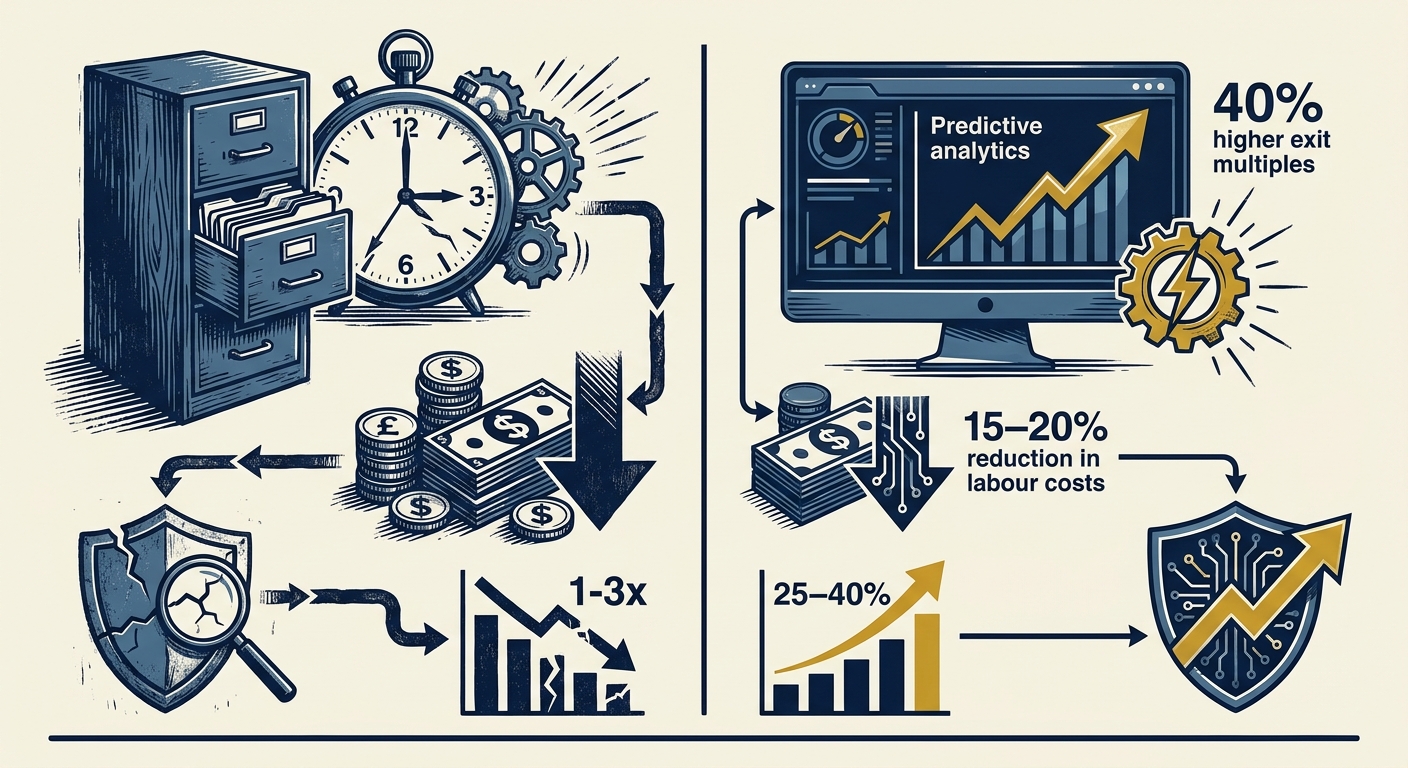
AI vs Standard Exit Planning: Key Metrics Compared
AI doesn't just speed up due diligence and fine-tune exit timing - it transforms the entire planning process. The contrast between traditional and AI-driven exit planning is striking. Standard methods are often reactive, with companies scrambling to organise KPIs and clean up data just three to six months before a sale. Yet, 81% of private equity sponsors believe exit preparation should start 12 to 24 months ahead of time 15. This ideal of ongoing readiness is exactly what AI makes possible.
The stakes couldn’t be higher. The Accordion Survey Report highlights that sticking to a checklist-driven approach can reduce perceived enterprise value by 1 to 3 turns of exit multiples, compared to a strategic approach that leverages AI 15. Furthermore, 85% of sponsors now take AI-enabled financial capabilities into account when evaluating a company's worth 15.
The day-to-day differences are just as stark. AI can handle tasks like contract and data analysis in mere hours, a process that otherwise takes weeks of manual work - a level of efficiency traditional methods simply can't match 2.
Comparison Table: Standard vs AI-Assisted Exit Planning
| Metric | Standard Exit Planning | AI-Assisted Exit Planning |
|---|---|---|
| Speed | Weeks-long manual due diligence; preparation begins 3–6 months pre-sale 15 | Hours-long contract and data analysis; continuous readiness 12–24 months ahead 2 14 |
| Accuracy | Relies on static models and subjective judgement, prone to bias 9 | Uses predictive analytics with real-time data; improves forecast accuracy by 40% 9 14 |
| Cost | High labour costs due to manual data processing 14 | Cuts labour costs by 15–20% with automation 2 14 |
| Risk Management | Reactive approach; risks often identified during buyer diligence 15 | Proactive detection using automated audit trails and citation-linked outputs 1 14 |
| Valuation Impact | Potential loss of 1–3 turns in exit multiples 15 | Potential for 25–40% higher multiples due to value creation 16 |
Companies that take advantage of slower market periods to clean up legacy data and upgrade their tech stacks with AI come out much stronger when the next deal window opens 15. With AI, exit planning shifts from being a last-minute rush to a state of constant readiness. It helps identify risks, refine the story you’re telling, and keep data rooms up to date throughout the entire holding period. This approach seamlessly aligns with the broader strategies discussed earlier, ensuring firms stay prepared for whatever comes next.
Conclusion: Making the Most of AI in Private Equity Exits
AI isn't just a buzzword in private equity - it’s proving to be a key driver of returns. Portfolio companies that integrate AI within the first 12–18 months of ownership see 40% higher exit multiples compared to those that delay implementation until later stages 8.
While AI enhances due diligence and exit timing, its real value lies in delivering measurable results. Early adoption, combined with clear before-and-after metrics, is critical. In fact, 67% of acquirers now formally evaluate AI capabilities as part of their assessments 8.
"The technology is not what buyers are paying for. It is what the evidence implies about the business: lower operational risk, more durable margins, and a workforce that has actually shown it can adopt and sustain change." - Amanda Miller, Content Writer, AI Assembly Lines 8
Sustainability is also becoming a central focus in exit strategies. Tools like Axion Lab are helping firms incorporate AI-driven sustainability analyses into vendor due diligence, quantifying the financial impact of ESG initiatives.
The firms that achieve the highest exit premiums are those that view AI as more than just a tool or a project. By embedding AI into their operating models - integrating it into daily workflows, maintaining proper governance, and documenting processes well in advance - they create a comprehensive framework that supports value creation across every phase of the exit process. This approach ensures that AI remains a cornerstone of their strategy, driving consistent and meaningful outcomes.


