A lender wants climate figures that sit beside the financial statements. A limited partner wants industry metrics that explain enterprise value. A European customer asks whether the company must report impacts on people and the environment, not only risks to profit. The CFO has the same invoices, the same HR system, and three incompatible requests in one week.
That collision is ordinary for deal teams and portfolio finance leads. ESG reporting frameworks disagree less about the factory floor than about the reader. One number can be mandatory for a regulator, irrelevant to a lender, and central to a community report. Choose the framework by who will read the number and which decision it drives. Then keep one evidence trail that can serve every framework those readers request.
Table of Contents
- Five ESG Reporting Frameworks Side by Side
- Impact Versus Financial Materiality in Practice
- GRI for Broad Stakeholder Reporting
- Convergence and Divergence
- Evidence Grades and Assurance for ESG Figures
- Choosing a Framework by Real Situation
- Confirm Your Framework Path Before Reporting
Five ESG Reporting Frameworks Side by Side
Say the CFO of a mid-market manufacturer opens Monday with three emails. An investor asks for IFRS S1 and IFRS S2. A bank asks for climate risk in the style of the old TCFD recommendations. An EU buyer asks about ESRS. None of them is asking for a different factory. Each is asking for a different test of what matters.
The GRI 2025 global sustainability reporting study found that 87% of large publicly listed companies published sustainability information, 40% referenced the GRI Standards, and 23% qualified as formal GRI reporters. Publication is common. Formal alignment with one standard is not.
| Framework | Owner | Primary reader | Materiality basis | Status in 2026 |
|---|---|---|---|---|
| GRI Standards | Global Sustainability Standards Board | Broad stakeholders | Impact materiality | Most widely used voluntary set; 40% of large listed firms referenced it in 2025 |
| IFRS S1 and S2 (ISSB) | International Sustainability Standards Board | Investors and lenders | Financial materiality | In force for periods from 1 January 2024 where a jurisdiction applies them |
| SASB Standards | ISSB (IFRS Foundation) | Investors | Financial materiality by industry | Industry metrics used alongside ISSB standards |
| ESRS | European Commission, drafted by EFRAG | EU regulators, investors, and wider stakeholders | Double materiality | Mandatory only for in-scope EU companies under CSRD |
| TCFD | Financial Stability Board | Investors and lenders | Climate-related financial risk | Recommendations folded into IFRS S2 |
Read the table from the reader column outward. GRI is impact-first. ISSB and SASB are investor-first. ESRS requires both views. TCFD is climate-only, and its recommendations now live inside the ISSB climate standard rather than as a separate rulebook.
A longer crosswalk of owners and audiences sits in Waymap's guide to ESG reporting frameworks. Use it when a deal team needs the map before arguing about metrics. Emissions totals still need a method. The GHG Protocol footprint guide is the calculation layer underneath these disclosure rules, not a sixth framework.
Practical rule: Name the reader of the number first. The framework that reader accepts comes second.
Impact Versus Financial Materiality in Practice
The same building can fail one inspection and pass another. A safety inspector asks what the building does to neighbours: fire spread, drainage, noise. A bank appraiser asks what the building is worth to the lender: rent, vacancy, insurance, resale. Same walls. Different questions.
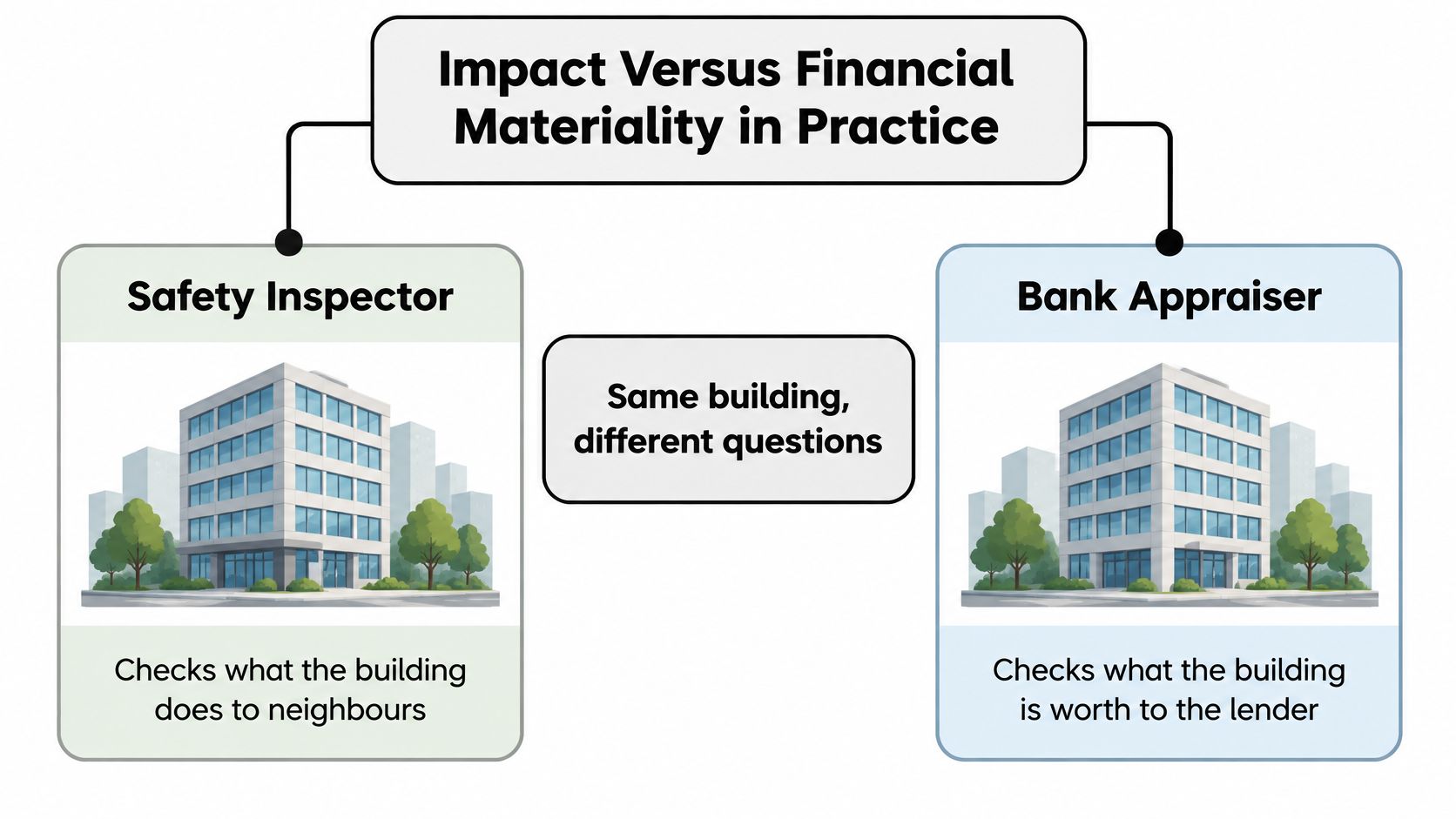
Impact materiality asks how the company affects people and the environment. That is the lens GRI is built on. Financial materiality asks how sustainability risks and opportunities affect enterprise value. That is the lens of ISSB and SASB.
Two tests, four outcomes
Under the EFRAG simplified ESRS 1 guidance, materiality is not limited to enterprise value. ESRS requires a double-materiality assessment covering both impact materiality and financial materiality. An issue can be material from one perspective, both, or neither. The two dimensions are considered together, and the resulting disclosures sit around governance, strategy and financial effects, management of impacts, risks and opportunities, and metrics and targets.
Take a food processor with one large agricultural supplier.
- River-basin water use can be material as an outward impact if withdrawals stress a scarce basin, even when the contract price does not move this year.
- A carbon price on process heat can be material financially if it hits margin within the hold period, even when neighbours barely notice the plant.
Neither topic is "ESG" in the abstract. One fails the neighbour test. One fails the lender test. A topic that fails both can stay off the report, provided the judgment is written down.
What to file for each trail
A portfolio company should keep two evidence trails, one for outward impacts and one for inward financial effects. For each trail, record the threshold, the stakeholder input, the time horizon, and the governance judgment that included, deprioritised, or left a topic unquantified. Without that file, a later reviewer cannot tell a deliberate exclusion from a missing spreadsheet.
Carry the result forward like this. If the binding question is harm to people or nature, lead with an impact standard. If the binding question is value to investors or lenders, lead with a financial-materiality standard. If an EU regime requires both questions, run both trails and do not collapse them into one score.
GRI for Broad Stakeholder Reporting
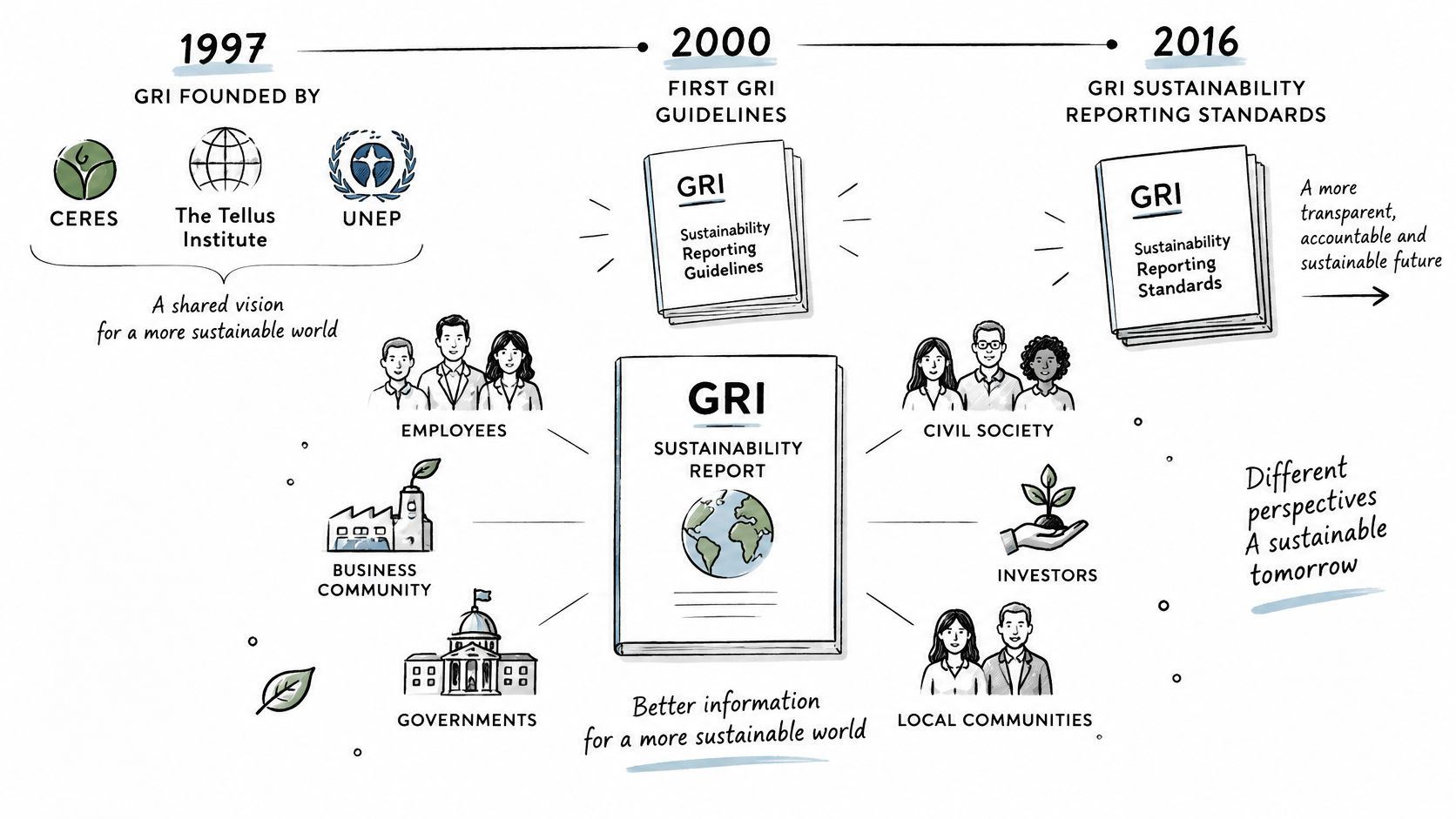
The Global Reporting Initiative started in 1997, founded by the Coalition for Environmentally Responsible Economies (CERES), the Tellus Institute, and the United Nations Environment Programme (UNEP). It published its first guidelines in 2000. In 2016 it released the GRI Sustainability Reporting Standards and became the first global standard setter dedicated to sustainability reporting, a shift the Queen's University Belfast authors' version on the GRI Standards traces from mostly voluntary environmental notes toward structured, comparable disclosures on economic, environmental, and social impacts.
Who it still serves
GRI is among the most widely used sustainability reporting standards in the world, and adoption runs deepest among the largest listed companies. That scale matters for one practical reason: a GRI report speaks a language that employees, communities, customers, and regulators already read.
GRI works like a town hall for corporate disclosure. Its topic standards answer the question "what does this company do to the world around it," covering economic, environmental, and social impacts in a format that is comparable across companies and years. An investment committee asks the opposite question: "what does the world do to this company's cash flows." GRI alone does not price an issue into enterprise value, so a deal team still needs an investor-facing layer on top of it.
When GRI leads
Lead with GRI when the audience is broad and the binding question is outward harm. Pair it with an investor-focused framework when capital is at stake.
A coatings plant reporting to the town on solvent emissions, contractor safety, and local hiring should lead with GRI topic disclosures, because each of those numbers is read by a resident, a worker, or a local authority deciding whether to trust the operator. The same plant's lender pack answers different readers, so it should add investor metrics on energy cost, compliance fines, and climate risk. One operations file can feed both packs. What changes is the materiality judgment applied to each figure, not the evidence underneath it.
Convergence and Divergence
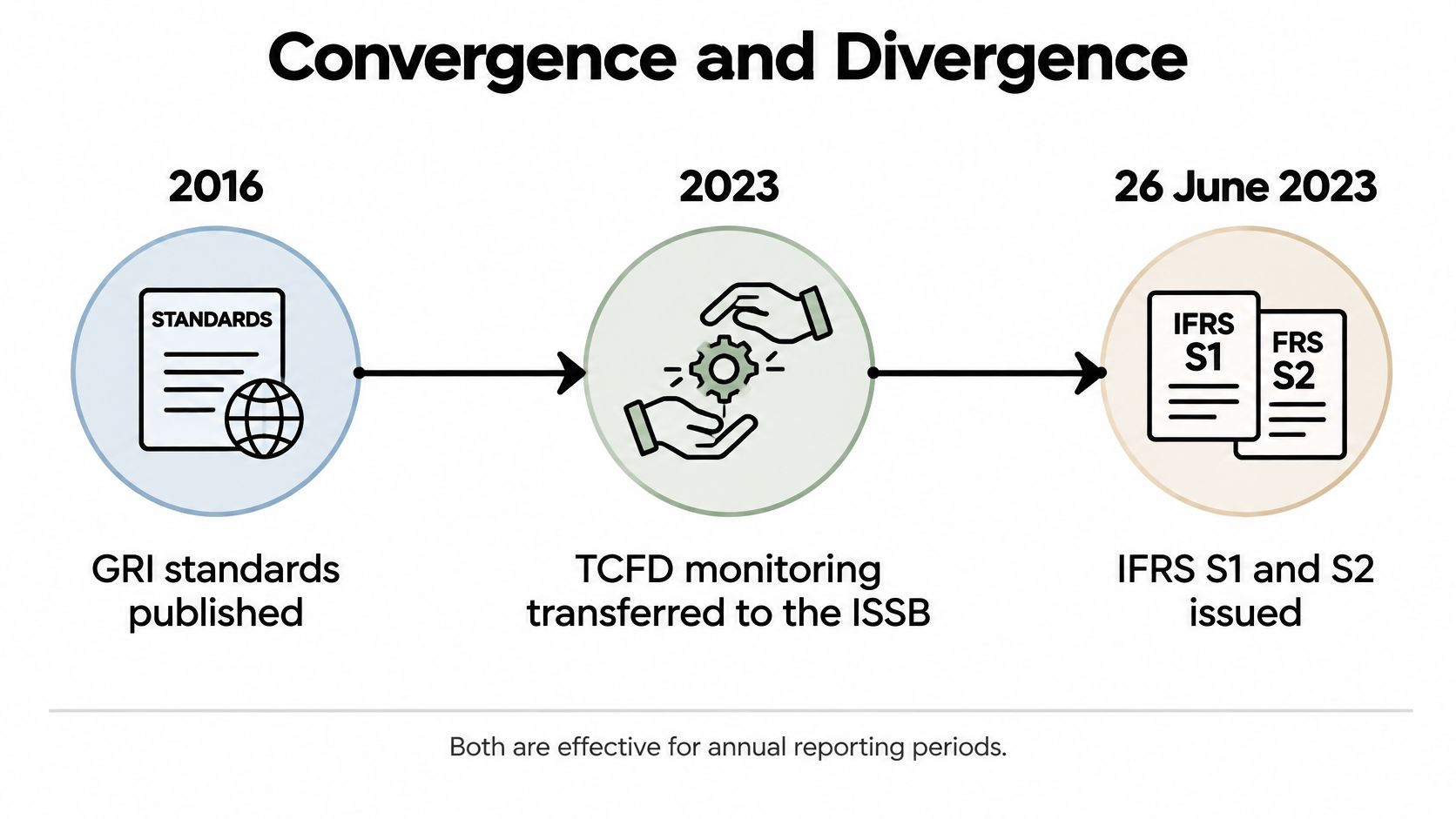
Standards have stacked, not replaced one another. GRI's full standards arrived in 2016. In 2023, monitoring of the TCFD recommendations moved to the ISSB. On 26 June 2023 the ISSB issued IFRS S1 and IFRS S2.
What the ISSB actually requires
The IFRS Sustainability knowledge hub sets both standards as effective for annual reporting periods beginning on or after 1 January 2024. Earlier application is permitted only when both standards are applied together. IFRS S1 sets general requirements for sustainability-related financial information. IFRS S2 addresses climate-related risks and opportunities. Companies applying them provide those disclosures for the same reporting period and at the same time as the annual financial statements.
Adoption is not automatic worldwide. Each jurisdiction decides whether and when to write the standards into law, and several are already moving to adopt them. Many large companies still cite the former TCFD recommendations while local rules catch up. The market still speaks TCFD. The standard-setter has moved the climate content into S2, so a TCFD-based process is a starting point rather than a finished answer.
Where ESRS does not fold in
ESRS keeps double materiality and is mandatory only for companies in scope of the CSRD. Disclosures are organised into four areas: governance; strategy; management of impacts, risks and opportunities; and metrics and targets. Topics and metrics often line up with ISSB language. Audience, materiality test, and disclosure objective do not.
Partial interoperability is the working condition, not a bug that a crosswalk spreadsheet will delete. An in-scope EU company should expect to satisfy both an impact-and-finance test and an investor baseline. The practical test is which reader each number serves: the CSRD report answers to a broad stakeholder audience, while the ISSB disclosure answers to investors pricing enterprise value.
Map each overlapping metric once. Store the activity data, the factor, and the boundary in one place, then point that record at the ESRS disclosure and the ISSB disclosure. One evidence trail, two outputs. Rewriting the tonne of CO2 for a second report creates two versions of truth and a reconciliation no one budgeted for.
Evidence Grades and Assurance for ESG Figures
Assurance is thinnest where readers need it most. In a 2025 Teneo survey of sustainability reports, 67% of companies obtained external assurance for at least one ESG data point, yet only 25% assured at least one social data point, down from 32% in 2024. Regulators are closing that gap in stages. A growing share of jurisdictions is moving toward mandatory sustainability assurance, and most regimes begin with limited assurance, the lighter check for obvious errors, before asking for reasonable assurance, the deeper opinion that the number is right.
That gap matters because an assured but loosely defined indicator can mislead more than a plainly labelled estimate. A training-hours figure assured against an undefined methodology tells a lender less than an estimated Scope 3 figure whose factor source and confidence limits are written down. Framework compliance alone does not make a number decision-useful. The test is whether the reader of that figure, auditor, lender, or board, can trace it back to evidence.
Grade the figure before you assure it
| Data type | Typical treatment | Assurance expectation | Keep on file |
|---|---|---|---|
| Metered energy and fuel invoices | Measured or invoiced | Readily auditable; limited assurance is common | Invoices, meter readings, unit conversions |
| Supplier-provided emissions data | Partner-reported | Sample-based checks; disclose the share from suppliers | Supplier letters, methods, data versions |
| Spend-based emission estimates | Modelled from spend and emission factors | Disclose as an estimate with lower confidence | Factor source and year, spend mapping |
| Social data such as training hours or injuries | Internal HR records | External assurance is rare; social data is the least-assured category | HR records, definitions, cut-off dates |
| Actions not yet quantifiable | Qualitative assessment | Not assurable as a number | Rationale and the data still needed |
Grade each figure once, against a single evidence trail. Store the source file, factor version, assumption, calculation logic, and the name of whoever signs off, then point that record at whichever framework asks for the number. For value-chain emissions, add how complete and how geography-specific the factor is. A labelled estimate beats a silent one, and the guide to labelling measured versus estimated carbon data shows how to mark that difference before a lender treats both as equally hard.
The top rows of that table live in systems finance rarely touches. Meter readings, asset registers, and e-waste logs sit with IT and facilities teams, so their handover decides whether your strongest data reaches the report as auditable evidence or as an anecdote. ESG reporting guidance for IT leaders is useful context when hardware refresh and energy data have to reach finance without spawning a second unofficial spreadsheet.
An expert signature is a review of method and conclusion. It isn't an audit or an independent assurance opinion. That still requires an appointed third party.
Choosing a Framework by Real Situation
Start with the situation you face, not with the framework that has the most famous acronym.
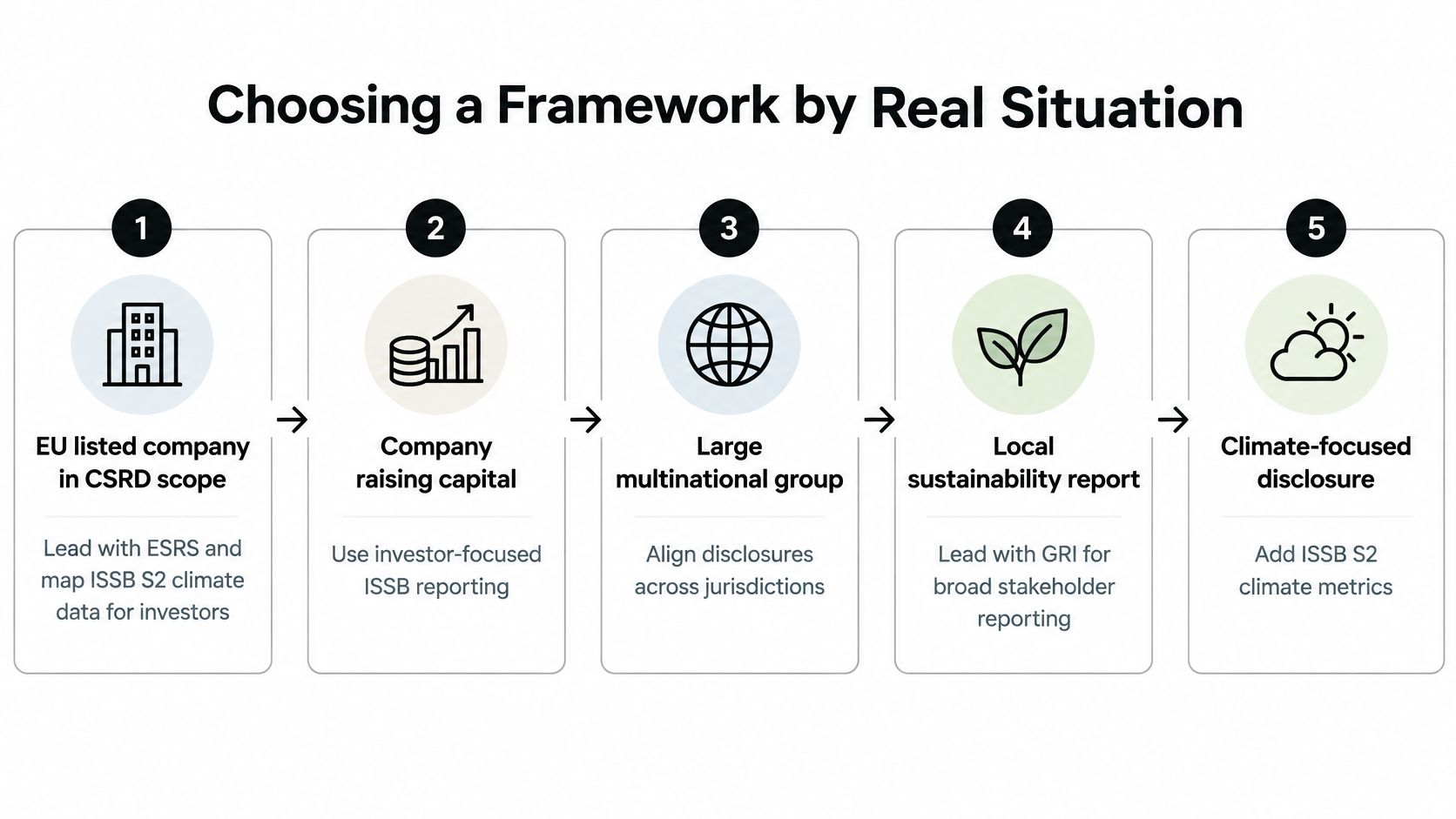
Five leads, not five parallel truths
An EU listed company in CSRD scope leads with ESRS and maps IFRS S2 climate data for investors. The failure mode is a single narrative that satisfies neither the outward impact test nor the inward value test.
A company raising capital in a market that is adopting ISSB leads with IFRS S1 and S2 and adds SASB industry metrics. Timing matters: sustainability information goes out with the financial statements, not in a PDF three months later.
A private equity portfolio company preparing lender KPIs uses ISSB-aligned metrics and one definition set across the fund. If each company invents its own boundary for "renewable electricity," the fund cannot compare holds or defend a sustainability-linked loan.
A company whose main readers are communities, employees, and customers leads with GRI. Add SASB or ISSB only for the investor appendix, and write down the impact threshold so a loud topic isn't promoted just because it is easy to count.
A first-time reporter answering a supplier questionnaire starts with the framework the buyer requests. Coverage of every topic is less important than the quality of supplier activity data. A complete-looking spend estimate that hides the factor year will fail a procurement audit faster than a short, sourced answer.
| Situation | Primary framework | Add-on frameworks | Watch for |
|---|---|---|---|
| EU listed company in CSRD scope | ESRS | ISSB S2 for investor climate data; GRI cross-reference | Double materiality evidence trail for both views |
| Company raising capital in an ISSB-adopting market | IFRS S1 and S2 | SASB industry metrics | Sustainability information reported with financial statements |
| Private equity portfolio company with lender KPIs | ISSB-aligned metrics | GRI or ESRS for wider stakeholder data | One set of definitions across the fund |
| Company with a broad stakeholder audience | GRI Standards | SASB or ISSB for investor readers | Documented impact materiality threshold |
| First-time reporter answering supplier requests | Framework the buyer requests | Supplier-specific emissions data | Data quality over coverage |
The same activity data can serve several of these rows when it is filed by metric and evidence, not by the title of last year's PDF. Reporting tools help only after that filing exists. A practical comparison of what software should hold is in this note on ESG reporting software.
Confirm Your Framework Path Before Reporting
Run this sequence before anyone drafts a chapter heading.
- Name the reader and the decision. Investment committee, lender, regulator, customer, or workforce. A number without a decision is a brochure.
- Confirm the legal trigger in each jurisdiction. Check whether CSRD scope or an ISSB-based rule applies. A voluntary request and a filing obligation do not get the same calendar.
- Pick the lead framework from the situation you are in. Add-ons come after the lead, not instead of it.
- List overlapping metrics once. Tag each metric with the materiality test it must satisfy so the same tonne isn't argued twice.
- Grade every figure. Flag estimates, social data, and items that can't yet be quantified. Don't send an ungraded total into assurance or a loan covenant.
- Name the owner who signs each number. If nobody owns the cut-off date, the figure will move between drafts.
The first working session is a scoping meeting. Agree who the report is for and what it must cover before new data requests go out. Axion Lab's process starts with a scoping call with an expert for that agreement. The platform then analyses the files the client already sends, drafts the full report, and asks only the questions the documents couldn't answer. For a portfolio company those files are usually prior reports, policies, invoices, and board papers. For a live deal, they are the data room.
Answer one question before the scoping call ends: who will rely on this number, and what will they decide with it?
Axion Lab builds sustainability analyses for private equity funds and portfolio companies from the documents already on file, with a senior expert setting scope and signing the deliverable. That work ties framework choices to the decision in front of the deal team, whether the output is a lender pack, a board review, or a disclosure draft. Visit Axion Lab to scope who the report is for and what the existing files can already support.
Prepared with the Outrank app