

AI is transforming post-acquisition integration by addressing common challenges like system mismatches, delays, and employee turnover. With 83% of failed M&A deals linked to poor integration, AI offers solutions that improve efficiency, reduce risks, and accelerate results. Key benefits include:
- Real-time monitoring: AI identifies risks and tracks synergies early, avoiding delays and missed targets.
- Automated due diligence: Speeds up pre-integration tasks by analysing contracts, financials, and IT systems.
- System integration: AI aligns mismatched software and cleans up fragmented data faster.
- Cost savings: AI reviews vendor contracts, consolidates suppliers, and identifies savings opportunities.
- Risk management: Predicts issues like employee attrition or regulatory gaps before they escalate.
- Knowledge retention: Captures lessons from each deal to improve future integrations.
Companies using AI report faster integration timelines, fewer errors, and better synergy realisation. For instance, a healthcare firm standardised its systems within 90 days using AI, enabling smoother acquisitions. With AI adoption in M&A rising, firms not leveraging these tools risk falling behind.
Automating Due Diligence and Pre-Integration Analysis
Automating due diligence with AI is transforming integration processes by cutting down delays and enabling teams to focus on creating value. Traditional due diligence often drags on for weeks, filled with manual tasks like reviewing contracts, exporting IT data, and piecing together fragmented information from spreadsheets. AI flips this script by automating how structured data (like financial reports and customer lists) and unstructured data (such as emails, contracts, and social media) are discovered, extracted, and analysed 6. This isn’t a niche trend either - by 2025, around 86% of organisations had adopted generative AI in their M&A workflows. Additionally, 82% of dealmakers report that AI and advanced analytics significantly speed up pre-deal insights, particularly during due diligence and pre-integration analysis 28.
AI-powered tools can cut the time needed for audits and assessments by over half 6. For example, natural language processing (NLP) allows deal teams to use text-based queries to generate SQL statements, directly pulling data from databases without waiting on IT teams. This removes bottlenecks and lets integration teams focus on strategic decisions rather than administrative headaches. The sections below explore how AI enhances document analysis and risk identification, streamlining these once time-consuming processes.
AI-Powered Document Analysis
AI tools, such as Virtual Data Room (VDR) copilots, can summarise lengthy documents and extract key clauses, including change-of-control provisions, exclusivity terms, and unusual contractual obligations 8. In legal due diligence, AI operates like a "skilled legal associate", reviewing thousands of contracts to pinpoint pricing inconsistencies or duplicative terms 7.
This capability isn’t limited to legal documents. Gemini 2.5, for instance, analyses financial statements and tax filings with exceptional precision 9. It can also flag unusual accounting practices or inconsistencies in revenue recognition 9.
For operational insights, AI inventories technology stacks, maps dependencies between systems, and identifies overlaps in organisational charts 1. In November 2025, Deloitte used AI tools to assess employee sentiment and communication tone, helping to gauge cultural compatibility between merging organisations. This allowed them to address potential human and operational risks, such as employee attrition, before they became problems 9. Similarly, during a European acquisition in late 2025, an AI compliance tool scanned supplier contracts, identifying outdated data protection clauses. This ensured regulatory compliance before the deal closed, avoiding potential penalties 9.
Identifying Synergies and Risks
AI goes beyond document review by uncovering operational synergies and hidden risks. For example, it can detect financial risks like unusual revenue patterns, inconsistencies in financial statements, or high customer concentration 8. It also identifies opportunities for synergy, such as supplier rationalisation, vendor rate comparisons, and co-location possibilities by analysing site-level square footage and usage 17. These insights don’t just stop at pre-integration - they carry forward into later stages of the acquisition, ensuring the process remains seamless and proactive. AI even influences critical decisions like deal pricing, Day 1 priorities (such as payroll and email systems), and linking investments directly to underwriting assumptions 13.
The impact is clear: 65% of dealmakers say AI enhances insights into M&A deals 8, while 80% of companies using generative AI in M&A report dramatic reductions in manual work 8. Tony Dahlager, VP of Account Management at Analytics8, captures it well:
Having quality data is key to maintaining unbiased visibility into organizational performance; Data Analytics is the best way to keep a strategic eye on success criteria and capitalize on opportunities quickly
6.
sbb-itb-6ca8558
Building Data Foundations and System Integration
When organisations merge, they often find their IT systems don’t play well together. Imagine one company running on SAP while the other relies on Oracle. Customer data might sit in separate CRMs, financial records could follow entirely different formats, and even something as simple as phone numbers might be structured differently. These mismatches in systems and data can quickly drain value from a deal 11.
The challenges are immense. Daniel Bae, Co-founder and CEO of Amafi Advisory, sums it up:
The bottleneck is operational: mapping thousands of systems and processes, aligning hundreds of teams... these are exactly the kinds of high-volume, pattern-recognition, coordination-intensive tasks where AI adds genuine value
1. Without a unified data foundation, integration teams can spend months untangling spreadsheets while leadership is left in the dark, unable to track progress or spot risks.
AI steps in to handle the heavy lifting of system integration. It processes IT documentation, licence records, and infrastructure logs to map out technology stacks, pinpointing redundancies like overlapping CRM or ERP systems. AI also analyses data schemas across systems, generating migration specifications automatically 1. A striking example comes from a US-based healthcare platform that, in March 2026, adopted an industrialised integration model. Within 90 days of each acquisition, they retired legacy systems and migrated everything to a standardised, AI-powered digital stack. This approach kept their data unified and avoided the chaos that often comes with rapid acquisitions 3.
Unifying Different Data Sources
Once system integration is automated, the next step is consolidating data. AI begins by mapping fields between systems, going beyond mere names to analyse actual data content. For example, it can link "Gift_Amount" in one database to "Donation_Amt" in another, even if the naming conventions differ 10. Using semantic understanding, AI can also recognise that "Annual_Fund_2024" in one system corresponds to "Year_End_Campaign" in another 10.
AI also excels at deduplication. Machine learning identifies "fuzzy matches" across databases, such as recognising that "Bob Smith" and "Robert J. Smith" at the same address likely refer to the same person. This reduces manual data cleaning time by as much as 70% to 80% compared to traditional methods 10.
Process mining adds even more clarity. By analysing system logs and user behaviours, AI creates an accurate picture of how systems are actually used, often uncovering discrepancies between documented and real-world workflows 105. This insight helps teams decide which systems are essential and which can be retired. Autonomous AI agents can then take over multi-step processes, such as managing the "procure-to-pay" workflow, identifying inefficiencies, and routing tasks intelligently 2.
| Integration Challenge | AI Solution | Outcome |
|---|---|---|
| Fragmented Systems | Automated system inventory | Single source of truth for IT landscape |
| Duplicate Records | Machine learning-based deduplication | Clean, reliable data for reporting |
| Data Migration Stalls | Automated schema analysis | Faster migration with fewer errors |
| Inconsistent Governance | AI-enabled policy standardisation | Reduced security and compliance gaps |
By creating a unified and accurate data foundation, organisations streamline operations and gain the real-time monitoring they need to manage integration risks effectively.
Ensuring Data Accuracy and Consistency
After systems are unified, maintaining data accuracy becomes key. Clean data is critical for integration success, but 83% of data migration projects either fail or overrun their budgets and timelines 10. AI tackles this by profiling data before migration, flagging missing fields, inconsistent formats, and other potential issues 10.
AI tools standardise formats for addresses, phone numbers, and dates, while performing internal deduplication within each system. A phased pilot migration ensures that transformation rules work as intended before full-scale deployment. High-confidence matches are merged automatically, while lower-confidence ones are flagged for human review 10. Justin Boitano, VP of enterprise software at NVIDIA, explains:
Agentic AI is enabling enterprises to enhance productivity with intelligent agents capable of handling complex, multi-step challenges
2.
Post-migration, AI-powered monitoring ensures data quality stays intact. Instead of relying on monthly reports, AI provides real-time alerts for any new issues, preventing small problems from spiralling into major headaches 10. Leading acquirers now see the "digital core" as a key deal asset, prioritising rapid transitions to standardised, AI-enabled systems to avoid fragmentation 3. However, as NRI cautions:
If the underlying data is disorganised or governance standards are unclear, AI can just as easily amplify errors and scale risk across the combined enterprise
11.
Real-Time Monitoring with AI Dashboards
When data is unified, real-time dashboards become a powerful tool for keeping integration processes on track. Quarterly reviews just don’t cut it anymore - teams need continuous oversight to manage integration effectively. AI-powered dashboards step in by pulling data from financial systems, operational databases, and HR platforms across organisations, creating a standardised, live view of progress 1. Companies using these dashboards have seen synergy realisation rates soar to 86–93%, compared to just 62% with manual tracking methods 13. Even better, integration timelines have been shortened by as much as 40% 12. These dashboards don’t just provide a snapshot - they act as a nerve centre, offering tailored insights and alerting teams to issues before they spiral.
Customisable KPI Dashboards
Real-time data is only useful if it’s relevant to the right people. That’s why dashboards need to be flexible and tailored. Different roles require different insights: CXOs might focus on high-level synergy summaries, the Integration Management Office (IMO) needs detailed views of workstream interdependencies, and functional leads are likely to track specific metrics like IT system migration progress 12. AI makes this customisation possible by aligning metrics with deal objectives. Whether it’s revenue and cost synergies, procurement savings, headcount targets, or facility consolidation, AI ensures the right data reaches the right hands 1.
Early Issue Detection
One of AI’s standout features is its ability to spot problems before they become crises. Instead of waiting for quarterly reports to reveal issues, AI analyses trends in real-time, flagging risks in areas like employee sentiment, customer churn, or IT compatibility 113. Exception-based reporting takes this a step further, notifying leaders only when KPIs deviate from expectations 13. For instance, Oracle’s Fusion Analytics Warehouse processes half a million integration metrics daily, generating around 12 high-priority alerts per integration 13. Apollo Global Management offers another example: during the integration of 32 portfolio company add-ons, their machine learning platform predicted synergy shortfalls 60 days ahead of financial reports, with an 82% accuracy rate in preventing missed targets 13. AI also tracks thousands of milestones, identifying critical delays - like office consolidations held up by IT migration issues - before they derail timelines 113.
| Feature | Traditional PMI (Excel-based) | AI-Enhanced PMI (Dashboards) |
|---|---|---|
| Data Frequency | Monthly/Quarterly reporting | Real-time streaming data |
| Risk Detection | Reactive (after the miss) | Proactive (predictive alerts) |
| Synergy Tracking | Manual reconciliation | Automated API-driven tracking |
| Synergy Realisation | ~62% 13 | 86–93% 13 |
AI-powered dashboards are becoming indispensable in post-acquisition integration. They allow teams to manage proactively, resolve issues quickly, and achieve better outcomes. Providers like Axion Lab (https://axionlab.ai) offer solutions that demonstrate how AI-driven tools can simplify and enhance the integration process with early, actionable insights.
Optimising Vendor Contracts and Procurement Processes
With unified data and real-time insights in place, AI takes streamlining vendor contracts and procurement processes to the next level.
When two organisations merge, their combined vendor portfolios often hide opportunities to cut costs. Traditional manual contract reviews typically cover just 5–10% of agreements, leaving most potential savings undiscovered. AI changes the game by analysing 100% of contracts, ensuring no hidden liabilities or overlapping commitments are overlooked 14. This allows AI to identify duplicate vendor relationships - where merging companies pay separately for the same services - and reconcile inconsistent vendor names across systems. By providing a full picture of contracts, AI lays the groundwork for reducing costs and improving procurement workflows.
Contract Analysis for Cost Optimisation
AI goes beyond the limits of manual reviews, uncovering inefficiencies that might otherwise stay hidden. For example, it compares rates and terms for similar services - like CRM, ERP, or payroll systems - across the newly merged organisation. This analysis pinpoints where renegotiating contracts could bring the most value. AI also highlights "tail spend", those small, irregular purchases that often bypass procurement processes and lead to unnecessary expenses 7.
In February 2026, a Fortune 500 manufacturer with $15 billion in revenue used AI to uncover £23 million in savings by identifying duplicate vendors and consolidating suppliers 17. Beyond just saving money, AI tracks renewal dates and notice periods, helping organisations avoid accidental auto-renewals of unfavourable agreements. As Arpita Chakravorty, SEO Content Strategist at Sirion, explains:
The difference isn't just speed - it's strategic clarity
14.
| Capability | Traditional Manual Review | AI-Enhanced Integration |
|---|---|---|
| Coverage | 5–10% (sampling) | 100% (full population) |
| Vendor Identification | Manual reconciliation of names | Automated harmonisation of data |
| Cost Optimisation | Focused on high-value contracts | Identifies tail spend and pricing gaps |
| Renewal Tracking | Spreadsheet-based; error-prone | Automated alerts and triggers |
| Efficiency | Weeks to months | Days to weeks |
Streamlining Procurement Workflows
Once savings opportunities are identified, AI boosts efficiency by automating procurement workflows. By consolidating spend categories across various legal entities, AI provides the insights needed to negotiate volume discounts with suppliers. Modern AI tools can process up to 500 contracts in just four to eight hours - a task that would traditionally take two to four weeks 16.
Agentic AI takes this further by automating the entire workflow, from creating purchase orders to processing payments. It flags anomalies and predicts potential issues in real time 2. This automation can cut manual contract review efforts by as much as 80% 15, allowing procurement teams to focus on strategic negotiations rather than administrative tasks. Tools like Axion Lab (https://axionlab.ai) showcase how AI can deliver actionable insights early in the procurement process, enabling organisations to consolidate vendors and optimise spending from the very start of integration.
Predictive Risk Management and Culture Alignment
AI doesn't just stop at helping with contracts and procurement - it also plays a key role in addressing two major challenges after acquisitions: forecasting risks and aligning organisational cultures. These challenges are critical, especially since about 70% of M&A deals fail to achieve their expected synergies due to execution missteps rather than issues with the deal itself 1. By shifting the focus from reactive problem-solving to proactive risk management, AI helps identify potential issues weeks before they can escalate.
Risk Forecasting and Mitigation
AI provides real-time tracking of synergy progress, flagging underperforming areas like delayed procurement savings or stalled contract renegotiations long before they show up in quarterly reports 1. This early detection gives leadership the chance to intervene while there’s still time to steer things back on track. For instance, AI can spot operational drift - where actual performance starts to deviate from the plan - and alert teams to take corrective action promptly 8.
In cross-border deals, AI helps by mapping out regulatory requirements across different jurisdictions. It compares laws on data protection, employment, and cybersecurity, identifying potential compliance issues that could derail the integration process 1. Additionally, AI evaluates the target company’s cybersecurity setup, identifying vulnerabilities and third-party risks before system consolidation begins 8. As Jeff Flaks, CEO of Hartford HealthCare, puts it:
The types of improvements we're able to do with AI and machine-based learning and the ability to intervene quickly to make significant improvements is different today than ever before
8.
| Risk Category | AI Predictive Application | Mitigation Outcome |
|---|---|---|
| Human Capital | Attrition risk scoring and sentiment analysis | Prevents loss of key talent and identifies cultural silos 15 |
| Financial | Variance detection in synergy realisation | Enables early intervention for underperforming workstreams 18 |
| Operational | Dependency and milestone tracking | Prevents delays in critical path items like IT migrations 1 |
| Compliance | Multi-jurisdiction requirement mapping | Avoids regulatory violations in cross-border transactions 1 |
| Commercial | Customer churn and account risk prediction | Focuses retention efforts on high-risk, high-value accounts 18 |
| Technical | Cybersecurity attack surface assessment | Identifies vulnerabilities before system consolidation 8 |
While risk forecasting addresses operational challenges, AI also tackles the cultural barriers that often undermine successful integration.
Culture Compatibility Analysis
Cultural misalignment is one of the trickiest and most frequent reasons mergers fail. AI steps in by analysing internal communications - such as emails, meeting patterns, and usage of collaboration tools - to assess sentiment and morale 1. It also examines the density of communication networks across entities to determine whether teams are integrating or staying siloed, flagging potential barriers to collaboration 1.
Predictive models can identify employees at "flight risk" by examining factors like role changes, pay discrepancies, or reduced involvement in projects. This helps organisations focus retention efforts on key talent during the critical "First 100 Days" of integration 15. Generative AI also combines data from sources like Glassdoor and internal surveys to predict areas of cultural friction 18. For example, if the majority of employees in the target company prefer hybrid working but the acquiring firm insists on full-time office attendance, AI highlights this mismatch early in the planning phase 18.
Tools like Axion Lab (https://axionlab.ai) provide multi-domain AI analysis to pinpoint cultural and operational risks early in the integration process. By using aggregated, anonymised data at the team level rather than monitoring individuals, these tools maintain employee trust while delivering actionable insights 1. As Daniel Bae, Co-founder & CEO of Amafi, explains:
AI works best in PMI when it augments human decision-making with better data, faster analysis, and broader coverage. It works worst when it's treated as a replacement for the human judgement, leadership, and emotional intelligence that integration demands
1.
AI Knowledge Management for Continuous Improvement
After enhancing integration through real-time monitoring and streamlined procurement, AI takes post-acquisition success a step further by embedding lessons learned across transactions. Every acquisition offers insights - what succeeded, what failed, and the reasoning behind key choices. Yet, much of this knowledge can be lost when employees leave or integration teams shift focus to the next deal 521. AI-powered knowledge management solves this by creating a durable institutional memory, capturing insights throughout the merger process to ensure that each deal builds on the last 5.
Centralised Knowledge Repositories
AI can create a centralised, easily searchable repository to store integration-critical documents, playbooks, and the rationale for major decisions 225. Unlike static project tools, AI systems go further by indexing conversational data from platforms like Slack, meeting transcripts, internal wikis, and incident logs 1920.
For example, in 2026, a vocational training provider backed by KKR, operating in three European countries, used the Rebase platform to integrate four disconnected technology systems after multiple acquisitions. Within three weeks, the AI-driven context engine generated cross-system intelligence and a queryable knowledge graph 19. Mubbashir Mustafa from Rebase highlighted its impact:
The context engine becomes the unified intelligence layer for the combined organisation, providing cross‐system context that would have taken years to rebuild organically
19.
This preserved knowledge enables organisations to improve continuously, setting the stage for smoother future integrations.
Learning from Past Integrations
With a solid data foundation and proactive monitoring in place, organisations can leverage insights from previous deals to refine their integration strategies. AI doesn’t just store information - it identifies patterns and highlights success factors across multiple transactions 5. Machine learning algorithms analyse historical outcomes to transform static playbooks into adaptive, data-driven guides. As Tribe AI aptly put it:
The knowledge gained from one integration becomes rocket fuel for future deals
5.
A US-based healthcare platform exemplifies this approach. Using an industrialised rollout model, the company executed an aggressive buy-and-build strategy, retiring legacy systems within 90 days and migrating acquisitions onto a standardised AI-enabled digital core. This approach ensured a unified, interoperable data foundation that strengthened with each transaction 3. Accenture noted the compounding benefits of this method:
Each transaction strengthens the next. Execution effort declines. Advantage compounds
3.
Tools like Axion Lab (https://axionlab.ai) further aid this process by providing multi-domain AI analysis across legal, commercial, financial, operational, and cultural areas. Deploying context engines early - ideally within the first two weeks - helps organisations map dependencies and ownership relationships automatically, creating a living knowledge base that avoids revisiting past decisions months later 1920.
Implementation Best Practices
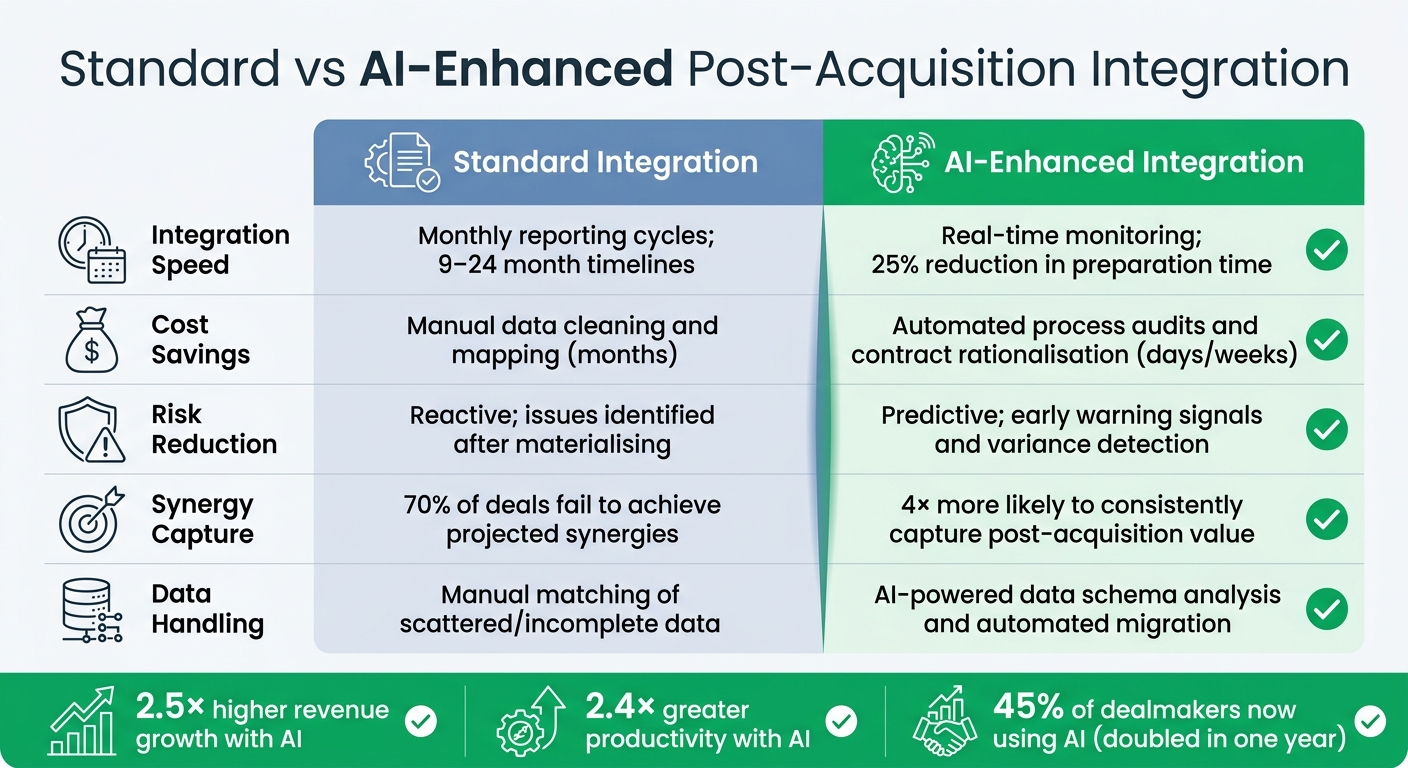
AI vs Traditional Post-Acquisition Integration: Performance Comparison
Deploying AI in post-acquisition integration requires thoughtful preparation and a commitment to ongoing learning. To achieve the best results, integration planning should start during due diligence, not after the deal is finalised. This ensures readiness to integrate and extract value from day one 4. Viewing the digital core as a key asset is essential - this means assessing data architecture and AI preparedness alongside the usual financial and operational metrics 3. Taking this approach early on helps secure cost efficiencies and manage risks effectively throughout the integration process.
Comparison of Standard vs AI-Enhanced Approaches
The table below highlights the performance improvements that AI can bring to integration efforts:
| Feature | Standard Integration | AI-Enhanced Integration |
|---|---|---|
| Integration Speed | Monthly reporting cycles; 9–24 month timelines | Real-time monitoring; 25% reduction in preparation time 123 |
| Cost Savings | Manual data cleaning and mapping (months) | Automated process audits and contract rationalisation (days/weeks) 5 |
| Risk Reduction | Reactive; issues identified after materialising | Predictive; early warning signals and variance detection 1 |
| Synergy Capture | 70% of deals fail to achieve projected synergies 1 | 4× more likely to consistently capture post-acquisition value 2 |
| Data Handling | Manual matching of scattered/incomplete data | AI-powered data schema analysis and automated migration 1 |
For example, a European bank in 2025/2026 leveraged generative AI to refine synergies and develop IT and HR integration playbooks. This approach cut integration time by 25% and uncovered nearly €600 million in cost and revenue synergies 23. Similarly, two commodity-focused firms used AI to optimise purchasing and hedging within two months - far faster than the 12 months estimated for a manual approach - resulting in $100 million in savings, 20% more than manual methods could achieve 23.
Practical Steps for Adoption
To successfully implement AI, focus on high-impact use cases like automated onboarding, real-time KPI dashboards, and vendor contract rationalisation 5. Avoid using project management tools designed for single-company operations; instead, invest in platforms tailored to the unique needs of integrating two organisations 4. Test AI technologies during live deal processes before scaling them across the organisation to maximise their effectiveness 2.
Establishing strong governance is crucial. Assign roles such as Deal Lead, AI Product Owner, Legal Reviewer, and Cyber Risk Lead 8. Early data cleaning and consolidation are critical, as AI's success depends on having a solid data foundation 5. These roles ensure that AI supports, rather than replaces, human judgement, particularly in complex areas like change management and leadership alignment 15. Additionally, invest in upskilling teams to work alongside AI, as 67% of deal professionals acknowledge the need for such training 3.
Justin Boitano, VP of enterprise software at NVIDIA, emphasised the transformative potential of AI, saying:
Agentic AI is enabling enterprises to enhance productivity with intelligent agents capable of handling complex, multi-step challenges
2.
Tools like Axion Lab (https://axionlab.ai) can further support integration efforts. These platforms provide AI-driven analysis across legal, financial, operational, and other domains, offering teams traceable and auditable insights for informed decision-making. By following these practices, organisations can not only optimise their current integration processes but also set a strong precedent for future acquisitions.
Conclusion
Poor execution during integration is responsible for a staggering 83% of deal failures 4. AI is changing the game by drastically cutting integration timelines, uncovering hidden risks, and offering real-time insights that traditional methods simply can't match. Companies that integrate AI throughout the process report 2.5× higher revenue growth and 2.4× greater productivity compared to those relying on manual approaches 2.
This shift from outdated monthly reporting to continuous monitoring isn't just a step forward in operations - it redefines how private market firms secure and protect deal value. For instance, AI-powered dashboards can pinpoint synergy gaps by week six instead of waiting until month four. Tools like sentiment analysis even detect cultural friction early, helping firms address potential talent losses before they escalate 1. This proactive stance is crucial, especially since integration challenges remain the top reason for value erosion.
Beyond monitoring, AI also ensures that lessons learned during integration aren't lost. By turning each deal into a learning experience, AI-driven knowledge management equips firms with actionable insights for future transactions. It processes data in less than 10% of the time manual methods require and forecasts labour synergies with an impressive 90% accuracy 23. This speed and precision empower firms to make quicker, smarter decisions while maximising deal value.
AI has become a cornerstone for successful integrations. With 45% of dealmakers now using AI - more than double the rate from just a year ago 23 - delaying adoption puts firms at risk of falling behind competitors already reaping its benefits. Platforms like Axion Lab (https://axionlab.ai) provide auditable, traceable insights across legal, financial, operational, and cultural areas, ensuring a solid data foundation for integration success.
The real question isn't whether to adopt AI for post-acquisition integration, but how fast firms can implement it to remain competitive in today's data-driven M&A environment. Embracing AI now could turn integration hurdles into a lasting edge over competitors.


