

Human-AI collaboration is transforming ESG due diligence in private equity, especially in the EU and UK, where strict regulations demand thorough, auditable evaluations of environmental, social, and governance factors. By combining AI’s ability to process massive data volumes with human expertise for decision-making, firms can meet these regulatory demands while improving efficiency and accuracy. Here’s how this works:
- AI handles repetitive tasks like document reviews, risk identification, and data standardisation, cutting review times by up to 70%.
- Humans focus on judgment and strategy, ensuring findings are contextualised and aligned with investment goals.
- Regulations like SFDR 2.0 and CSRD require due diligence outputs to be traceable and defensible, making AI-assisted workflows essential.
- Real-world examples show AI detecting risks (e.g., discrepancies in sustainability reports) and saving firms hundreds of hours in manual labour.
This approach ensures faster, more reliable ESG assessments, avoids compliance risks, and strengthens decision-making in private equity deals.
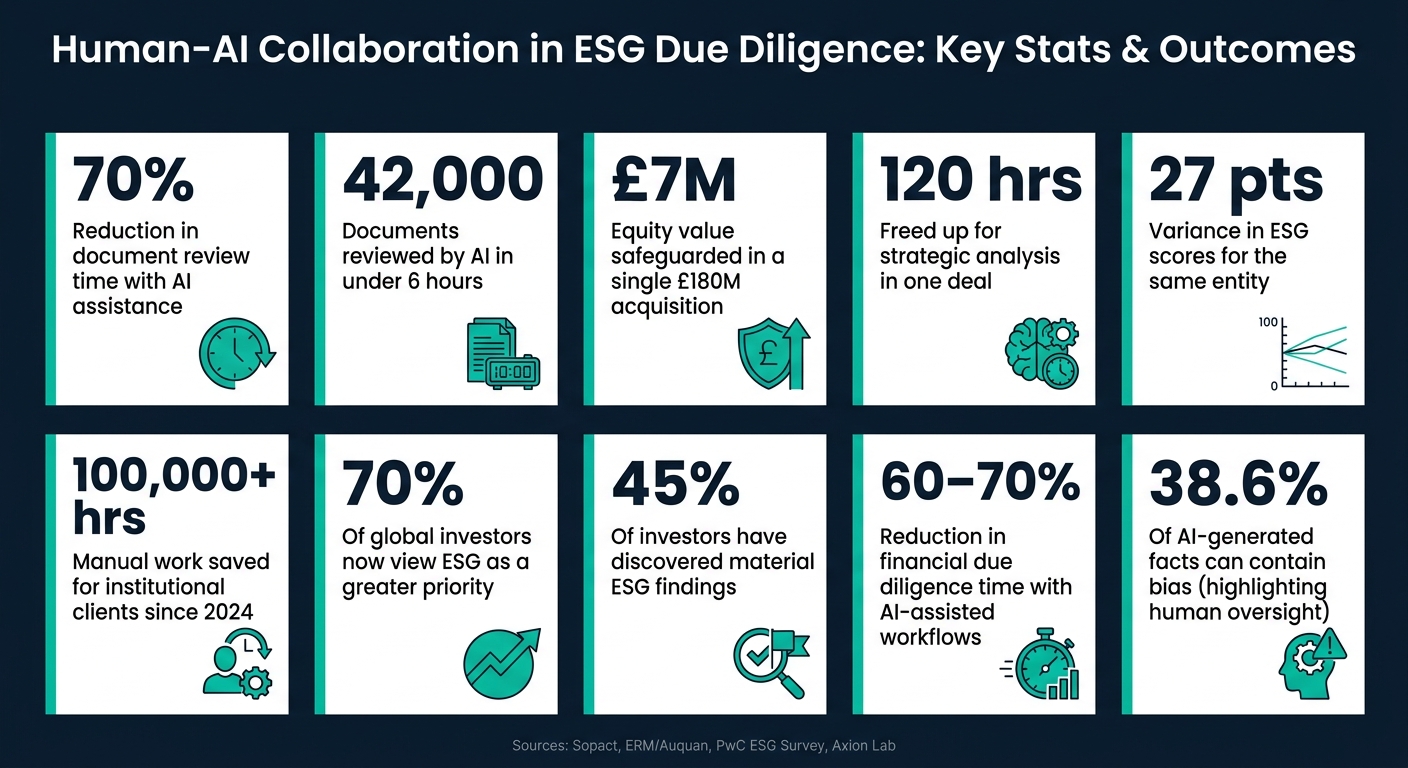
Human-AI Collaboration in ESG Due Diligence: Key Stats & Outcomes
Performance Gains from Human-AI Collaboration
Efficiency and Coverage Improvements
The partnership between humans and AI can dramatically boost productivity. Take the example of a mid-market private equity firm evaluating a £180m healthcare services acquisition in early 2026. By employing AI, the firm reviewed 42,000 documents in under six hours. The AI flagged £3.2m in EBITDA adjustments - such as non-recurring legal costs and above-market management fees - that a manual review had entirely missed. This freed up 120 hours for strategic analysis, ultimately safeguarding an estimated £7m in equity value for the deal 1.
AI also bridges gaps that manual efforts alone cannot cover. For instance, over 90% of the world's largest companies now release annual sustainability reports, but these reports are often inconsistent in structure and terminology 3. AI can standardise the extraction of data across these reports, enabling it to derive specific ESG metrics even from incomplete disclosures. For example, AI can calculate the percentage of women in a workforce based on raw headcount data or convert environmental metrics like tonnes into gigajoules 3. This level of processing, at scale, is beyond the reach of human analysts working alone.
These advancements in efficiency not only save time but also enable more thorough and precise risk assessments.
Accuracy and Risk Reduction
Speed alone isn’t enough - accuracy is equally critical. Recent findings highlight that hybrid models combining human expertise with AI outperform either approach on its own. For example, third-party ESG rating providers often show a variance of up to 27 points on a 0–100 scale for the same entity 2, making these scores unreliable for decision-making. Human-AI workflows address this issue by replacing opaque external scores with an internally anchored rubric, where each data point is directly tied to its source.
A practical example comes from Sustainability Fund VII during the Q3 2025 cycle. Using the Sopact Sense platform, the fund analysed 47 portfolio entities. For one entity, INV-015, AI detected a mismatch between a company’s sustainability report and third-party audit logs. While the report claimed zero water-related incidents in 2024, the AI flagged two minor breaches recorded elsewhere. This prompted a follow-up call before finalising the investment narrative 2.
Examples from ESG Research and Practice
The benefits of this collaboration extend beyond efficiency and accuracy, as demonstrated by several ESG-focused case studies. AI-driven worker-voice analysis, for instance, has uncovered risks that traditional methods missed. During the same Q3 2025 Sustainability Fund VII cycle, AI analysed 142 worker-voice responses for supplier SUP-031. It flagged a retaliation risk that was absent from both the supplier’s self-assessment questionnaire and third-party scores. This discovery led to a formal Corrective Action Plan 2.
AI also strengthens ongoing monitoring efforts. In January 2026, ERM began using Auquan's Sustainability Agent to automate the scanning of global news and regulatory disclosures for its financial institution clients. This tool, introduced under the leadership of Andrew Radcliff, ERM’s Global Service Leader for Mergers and Acquisitions, identifies controversies and litigation in real time, significantly reducing the manual workload involved in reputational risk assessments 4.
"As demand for sustainability advisory accelerates and regulatory requirements become more complex, we are enhancing our capabilities by embedding scalable AI solutions to meet our clients' growing needs." - Andrew Radcliff, Global Service Leader for Mergers and Acquisitions, ERM 4
These examples highlight a clear trend: while AI excels at processing large volumes of data and identifying patterns, human expertise is essential for making nuanced judgments and handling the outcomes. Together, they create a powerful synergy.
sbb-itb-6ca8558
Key Human-AI Collaboration Models in ESG Due Diligence
These models span the entire ESG due diligence process, from initial screening to ongoing risk management, offering a blend of human oversight and AI efficiency.
Human-in-the-Loop Screening and Risk Triage
This model relies on AI to handle the initial screening phase, leaving the final judgement to human reviewers. AI processes vast amounts of data - sustainability reports, policy documents, audit logs, and stakeholder disclosures - all at once. It scores each document based on a predefined rubric and flags any inconsistencies. Importantly, the AI provides paragraph-level citations for its findings, allowing human reviewers to quickly verify the reasoning without combing through extensive data manually.
What strengthens this approach is the structured review process. Once AI completes its task, submissions are placed in a "reviewer release" queue, where a human data lead must formally approve the findings before they proceed to the Investment Committee. This ensures that errors or AI-generated inaccuracies don’t make it into final reports. Additionally, the model is adept at cross-referencing data. For example, it can identify discrepancies such as a company’s public claim of reduced energy consumption conflicting with rising utility bills in the same dataset 7. This level of precision lays the groundwork for more advanced analytical tools.
AI Co-Pilots for ESG Analysts
Rather than replacing ESG analysts, AI serves as an assistant, significantly enhancing their productivity. Tasks that once took weeks - like reviewing disclosures - are streamlined, enabling analysts to focus on higher-value activities such as interpreting results, preparing management Q&A sessions, and drafting Investment Committee memos. Meanwhile, the AI handles the heavy lifting of document processing.
To ensure reliability, teams establish an anchored rubric that aligns AI outputs with human judgement. This approach eliminates inconsistencies often seen in traditional ESG scoring, which can vary by up to 27 points 5. For example, Auquan's Sustainability Agent, introduced by ERM in January 2026, scans disclosures from over 550,000 companies and highlights controversies for analysts to review. Since 2024, this AI tool has reportedly saved institutional clients more than 100,000 hours of manual work 4. These capabilities naturally extend into post-transaction monitoring, where ongoing oversight is critical.
Continuous Monitoring and Portfolio Updates
Once a transaction is complete, the focus shifts from initial triage to continuous monitoring. AI systems take over by scanning global news, regulatory updates, and adverse media in real time, replacing the traditional periodic review model with constant vigilance.
The backbone of this monitoring is a persistent Entity ID, assigned during the initial due diligence questionnaire (DDQ). This ID links all subsequent audits, surveys, and monitoring cycles, creating a seamless chain of data. Crossroads Impact Corp, a CDFI subsidiary, adopted this method in collaboration with Sopact over a seven-year period. By aggregating ESG data throughout the investment lifecycle, the firm linked baseline metrics to current performance. This approach supported a £223 million year-over-year increase in environmental and social loans while providing auditable evidence that met LP requirements 5.
"How do we know our investments stay on the path of sustainability and inclusion across every stage, from sourcing to exit?" - Eric Donnelly, CEO and Director, Crossroads Impact Corp 5
This shift - from static, periodic snapshots to a continuous, linked evidence chain - provides a solid foundation for an ESG programme that’s built to last, not just exist on paper.
Governance and Safeguards for Human-AI ESG Workflows
As AI increasingly supports ESG workflows, having solid governance frameworks in place becomes non-negotiable. These frameworks are what separate ESG processes that can withstand regulatory scrutiny from those that might falter. With AI handling more of the analytical workload, defining accountability becomes a pressing issue.
Defining Roles and Decision Rights
Clear role definitions are essential to avoid confusion in decision-making. For instance, data scientists focus on ensuring model accuracy, ESG experts provide the necessary context, and deal teams are responsible for making the final calls.
One effective governance tool is the Reviewer Release process. This requires a human data lead to review and approve any AI-flagged discrepancies before they reach the Investment Committee 2. Another safeguard is the use of anchored rubrics - these are consistent, observable evidence standards applied across evaluators to maintain scoring integrity and prevent inconsistencies 2.
Data Quality and Transparency in AI Outputs
To ensure ESG outputs remain reliable, data quality and transparency need to be actively managed. A key challenge here is the divergence in ESG ratings: the same company can receive vastly different scores - like 47, 61, and 74 - from different providers, resulting in variances of up to 30 to 50 points 2. This highlights the importance of citation-linked evidence. AI outputs should reference paragraph-level sources, enabling reviewers to quickly verify findings.
Additionally, assigning a persistent Entity ID during the initial due diligence phase creates a seamless, auditable trail throughout the investment process. For example, applying a 24-point anchored rubric to 47 entities achieved full citation coverage and cut audit pack preparation time from six weeks to zero days 2.
Regulatory Alignment
Meeting regulatory requirements is another critical aspect of governance. Frameworks like the EU AI Act, ISO/IEC 42001, and the NIST AI Risk Management Framework provide clear guidelines 8.
- The EU AI Act requires firms to classify AI systems by risk and maintain thorough documentation.
- ISO/IEC 42001 outlines management system requirements for AI governance.
- The NIST framework offers practical steps for identifying and managing AI risks.
For private equity firms in the EU and UK, adhering to these standards is becoming a baseline expectation from both regulators and institutional investors.
Addressing Bias and Ethical Risks
Mitigating bias is essential for maintaining ethical integrity and meeting regulatory demands. Studies show that up to 38.6% of AI-generated facts can contain bias 10, which could distort ESG assessments, especially in emerging markets or under-disclosed sectors.
A multi-layered approach is needed to address this issue:
- Data-level strategies: Conduct statistical diagnostics before model training to identify uneven distributions or labelling errors 10.
- Algorithmic techniques: Use methods like adversarial debiasing and counterfactual fairness testing to uncover hidden disparities 10.
- Governance measures: Establish explicit risk-severity thresholds (low, medium, high) to determine when human intervention is necessary 9.
"Responsible AI is inherently aligned with ESG because it involves both legal and broader ethical considerations." - Springer Nature 8
Another concern is "AI machinewashing", where companies misuse Responsible AI labels for reputational gain without implementing genuine governance mechanisms 8. The solution? Every AI-detected ESG gap should be tied to a Corrective Action Plan (CAP) register. This register should document remediation steps, timestamps, and verification processes 2. Without such a documented chain of actions, governance claims lack credibility.
Lessons and Practical Applications for ESG Due Diligence
Key Takeaways for Private Equity Deal Teams
The numbers don’t lie: 70% of global investors now view ESG as a greater priority in transactions compared to 12 to 18 months ago, and 45% have discovered material ESG findings with significant deal implications. Over half of those findings even led to deals falling through 6. ESG considerations are no longer just a box to tick - they’re shaping deal outcomes.
One major adjustment in approach is moving away from relying solely on provider scores. These scores can vary by as much as 30 to 50 points for the same company across different providers, making them unreliable. Instead, deal teams should ensure the use of a persistent Entity ID throughout the deal lifecycle. This creates an auditable evidence trail, offering a clearer view of a company’s ESG trajectory rather than just a one-off snapshot 5.
Before applying AI to live deals, it’s crucial to test the system on two or three completed transactions. By comparing the AI’s findings with known outcomes, teams can identify and address gaps in escalation rules and rubrics. This step ensures the AI is calibrated and ready for real-world application 1.
Axion Lab: AI-Native ESG Collaboration in Practice
A standout example of these principles in action is Axion Lab, a platform tailored for EU and UK private equity. Its AI takes on the heavy lifting - tasks like extraction, benchmarking, modelling, and drafting - at a speed five to ten times faster than human capability. However, the final deliverables are reviewed and signed off by a senior sustainability partner, ensuring that the analysis is aligned with the specific deal context. This “human-in-the-loop” model strikes a balance: AI handles the volume, while experts make the critical judgement calls.
Axion Lab’s system addresses the full spectrum of regulatory requirements, including SFDR 2.0, CSRD (with the latest Omnibus updates), EDCI, SBTi, PRI, and LP obligations. What’s more, the platform improves with every transaction it processes. This “data flywheel” effect means that the system becomes more accurate over time, offering firms a growing advantage in producing reliable ESG outputs under tight deadlines.
Balancing Speed, Depth, and Regulatory Defensibility
Time is often the enemy in due diligence, but AI-assisted approaches can significantly cut down on timelines. For example, financial due diligence time can be reduced by 60 to 70% 1. In one mid-market transaction, an AI-driven method shortened the timeline for a Commercial Due Diligence Report from three weeks to just five days 11. However, speed alone isn’t enough - traceability and regulatory compliance are just as critical.
Under CSRD, regulatory defensibility requires double materiality - evaluating both how a company impacts the world and how ESG factors influence its enterprise value 11. To meet this standard, every AI-generated finding must directly link back to a cited source document. Without this level of traceability, the benefits of speed could turn into risks.
Dr Leigh Coney, Founder of WorkWise Solutions, captures the balance perfectly:
"AI due diligence does not replace human judgment. It amplifies it by handling the data-intensive analysis that consumes 60 to 70 percent of a DD team's time." 1
The firms that succeed are those treating AI as the engine for processing data, with human experts as the ultimate decision-makers - not the other way around.


