

Private market firms are facing stricter ESG compliance requirements due to regulations like the CSRD, SFDR 2.0, and AIFMD II. These frameworks demand detailed, traceable sustainability disclosures, similar to financial reporting standards. Many firms still rely on manual processes, which are prone to errors and inefficiencies. AI audit trails offer a solution by automating data tracking, ensuring accuracy, and meeting regulatory demands.
Key Points:
- Regulatory Pressure: Over 50,000 companies are now subject to the CSRD, requiring third-party assurance for ESG data.
- Challenges: Manual processes struggle with the complexity of ESG reporting, which can involve over 1,000 data points.
- AI Audit Trails: These systems track data lineage, log AI decisions, and ensure human oversight, creating a transparent compliance process.
- Benefits: Improved accuracy, faster reporting, and reduced audit preparation time. They also address inconsistencies in ESG ratings and provide traceable evidence for all disclosures.
AI audit trails are becoming essential for firms to stay competitive, avoid penalties, and build investor trust in a rapidly evolving regulatory landscape.
How AI Audit Trails Support ESG Compliance
What Are AI Audit Trails?
An AI audit trail is essentially a detailed record that tracks how organisations manage their AI tools. It includes information like data sources, AI decisions, policy acknowledgements, and human oversight. Think of it as a comprehensive evidence package that demonstrates active governance of AI systems. When it comes to ESG compliance, these trails create a transparent chain of accountability - from the original source, like a utility bill or supplier certificate, through all calculations and transformations, right up to the final disclosure.
The EU AI Act, set to be enforceable in February 2025, mandates that high-risk AI systems must have built-in logging capabilities to track events throughout their lifecycle. Providers of these systems are required to retain these logs for a minimum of six months. Non-compliance can lead to hefty penalties of up to €35 million or 7% of global annual revenue 25. Henna Virkkunen, Executive Vice President of the European Commission, highlighted the importance of these measures:
The step would help make advanced AI models in Europe not only innovative but also safe and transparent 5.
This regulation underscores the growing importance of reliable audit trails for meeting increasing ESG obligations.
AI audit trails typically cover five key traceability layers: Intent, Design, Code, Test, and Deploy. This layered approach addresses the shortcomings of superficial reporting. For example, a 2025 survey revealed that 67% of corporate sustainability professionals admitted their organisations reported ESG metrics mainly for compliance or reputational reasons, rather than as part of a strategic effort 4. By offering detailed and structured traceability, AI audit trails provide a solid foundation for ESG compliance.
Benefits for ESG Compliance
AI audit trails bring significant advantages to ESG compliance by improving data accuracy, speeding up processes, and ensuring better regulatory readiness. For instance, automated emissions tracking can reduce data errors by 43%, while real-time anomaly detection helps prevent reporting deviations 4. Additionally, automated evidence management links supporting documents - like invoices, certificates, and meter readings - directly to data points, saving time otherwise spent on manual searches.
Beyond these efficiencies, AI-powered audit tools can drastically cut down the time needed for tasks like audit preparation and month-end reporting - from weeks to just hours 7. They also address inconsistencies in ESG ratings. A 2024 MIT Sloan study found that correlations between major ESG rating providers are only around 0.54, compared to 0.99 for credit ratings. This lack of alignment is estimated to cost investors between 1.8% and 3.2% in annual alpha due to mispriced risks 4. With AI audit trails providing independently verified, traceable data, organisations can move beyond self-reported metrics to meet the demands of both regulators and investors for reliable measurements.
Core Components of AI Audit Trails
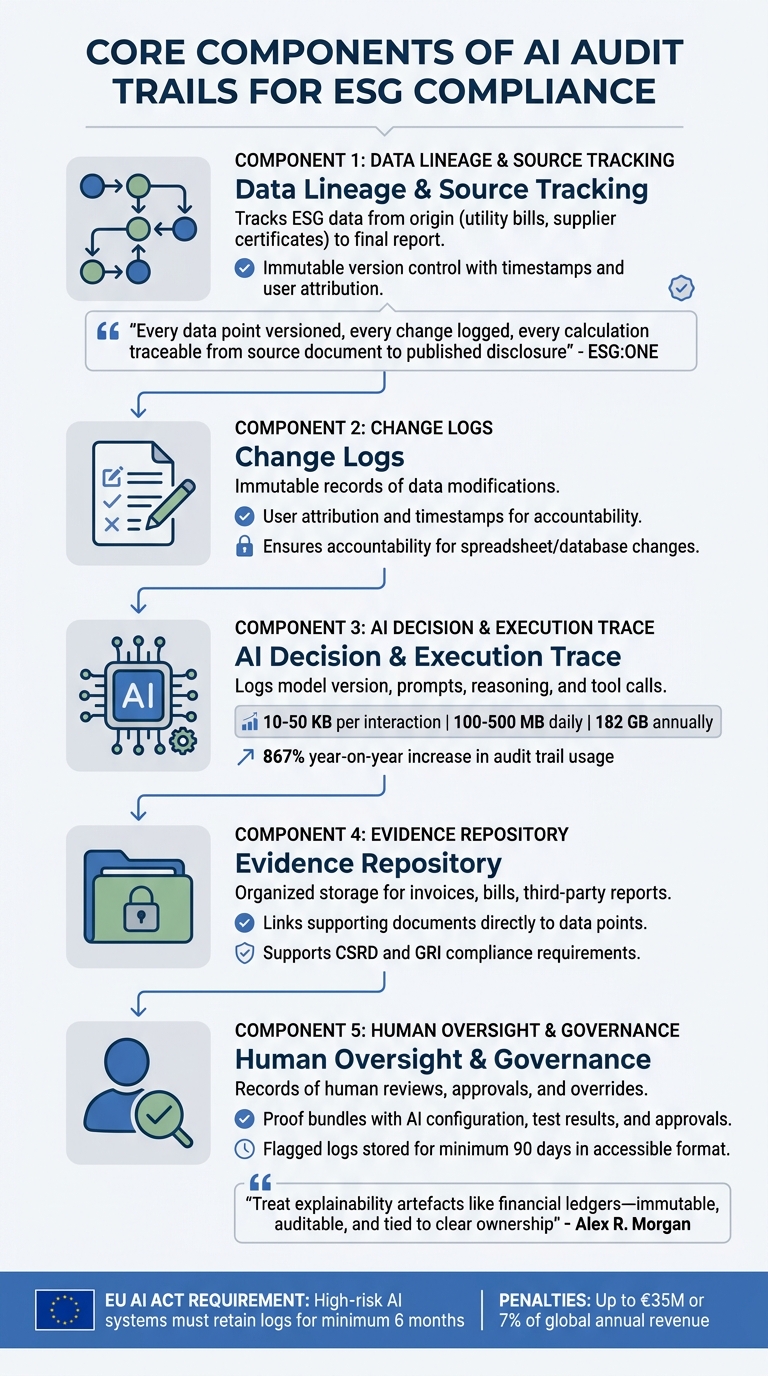
5 Core Components of AI Audit Trails for ESG Compliance
Data Lineage and Source Tracking
Data lineage acts as a roadmap, showing exactly how ESG data flows from its origin - like a utility bill or supplier certificate - to the final report. Think of it as a traceable supply chain for each data point, allowing auditors to trace any figure back through every stage of its journey 68. This level of detail is especially important for frameworks like CSRD and GRI, which demand the same precision for sustainability data as is required for financial reporting.
The backbone of this process is unchangeable version control. Every data point is time-stamped, attributed to a user, and logged with details about any changes made - what was altered, the previous value, the new value, and who authorised it 6. Supporting documents are linked directly to the relevant data points, creating a repository of evidence that simplifies audits. ESG:ONE summarises this approach perfectly:
Every data point versioned, every change logged, every calculation traceable from source document to published disclosure 6.
For private markets, this concept extends further, connecting key performance indicators (KPIs) to investment committee decisions and memos. This ensures that the rationale behind decisions is as transparent and auditable as the numbers themselves. To safeguard records, cryptographic signing (e.g., Ed25519) and hash chains are used, making it clear if any records have been tampered with or removed 10.
By building this solid foundation of traceable data, organisations can also improve the integrity of AI decision-making records.
AI Decision and Evidence Logging
Capturing the reasoning behind an AI system's decisions is just as important as recording the output itself. AI decision logs document the exact model version, prompt templates, system instructions, intermediate reasoning (such as chain-of-thought processes), and tool call sequences used during each interaction 8. This level of detail is crucial for answering regulatory queries. As Coverge points out:
If you cannot answer that question with specifics - which model was used, what data it received, what intermediate steps occurred... you have a problem 8.
Each interaction with an AI system can generate between 10–50 KB of audit data. Daily volumes might reach 100–500 MB, and annual storage could grow to as much as 182 GB, reflecting an 867% increase in audit trail usage year-on-year 8. This surge aligns with the push for mandatory disclosure frameworks like CSRD and the EU AI Act, which demand data integrity comparable to financial reporting standards.
| Component | Description | ESG Compliance Role |
|---|---|---|
| Change Logs | Immutable records of data modifications, including user attribution and timestamps. | Ensures accountability for changes made in spreadsheets or databases 6. |
| Execution Trace | Detailed logs of AI reasoning, tool calls, and token usage. | Provides clarity for AI-driven ESG risk assessments or classifications 8. |
| Evidence Repository | Organised storage for invoices, bills, and third-party reports. | Supports reported figures for CSRD and GRI compliance 6. |
| Pipeline Snapshot | Records of prompt versions, model IDs, and settings like temperature. | Confirms consistent AI system performance 8. |
These logs provide the groundwork for robust human oversight, ensuring compliance is thorough and transparent.
Human Oversight and Governance
While technical logs are essential, human oversight remains the ultimate safeguard for accountability. AI systems don’t operate in a vacuum - human intervention plays a critical role in contextualising decisions. Under Article 14 of the EU AI Act, high-risk AI systems must allow for effective human oversight, including the ability to interpret outputs and override or reverse decisions when needed 8. Audit trails must therefore include records of human reviews, noting the identity of the reviewer, the timestamp, and the decision taken (e.g., approved, rejected, or modified) 8.
"Proof bundles" consolidate AI configuration snapshots, test results, and human approval records into secure, unalterable artefacts. These satisfy regulatory requirements like SOC2 and the EU AI Act 8. Human reviewers are especially important for investigating exceptions flagged by the AI, such as low confidence scores, triggered guardrails, or data anomalies. Audit trails should be configured to flag such interactions for human review automatically. These flagged logs should be stored in an easily accessible format (a "hot tier") for at least 90 days to ensure readiness for audits 8.
As Alex R. Morgan, Senior Editor & Lead Audit Strategy at audited.online, advises:
Treat explainability artefacts like financial ledgers - immutable, auditable, and tied to clear ownership 9.
This approach ensures organisations can provide precise, documented evidence to regulators or stakeholders when asked why a particular decision was made, avoiding vague or incomplete explanations.
sbb-itb-6ca8558
How to Implement AI Audit Trails for ESG Compliance
Creating AI audit trails for ESG compliance requires thorough data integration, validation, and governance to ensure traceability and continuous evidence.
Mapping and Integrating ESG Data
The first step is cataloguing all ESG-relevant data sources within your organisation. This might include:
- Energy and utilities data from IoT sensors and building management systems.
- Procurement records sourced from supplier portals.
- Financial data from ERP systems.
- HR metrics related to diversity, equity, and inclusion.
- IT logs from cloud infrastructure.
Each data point should be aligned with relevant disclosure standards like CSRD, GRI, SASB/ISSB, or SEC climate regulations. This "map once, publish many" approach ensures consistency across different jurisdictions.
To streamline the process, integrate these systems using secure APIs from platforms like SAP, Workday, AWS, or Splunk. AI-driven tools can then standardise units (e.g., converting kWh to MWh or kg CO₂e to tCO₂e) and flag anomalies or missing values before the data reaches the reporting stage. Every data capture should include a timestamped audit record, creating an unchangeable lineage from the raw source to the final disclosure 11.
Owais Akbani, Data Consultant at Folio3, highlights the importance of this approach:
Data lineage is a clear record of every source, transformation, and validation step in your ESG process; it is foundational for demonstrating auditability to internal and external assurance teams. 11
Additionally, centralise all supporting documents in a searchable hub where AI can tag files with metadata, simplifying verification during audits 1.
This mapping process lays the groundwork for automated validation and strong audit trail governance.
Automating Data Validation and Monitoring
Once ESG data is mapped and integrated, automation becomes essential for validation and ongoing compliance. Given the complexity of ESG data, manual validation is inefficient. AI automation can reduce manual effort by up to 95% and shorten reporting cycles by as much as 85% 11. Machine learning tools can quickly identify outliers, missing values, and inconsistencies, allowing for timely corrections before external audits.
Real-time dashboards and alerts are crucial for tracking data drift and regulatory updates. AI can also conduct continuous gap analyses by comparing current disclosures against standards like CSRD or ESRS, flagging compliance gaps as they arise 1. When drafting ESG narratives, retrieval-augmented generation (RAG) ensures that every claim is backed by verifiable source evidence. By combining automated gap analysis with human review, organisations can achieve both speed and regulatory defensibility, reducing compliance review cycles and audit preparation efforts by up to 75% 11.
Establishing Audit Trail Governance
Effective governance is just as important as technical automation to maintain compliance and auditability. Start by implementing role-based access controls that define who - whether from legal, finance, or sustainability teams - can modify or approve data. Service level agreements (SLAs) should also be established to ensure timely expert reviews of AI-generated narratives and flagged data points 11.
Regular model versioning and scheduled retraining are necessary to keep up with changing ESG regulations. Frameworks like ISO 42001 offer a solid starting point for AI compliance, while governance practices should align with key reporting standards such as CSRD/ESRS, SEC climate rules, GRI, and SASB/ISSB 1112.
Incorporating audit readiness into daily workflows, rather than treating it as an annual task, can lead to significant cost savings. For example, EFRAG estimates that annual auditing costs for CSRD "limited assurance" range from £100,000 to £200,000 per year for every £8 million in revenue. By embedding compliance into everyday processes, organisations can manage these costs more effectively.
Conclusion
Benefits of AI Audit Trails
AI audit trails bring a new level of precision to ESG compliance by ensuring traceability, validation, and governance. With features like data lineage, AI decision logs, and human oversight, they provide a solid framework for tracking every ESG KPI back to its origin. This eliminates the need for manual reconstructions, which often rely on emails or memory, and ensures a clear distinction between deterministic processes and probabilistic AI outputs.
The regulatory landscape is evolving rapidly. For instance, the EU AI Act will require high-risk systems to implement automated record-keeping and human oversight starting 2 August 2026. Similarly, the Bank of England has been testing whether AI reasoning can remain observable during economic shocks. As Capital Refinery highlights:
Regulators have stopped accepting logs as proof. They want evidence of what ran, what was assumed, and why.
This shift in expectations, coupled with growing pressure from Limited Partners for verifiable compliance evidence, underscores the urgency for robust audit trails. The numbers speak for themselves: in 2024, there were 110 PE-backed bankruptcy filings, and by 2025, private-equity ownership was linked to 54% of the largest US corporate bankruptcies 3. These trends make the case for streamlined compliance solutions even stronger.
How Axion Lab Can Help

Axion Lab offers tools designed to meet these new compliance challenges head-on. Its AI-powered due diligence platform generates traceable evidence for every ESG claim and financial assumption, ensuring compliance with both the EU AI Act and GDPR. By using structured, domain-specific frameworks, Axion Lab identifies material risks and value-creation opportunities while maintaining the transparency regulators and Limited Partners now demand.
With over 15 private market firms across the EU and the UK currently beta-testing the platform, Axion Lab is helping GPs and management companies establish the decision-chain records that are now essential. As Sergei Maslennikov, Co-founder of Axion Lab, puts it:
Today's decision-making demands efficiency, coherence, and accurate information 13.


