

AI is transforming private markets by addressing challenges like fragmented data, slow decision-making, and limited transparency. Public markets, with their structured data and rapid decision cycles, offer a blueprint for leveraging AI effectively. Here's what you need to know:
- Public Markets: Benefit from structured data, real-time pricing, and AI-driven tools for fast decision-making, risk management, and scalability.
- Private Markets: Struggle with unstructured data, slower processes, and delayed reporting but are now integrating AI to streamline diligence, improve risk detection, and optimise workflows.
- Key Trends: By 2024, 64% of private equity deal teams used AI in diligence, and firms adopting AI report faster evaluations and better portfolio insights.
- Challenges: Private markets require robust data infrastructure and human oversight to ensure AI outputs are accurate and defensible.
Public markets demonstrate how AI can simplify complex workflows, and private markets are beginning to apply these strategies to improve efficiency and decision quality.
1. Public Market AI Applications
Data Utilisation
Public markets have seen a revolution in how they handle data. AI has expanded the tools available, uncovering complex patterns and relationships that traditional methods often miss 4. Today’s leading AI platforms process staggering amounts of information - over 10 TB of market data, 50 million news articles, and 500 million social media posts daily 3. The focus has shifted from simply collecting data to integrating and analysing it effectively.
Take the SESAMm platform, for example. By 2025, it was achieving 10.8% annualised returns through advanced Natural Language Processing (NLP) techniques like BERT and GloVe, which analysed 16 billion articles to guide ESG-focused investment strategies 3. The real success wasn’t about having more data - it was about turning high-dimensional, complex information into actionable insights 4. Systematic managers are now using AI to find relationships directly from the data, moving beyond human-designed factors and creating uncorrelated alpha 4. At the same time, discretionary managers use AI as a tool to automate time-consuming tasks, such as data collection and transcription, freeing up analysts to focus on deeper analysis and scenario planning 4.
"The promise of AI lies in generating an additional, uncorrelated source of alpha - beyond traditional factor and stock-selection alpha." - Weichen Ding, Director, Equity, bfinance 4
Decision-Making Efficiency
In public markets, closed-loop feedback systems powered by AI have drastically improved the speed of strategy adjustments. Between 2025 and 2026, Google (Alphabet Inc.) leveraged proprietary data from Search and YouTube to refine its AI models, boosting advertising relevance. This gave it a competitive edge, outperforming other major tech stocks by embedding AI into specific, high-value workflows rather than attempting broad, generalised applications 2.
The numbers back up the advantage. Advanced machine learning models like LSTMs, Transformers, and GANs have reached prediction accuracies of 65–75% in short-term market movements 3. By early 2026, a small but growing number of quantitative equity strategies were fully AI-driven, with machine learning forming the backbone of their investment processes 4. This shift reflects a move away from human-designed factors to algorithms that can dynamically adjust signals and weightings based on specific market conditions.
"AI does not replace that judgement; it accelerates and extends it." - Weichen Ding, Director, Equity, bfinance 4
AI’s speed doesn’t just enhance decision-making - it also strengthens risk management by enabling earlier detection of potential threats.
Risk Management Capabilities
By 2026, around 50% of companies reported using AI to identify financial risks more quickly 7. In public markets, predictive analytics plays a key role, using historical data to anticipate future events. This allows firms to mitigate risks - credit, market, fraud, operational, or liquidity - before they escalate, thanks to AI’s ability to spot patterns and anomalies across massive datasets 7.
In February 2026, the U.S. Treasury introduced the Financial Services AI Risk Management Framework (FS AI RMF) to establish common standards and terminology for managing AI risks 8. This move highlights the importance of maintaining market integrity. However, effective use of AI in risk management requires rigorous validation. AI-generated outputs must undergo robust testing and regular retraining to avoid overfitting 4.
"Clear terminology and pragmatic risk management are essential to accelerating AI adoption in financial services. These resources are designed to help institutions move faster with AI by reducing uncertainty and supporting consistent, scalable implementation." - Paras Malik, Chief Artificial Intelligence Officer, U.S. Department of the Treasury 8
Scalability and Adaptation
AI’s scalability is another game-changer for public markets. Platforms like Exabel and Aiera demonstrated this in 2025 by integrating over 50 pre-mapped alternative datasets with key performance indicator (KPI) data, speeding up the creation of alpha signals for buy-side firms 3. This level of data integration and automation enables market participants to monitor thousands of securities without sacrificing analytical depth.
The lesson here is clear: success depends on the ability to clean, align, and process unstructured data into actionable signals 4. Since ChatGPT’s launch in November 2022, the Nasdaq has surged by over 90% 5, underscoring how quickly markets adapt to technological shifts. By mid-2025, the percentage of U.S. businesses using AI had grown to 9.3%, nearly double the figure from early 2024 5. This rapid adoption reflects a shift toward AI-powered platforms delivering services that were once handled by human-led outsourcing 5.
sbb-itb-6ca8558
2. Private Market AI Applications
Data Utilisation
Private markets deal with a chaotic mix of fragmented and unstructured data - think CIMs, nested tables, and scanned documents - unlike the standardised, real-time data of public markets 91. AI steps in to make sense of this mess, turning it into organised, searchable intelligence. This process eliminates the need for days of manual data extraction by normalising opaque information.
In June 2025, New Enterprise Associates (NEA) led a Seed round for Foresight, a platform offering a three-product suite: Sourcing, Portfolio, and Diligence. This system moves beyond spreadsheets and outdated BI tools by integrating diverse data sources. Madison Faulkner, NEA's Principal, described this shift as transformative:
"The edge shifted from exclusivity to execution. From 'who you know' to 'what you can do with what you know'" 11.
Private markets aren’t about linear time-series data like public markets; they rely on intricate, interconnected relationships among founders, operators, and investors 11. By transforming this complex data, AI enables faster and more effective deal evaluations.
Decision-Making Efficiency
AI dramatically shortens the deal lifecycle by automating time-consuming, repetitive tasks that once bogged down analysts. For example, early-stage screening can boost productivity by as much as 85%, and IC memo synthesis times have dropped from 15 hours to just 4 9.
By 2025, more than 75% of venture capital deal reviews relied on AI and data analytics 11. This adoption has reduced deal evaluation timelines from the typical 6–8 weeks to just 2–3 weeks, all without compromising thoroughness 6. Alex Turgeon, President of Valere, highlights this shift:
"AI handles the heavy lifting whilst humans focus on strategic assessment" 6.
This efficiency allows senior analysts to move away from routine document synthesis and focus on higher-level tasks like building strategic theses and negotiating deals.
Risk Management Capabilities
AI doesn’t just speed things up - it also revolutionises risk management. The technology excels at spotting red flags, such as change-of-control clauses, concentration risks, or even revenue manipulation, far earlier than manual reviews 916. While public market AI focuses on standardised disclosures, private market AI maps complex relationships across portfolios to uncover systemic risks.
For a firm reviewing 600 documents monthly, AI-enabled document analysis can save up to 5,400 hours annually 9. But it’s not just about saving time; AI also enables real-time monitoring of critical metrics like customer acquisition costs or churn rates. Instead of waiting 30–60 days for traditional reports, firms can act immediately when issues arise 96.
Scalability and Adaptation
The private market is evolving beyond standalone AI tools toward more advanced systems - autonomous agents that handle multi-step workflows across origination, diligence, and portfolio management 910. However, success in this space requires more than just adopting AI. Firms need strong infrastructure to turn complex data into a competitive edge. While 91% of middle-market firms (£750 million–£7.5 billion AUM) have adopted generative AI, only 25% have managed to integrate it effectively into their operations 9.
"The winners are the firms that invest in the unglamorous infrastructure - clean data, domain-encoded workflows, and explicit human accountability" 9.
Limited partners are raising the bar, now including AI maturity questions in due diligence. Nearly all (99%) expect general partners to use AI in dealmaking, and 66% specifically anticipate its use in due diligence 9. The payoff can be substantial: for every £1 invested in AI transformation, firms can achieve an annualised EBITDA uplift of 2–4× at exit 9. However, a "barbell effect" is emerging - megafunds are building proprietary AI infrastructure, while smaller, tech-savvy managers leverage accessible tools. This leaves mid-market firms at risk if they fail to formalise an AI strategy 9.
Platforms like Axion Lab are leading the charge, offering AI-powered due diligence tools that turn fragmented data into actionable insights. These tools help private market players navigate complex data landscapes and make informed, strategic decisions.
Advantages and Disadvantages
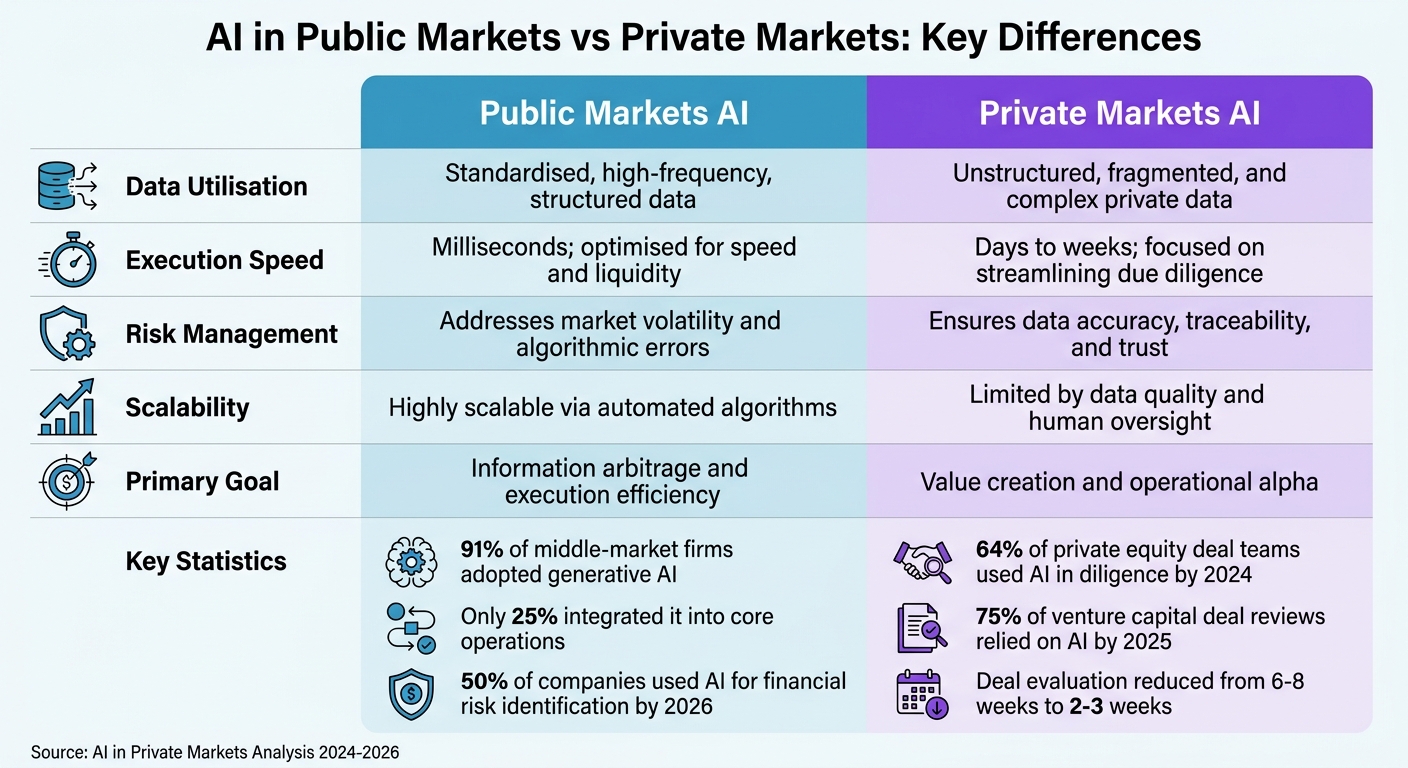
AI Applications in Public vs Private Markets: Key Differences
AI operates differently in public and private markets due to variations in data structure, speed, risk management, and scalability. Public markets benefit from standardised, high-frequency data, enabling decisions in milliseconds and supporting the scalability of algorithmic trading. On the other hand, private markets deal with fragmented, unstructured data that requires extensive normalisation before AI can generate actionable insights.
In public markets, AI excels at rapid execution, such as arbitrage, where decisions are made in milliseconds. In private markets, AI significantly reduces the time required for due diligence - compressing months of work into days - but still relies on human oversight. As Lampi AI aptly put it:
"The firms extracting real value are designing AI as a decision amplifier for analysts, not a replacement" 9.
This method prioritises defensible decisions over scalability, especially given the high stakes in private markets, where a single misstep in a £10 million deal can erode trust.
Risk management also varies. Public market AI uses algorithmic hedging to mitigate volume errors, while private market AI must ensure near-perfect accuracy and traceable data for each transaction.
Scalability is another key difference. Public markets achieve extensive scalability by automating processes across large asset classes. In private markets, scalability is constrained by data quality and the need for human involvement. Interestingly, while 91% of middle-market firms have adopted generative AI, only 25% have integrated it into their core operations. This creates a "barbell effect", where large funds build proprietary AI systems, smaller firms leverage accessible tools, and mid-market firms often struggle to keep pace 9.
The table below highlights these contrasts:
| Criterion | Public Markets AI | Private Markets AI |
|---|---|---|
| Data Utilisation | Standardised, high-frequency, structured data | Unstructured, fragmented, and complex private data |
| Execution Speed | Milliseconds; optimised for speed and liquidity | Days to weeks; focused on streamlining due diligence |
| Risk Management | Addresses market volatility and algorithmic errors | Ensures data accuracy, traceability, and trust |
| Scalability | Highly scalable via automated algorithms | Limited by data quality and human oversight |
| Primary Goal | Information arbitrage and execution efficiency | Value creation and operational alpha |
These differences demonstrate how public market AI strategies can inspire advancements in private markets. For instance, platforms like Axion Lab apply public market principles to transform fragmented private data into actionable and traceable insights, enhancing decision-making and driving value creation.
Conclusion
Public markets demonstrate how AI can integrate seamlessly into workflows to deliver clear, measurable results. The shift from general AI adoption to a focus on immediate returns and efficient capital use offers a valuable lesson for private markets: prioritise applications that show a tangible return on investment (ROI) 2. As Joyce Shen aptly put it:
"As AI functionality becomes more widely accessible, differentiation will increasingly depend on how seamlessly it is delivered within real‐world use cases" 2.
Private markets come with their own set of challenges - fragmented data, opaque valuations, and the necessity for human oversight. These complexities demand customised AI solutions. While many deal teams already use AI for due diligence, the real advantage lies in embedding AI into high-value workflows. For instance, this approach can cut document review times by as much as 70% 1. The most forward-thinking firms leverage AI as a precision tool, enhancing human judgement while ensuring outputs remain traceable and defensible. This reflects the strategies seen in public markets, adapted to the unique hurdles of private markets.
The next step is moving from static, point-in-time analyses to continuous intelligence. Private market players who invest in clean data infrastructure, encode domain-specific workflows, and adopt rigorous evaluation frameworks will fully harness AI's potential. This shift not only improves operational efficiency but also lays the groundwork for long-term competitive advantage. As Giorgio Fenancio explains:
"The most successful GPs treat AI as an extension of their investment philosophy. They build systems that reduce friction, improve underwriting discipline, and generate consistent insights across deals and sectors" 1.
Specialised platforms are emerging to address these specific needs. By applying lessons from public markets, private market firms can tackle their unique challenges head-on. Tools like Axion Lab are helping transform fragmented private data into actionable insights across legal, commercial, financial, and operational due diligence. These platforms enable firms to adapt public market strategies to their asset class, ultimately leading to better decisions and stronger portfolio performance.


