

Private equity deal teams are increasingly relying on AI to process data faster and more accurately. But AI isn't a replacement for human judgement. The best results come when each has clearly defined roles:
- Humans: Handle judgement, ethics, relationship-building, and strategic decisions. They ensure trust and accountability in negotiations and final approvals.
- AI: Automates repetitive tasks like data extraction, financial modelling, and benchmarking. It speeds up due diligence by identifying risks and patterns in large datasets.
Key challenges include balancing efficiency with security and overcoming organisational resistance. Firms must build frameworks where AI supports human oversight, ensuring compliance, accuracy, and traceable decisions. By combining AI's speed with human insight, deal teams can navigate tighter timelines and high-stakes decisions effectively.
Human and AI Strengths in Deal Processes
Successful deal teams leverage the unique strengths of both humans and AI. With AI becoming more integrated into private markets, it's vital to understand where human expertise ends and AI capabilities take over. This clarity helps assign roles effectively throughout each phase of a deal.
What Humans Bring: Ethics, Creativity, and Strategy
Humans play a critical role in strategic judgement, accountability, and building relationships. While AI can highlight risks in a contract, only humans can decide whether those risks align with a firm's risk tolerance and investment goals. As David Schumer, Managing Partner at Calibre One, points out:
Judgment, accountability, and trust cannot be automated away. AI elevates high performers and exposes underperformers faster, but it doesn't replace the people 7.
Humans excel at picking up on unstated concerns and subtle cultural nuances that go beyond formal documentation. In negotiations, trust and interpersonal skills are essential for closing deals. Katie May, Managing Director EMEA at Ontra, underscores this:
Human involvement ensures AI is used in a way that's safe and drives real business outcomes 6.
This human oversight is crucial for avoiding reputational risks that can stem from AI errors or misinterpretations of legal clauses in private market transactions.
What AI Brings: Data Processing, Pattern Recognition, and Speed
While human insight is invaluable for nuanced judgement, AI stands out for its speed and ability to handle vast amounts of data.
AI can automate repetitive tasks that would take humans days or even weeks. For instance, it can process Information Memorandums (CIMs), organise Virtual Data Rooms (VDRs), and extract contract terms at scale, allowing humans to focus on strategic decisions. Professionals using generative AI for document processing have reported productivity gains of nearly 60% 1, while firms employing AI-powered sourcing platforms have seen a 36% boost in direct sourcing deals 5.
AI's strength lies in its ability to recognise patterns across large datasets. It can identify 195 potential targets in the time it might take a junior analyst to find just one 5. During due diligence, AI can flag red flags and off-market terms by comparing deal data against historical benchmarks. Automated financial modelling can reduce the time spent building models by 90% 5. Additionally, AI provides evidence-based outputs, referencing specific document sections to support human decision-making during investment committee meetings 2.
sbb-itb-6ca8558
Assigning Roles Across Deal Stages
Mapping the strengths of humans and AI to specific deal stages is key to maximising efficiency. From sourcing to due diligence and closing, each phase benefits from a tailored balance of automation and human input.
Sourcing Phase: Finding Opportunities
AI shines in monitoring the market continuously, scanning sources like news feeds, patent filings, hiring trends, and regulatory updates to identify companies that align with your investment thesis 52. While traditional sourcing methods capture only 16–18% of relevant deals in a given market, AI can identify 195 potential targets in the time it takes a junior analyst to find just one 5.
AI also automates data extraction and triage, pulling key metrics - such as revenue, EBITDA, and margins - from Confidential Information Memorandums (CIMs) and teasers into standardised templates. It can even draft personalised outreach emails and produce initial summaries based on predefined criteria 291.
Humans, on the other hand, set the strategic framework. They define the investment thesis, evaluation rubrics, and sector focus that guide AI's filtering process. Personal connections and professional networks remain the domain of humans, as trust and relationship-building are critical in direct outreach. Most importantly, humans validate AI-generated screenings for accuracy and make the ultimate "pass or advance" decisions 529.
This division of labour ensures that the sourcing phase is both efficient and strategically aligned, setting the stage for a thorough due diligence process.
Due Diligence Phase: Analysing Risks and Opportunities
In due diligence, AI handles the data-heavy tasks, such as standardising financial information, identifying EBITDA adjustments (e.g., one-time expenses), and scanning Virtual Data Rooms (VDRs) for critical clauses like "change-of-control" or "indemnification" 1110.
For example, in early 2026, a mid-market private equity firm used AI-assisted due diligence for a £180 million healthcare services acquisition. The AI system uncovered £3.2 million in EBITDA adjustments - non-recurring legal costs and above-market management fees - that manual review had overlooked. This freed up 120 hours for the deal team to focus on strategic analysis, ultimately identifying a customer concentration risk that preserved an estimated £7 million in equity value at exit 11.
Humans focus on validation and strategic insights. They review AI-flagged anomalies and assess broader factors like management capabilities, competitive advantages, and cultural fit 11. Site visits, management interviews, and expert calls remain human-led but are informed by AI-generated insights 18.
"AI due diligence does not replace human judgement. It amplifies it by handling the data-intensive analysis that consumes 60 to 70 per cent of a DD team's time" 11.
With AI streamlining the bulk of data analysis, humans can concentrate on strategic risk assessment, preparing them for the negotiation phase.
Negotiation and Closing Phase: Finalising the Deal
In negotiations, AI serves as an intelligence layer, delivering real-time insights and benchmarking proposed terms against market data. It can analyse counterparty behaviour, auto-generate redlines based on playbooks, score clauses for deviations, and even simulate counterparty responses by reviewing prior agreements and public filings 1413.
For instance, Walmart International used a chatbot in 2022 to automate negotiations for 89 supplier contracts, reaching agreements with 64% of participants and achieving an average cost saving of 1.5% 12.
Humans, however, manage strategic trade-offs and relationships. They make final decisions on redlines, determine risk tolerance, and oversee stakeholder sign-offs 13. While AI provides robust analytical support, human oversight ensures that commercial and legal considerations are thoroughly evaluated.
"The shift isn't about replacing human judgement - it's about arming humans with information they never had before" 14.
To maintain control, all AI-generated redlines and high-risk clauses, such as indemnification caps or IP warranties, should undergo mandatory human review 13. This ensures that despite AI's contributions, the final decisions remain firmly in human hands.
Building Decision-Making Frameworks
After clearly assigning roles across deal stages, the next step is to create a decision-making framework that ensures every action is accountable and traceable. In private markets, where investments often involve tens or even hundreds of millions of pounds, it's crucial to establish clear accountability for decisions.
At its core, the principle is straightforward: AI should never operate independently when making decisions. Instead, AI functions as an intelligence layer that humans review, validate, and act upon. To achieve this, systems need to be designed to produce auditable evidence, enforce human oversight, and maintain clear responsibility from the initial screening to the final approval by the Investment Committee (IC).
Using Traceable Insights for High-Stakes Decisions
Every insight generated by AI must connect to a verifiable source. This is a non-negotiable requirement for compliance and governance. AI tools should be configured to provide answers tied to specific document identifiers, page numbers, and line excerpts from the Retrieval-Augmented Generation (RAG) index. If no source can be found, the system should state, "No verifiable source found", instead of generating a fabricated response 15.
For example, in late 2025, a mid-stage venture capital firm introduced an LLM copilot to summarise cap tables and investor commitments. By employing deterministic pseudonymisation, deploying the tool within a private VPC with "do-not-train" flags, and requiring mandatory partner sign-offs for every investment decision, the firm cut its time-to-first-assessment by 42% without compromising sensitive data 15. A key factor in this success was the use of evidence-first prompting. The AI was designed to return only claims supported by specific documents in the Virtual Data Room (VDR), with automated citations included in every report.
To uphold this standard, it's essential to implement immutable audit ledgers. These should log every query, along with timestamps, user IDs, and linked source documents, creating a defensible record for both Investment Committees and regulators 15. Additionally, confidence thresholds should be set to flag any AI response falling below a pre-defined accuracy score for human review 15. This approach ensures traceability while reinforcing the need for continuous human oversight.
Keeping Human Oversight and Ethical Control
Human-in-the-loop (HITL) checkpoints should be established at critical stages throughout the deal process. For instance, a deal partner or compliance officer must provide explicit approval before acting on AI-generated outputs. This could include advancing a company to due diligence, flagging a problematic clause, or drafting an IC memo 152. Such measures ensure that AI remains a tool for strategic support rather than an independent decision-maker.
"Investment judgement remains human. AI does not decide whether to deploy capital. It accelerates synthesis, reduces blind spots, and increases cognitive leverage." – Third Bridge 8
To maintain accountability, role-based governance should be clearly defined. Each role has specific responsibilities, ensuring that ethical and business considerations remain firmly under human control, even as AI handles the heavy lifting of data processing.
| Role | Primary Responsibility | Accountability Metric |
|---|---|---|
| Data Owner | Final investment decision & file use approval | Deal outcome & ethical alignment |
| Data Steward | Classification, redaction, & retention enforcement | Data privacy & compliance audit |
| Model Owner | Model access, logging, & "do-not-train" configurations | Technical security & model integrity |
| Compliance/Legal | Regulatory alignment (SEC, EU AI Act, GDPR) | Regulatory standing & DPA adherence |
This clear division of responsibilities ensures that while AI handles data-intensive tasks, ethical and regulatory considerations stay firmly under human control.
Creating Feedback Loops for Improvement
Once you've established clear, traceable decision-making protocols, the next step is to ensure the system remains adaptable and effective through continuous feedback loops. These loops are essential for refining human–AI collaboration over time. The most successful deal teams treat AI deployment as an evolving process, not a one-time setup. For example, teams using weekly retraining cycles have seen quality improvements occur 2.1× faster than those relying on monthly updates 16.
Improving AI Models Based on Deal Outcomes
To maximise effectiveness, use a combination of fast loops for immediate adjustments and slower loops for more in-depth periodic retraining. A fintech company demonstrated this approach with a risk-tiered oversight system, which reduced critical incidents to zero within just six weeks 16. Capturing inline edits - where human corrections are compared against AI outputs - provides valuable training data for refining models 16.
Another key strategy is creating "golden sets." These are curated libraries of 200–500 examples of ideal deal analysis, which serve as benchmarks for training and testing 16. Direct Preference Optimisation (DPO) is another effective method for improving AI models. By batching corrections weekly, DPO offers a more stable and resource-efficient alternative to traditional reinforcement learning 18. When combined with Targeted Human Feedback (RLTHF), which focuses on challenging or uncertain outputs, this method aligns models with only 6–7% of the typical annotation workload 18.
These continuous improvements also contribute to better bias correction and optimisation of AI prompts.
Correcting Biases and Improving Prompts
Addressing biases requires well-defined rubrics that ensure reviewers provide consistent feedback on accuracy and tone 16. Without these rubrics, label drift can occur, where the same AI output is assessed differently by various reviewers. To manage this, route low-confidence outputs (confidence scores below 0.65) to human experts. This approach can reduce review costs by up to 55% 16.
Before acting on any AI output, apply the "Three Questions" filter:
- What are the consequences if this is wrong?
- Can this decision be reversed?
- Does this require judgement the AI cannot provide? 17
"Risk-tiered HITL with clear SLAs is the fastest path to reliable AI in regulated environments." – 2024 Deloitte Responsible AI brief 16
Prompt engineering should be treated like coding: version control and test every adjustment against golden sets to prevent regression 16. For more complex tasks like due diligence, use multi-step prompting to guide the AI through a structured analysis rather than relying on a single query 3.
Weekly 30-minute calibration meetings can be invaluable. These sessions focus on edge cases where human judgement differs from AI outputs, helping to refine evaluation rubrics and encouraging a culture where questioning AI output is seen as professional judgement rather than mistrust of the technology.
"The human is not a step in the process. The human is the process" 17.
Fairness audits are another important step. Conduct these regularly across different deal segments - such as size, jurisdiction, and industry - to identify any systematic biases. Randomising which team member reviews AI outputs can also help uncover biases from both AI and human reviewers 16. Mature human-in-the-loop programmes aim for groundedness scores above 95% and citation accuracy above 90%, achievable only through disciplined and continuous refinement 16.
Building a Human-AI Role Definition Table
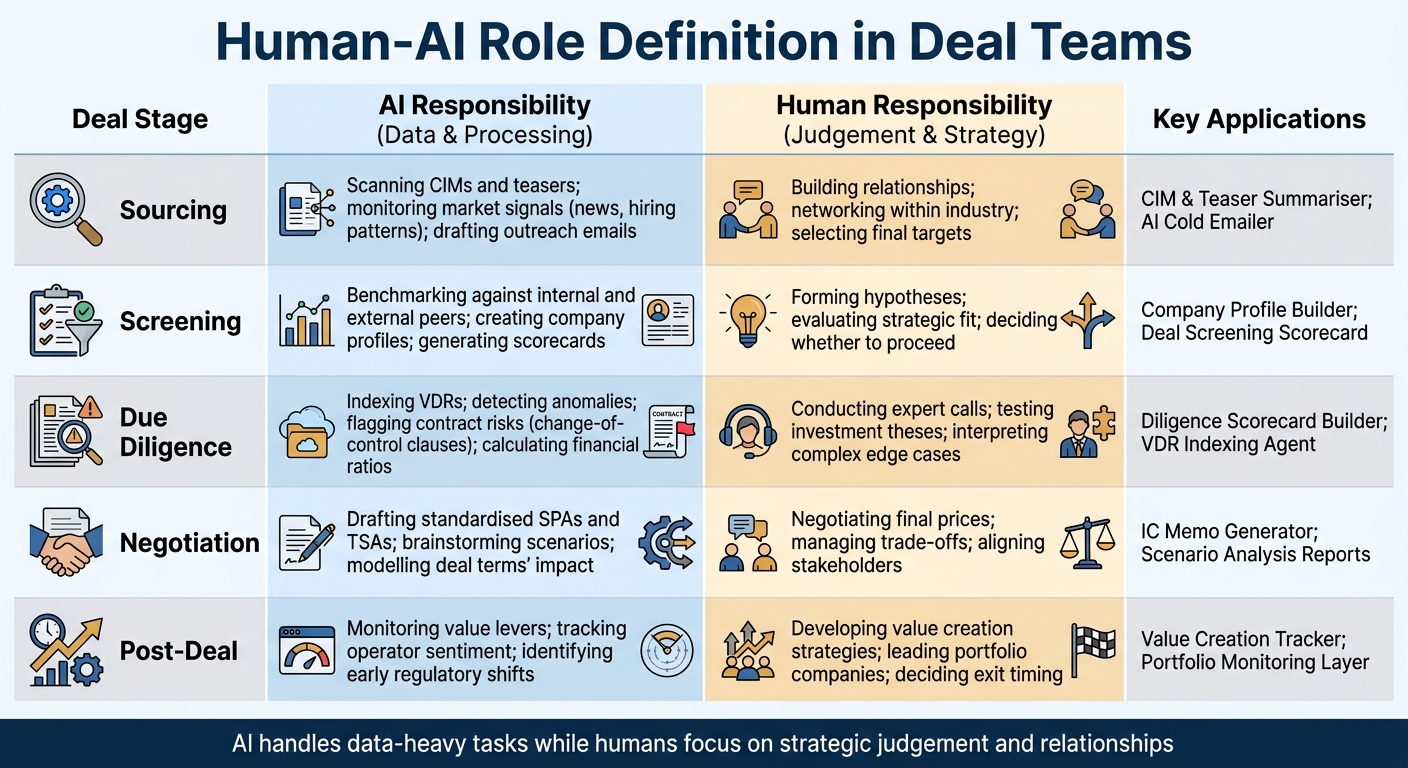
Human vs AI Roles Across Private Equity Deal Stages
Once feedback loops and governance protocols are in place, defining clear roles for humans and AI becomes essential. This process isn't about replacing human judgement but about offloading repetitive tasks, enabling deal teams to focus on strategic decisions and relationship management 8.
The table below outlines how responsibilities are divided at each stage of the deal process. AI takes on data-heavy tasks such as indexing, pattern detection, and drafting, while humans manage the more nuanced aspects like relationship building and making critical strategic decisions.
Role Definition Table
| Deal Stage | AI Responsibility (Data & Processing) | Human Responsibility (Judgement & Strategy) | Enabled Applications |
|---|---|---|---|
| Sourcing | Scanning CIMs and teasers; monitoring market signals (e.g., news, hiring patterns); drafting outreach emails | Building relationships; networking within the industry; selecting final targets | CIM & Teaser Summariser; AI Cold Emailer |
| Screening | Benchmarking against internal and external peers; creating company profiles; generating scorecards | Forming hypotheses; evaluating strategic fit; deciding whether to proceed | Company Profile Builder; Deal Screening Scorecard |
| Due Diligence | Indexing VDRs; detecting anomalies; flagging contract risks (e.g., change-of-control clauses); calculating financial ratios | Conducting expert calls; testing investment theses; interpreting complex edge cases | Diligence Scorecard Builder; VDR Indexing Agent; Axion Lab's tools |
| Negotiation | Drafting standardised SPAs and TSAs; brainstorming scenarios; modelling deal terms' impact | Negotiating final prices; managing trade-offs; aligning stakeholders | IC Memo Generator; Scenario Analysis Reports |
| Post‐Deal | Monitoring value levers; tracking operator sentiment; identifying early regulatory shifts | Developing value creation strategies; leading portfolio companies; deciding exit timing | Value Creation Tracker; Portfolio Monitoring Layer |
Axion Lab's tools, particularly for due diligence, provide citation-linked and auditable evidence across multiple domains, including legal, commercial, financial, operational, and digital. This ensures that every identified risk or insight is traceable back to the original source documents - crucial for both Investment Committee reviews and regulatory compliance 8 2. By leveraging structured signal extraction, manual transcript reviews, which previously took 10–20 hours, can now be completed in just minutes 8.
This framework emphasises human oversight and ensures that AI-generated outputs, such as screening scorecards or Investment Committee memo drafts, are always validated by humans. The result? Faster, well-supported decisions that are essential in competitive deal environments 8.
Conclusion
Using a well-structured framework and feedback loops, clearly defining roles within deal teams can significantly enhance performance. The goal isn't to pit technology against people but to create a collaborative system where both excel in their strengths. AI takes on data-heavy tasks like indexing virtual data rooms, extracting KPIs, and drafting scorecards, while humans focus on critical areas such as ethics, strategic judgement, and building relationships. This thoughtful division of responsibilities has led to noticeable productivity gains, helping teams work smarter and more effectively. Beyond efficiency, this approach also lays a foundation for strong ethical governance.
However, adopting AI successfully involves more than just plugging in new tools. It calls for a "diamond-shaped" team structure, where mid-level professionals play a pivotal role in supervising and validating AI outputs. This setup encourages professional scepticism - essential for catching AI errors, such as hallucinations, and ensuring outputs align with trustworthy sources. The role definition table highlights that while AI excels in processing data, human insight remains irreplaceable for strategic and ethical decision-making.
Ethical oversight plays a critical role in this equation. Every insight generated by AI must be traceable to reliable, auditable sources, with human approval required for any high-impact decisions. Processes like confidence thresholds, redaction pipelines, and feedback loops ensure that AI functions as a valuable adviser rather than an autonomous decision-maker.
Continuous learning is the glue that holds this system together. Firms that prioritise AI literacy - by refining prompts, cross-checking recommendations with diligence materials, and fostering a culture of ongoing improvement - stand to gain the most. As Charindra Pathiwille, Managing Partner at Deloitte UK, aptly states:
AI represents an opportunity, not a threat for the next generation of M&A deal makers... AI will enable you to do more with data and gain more insight with greater speed 4.
The firms that thrive will be those that see AI as an extension of their team's abilities, empowering professionals to focus on strategic thinking, decisive action, and meaningful human connections. For more insights on integrating AI into your deal-making processes, visit Axion Lab (https://axionlab.ai).


