

AI in private markets comes down to a choice: speed or precision. Scalable AI tools are quick to deploy, cost less upfront, and handle large data volumes efficiently. Customised AI, on the other hand, offers precision for complex tasks but is expensive, time-consuming, and resource-intensive to build.
Here’s a quick breakdown:
- Scalable AI: Ideal for general tasks like due diligence and deal sourcing. Cuts review times by up to 95% and boosts productivity by up to 85%. However, it risks shallow insights and amplifies flawed processes.
- Customised AI: Best for niche tasks like legal compliance or bespoke financial modelling. Delivers up to 30% better accuracy but requires high upfront investment (£40,000–£400,000) and months to implement.
The solution? Many firms are blending both approaches. Use scalable tools for routine processes and custom AI for high-stakes workflows. This hybrid method balances speed and precision while maximising ROI.
Why Your AI-Built App Will Stop Scaling (And How to Fix It)
sbb-itb-6ca8558
AI Scalability: Benefits and Drawbacks
Scalable AI is reshaping how private markets handle time-consuming tasks. For example, AI-driven due diligence can slash document review time by an impressive 80–95%, potentially saving a firm around 5,400 hours annually if they review 600 documents per month 4. Similarly, applying AI to deal origination tasks can boost productivity by 35–85% during early-stage screening 4. For firms overwhelmed by Confidential Information Memorandums (CIMs) and data room documents, this means processing thousands of pages in hours rather than days. Even the time spent creating Investment Committee memos can drop from 15 hours to just 4 hours 4.
Benefits of Scalability
The advantages of scalable AI go beyond just speeding up processes. It allows firms to expand their deal coverage without needing to proportionally increase their workforce. This means teams can explore more sectors and regions while staying lean. Currently, over 60% of private equity professionals are experimenting with AI pilots for deal sourcing and due diligence 3. One reason for this interest is scalable AI's ability to track unconventional signals - like web traffic, patent filings, and management changes - to uncover potential deals before they hit the broader market.
AI platforms also centralise due diligence data, making it easier for teams to access insights across the firm. Automated tools can reduce the time needed to produce investment one-pagers from 3–6 hours to less than 30 minutes 4. For firms managing the global private credit market - forecasted to hit US$2.28 trillion AUM by 2025 and grow to US$4.5 trillion by 2030 5 - this kind of scalability isn’t just helpful; it’s a necessity.
However, while the benefits are substantial, scaling AI can also magnify existing flaws in data and processes.
Drawbacks of Scalability
One major downside is that scalable AI can amplify weaknesses in a firm’s workflows. If a firm’s internal processes are messy or its data definitions inconsistent, scaling AI will only speed up these flawed practices, increasing risks. Around 54% of private equity professionals rate their internal data as merely "adequate" for AI pilots, highlighting a significant obstacle to scaling effectively 3.
Another issue is the potential for generating generic or incomplete insights. Off-the-shelf AI solutions often struggle with industry-specific terminology and the nuances of bespoke agreements. For instance, private market financial data often includes complex tables, inconsistent footnotes, and scanned exhibits, where the same figure might appear differently in various contexts 45. A scalable AI model might miss a critical "change-of-control" clause hidden in a customised credit agreement, creating blind spots. Additionally, Large Language Models (LLMs) may fabricate details when faced with ambiguous information - a serious concern during high-stakes due diligence 4.
These challenges highlight the delicate balance between speed and precision that firms must manage when adopting scalable AI.
Scalability Pros and Cons: Comparison Table
Below is an overview of the key benefits and challenges associated with scalable AI in private markets.
| Aspect | Scalability Impact | Private Markets Example |
|---|---|---|
| Data Processing | Handles large volumes of unstructured data quickly | Analysing over 3,000 pages of CIM materials per quarter to extract financial KPIs 4 |
| Operational Capacity | Enables growth without proportional headcount increases | Expanding deal sourcing into new regions without hiring additional junior analysts 45 |
| Due Diligence Speed | Reduces review times from weeks to days | Instantly identifying change-of-control clauses or litigation risks across an entire virtual data room 4 |
| Insight Quality | Risks producing shallow analysis that misses critical nuances | Failing to detect non-standard covenant structures in specific jurisdictions or asset classes 4 |
| Risk Management | Can quickly propagate errors in flawed data | Spreading inconsistent EBITDA definitions across portfolio valuations at scale 5 |
AI Customisation: Benefits and Drawbacks
While scalable AI shines in handling large volumes of data, customised AI steps in to tackle precision challenges. For instance, private markets often need AI that can distinguish between the meaning of "EBITDA" in a UK manufacturing context versus a US SaaS business or identify non-standard change-of-control clauses buried within a data room of 1,000 documents. This is where tailored AI proves its worth, addressing the nuances of legal, financial, and sustainability due diligence that generic models frequently overlook. However, these benefits come with certain trade-offs, especially when compared to the speed and simplicity of scalable solutions.
Benefits of Customisation
Custom AI offers precision that goes beyond what generic platforms can achieve. It can detect subtle details in Confidential Information Memorandums, flag inconsistencies in margin reporting across exhibits, and process fragmented, multi-language data often encountered in cross-border transactions. Additionally, it ensures compliance with regulations like GDPR through tailored governance measures, such as on-premise deployments 78911.
The efficiency gains are undeniable. Customised solutions can automate complex tasks like financial modelling, cutting the time required from weeks to mere hours - or even minutes - representing up to a 90% time reduction 7. A notable example comes from October 2025, when an engineering consulting firm adopted a customised AI platform using natural language processing to analyse RFP opportunities. This led to over a 20% increase in RFP win rates, a 60% reduction in review time, and a 20% revenue boost from successful bids 9.
"The gap between mediocre and transformative AI implementations comes down to one thing: customization." – Ironclad 12
Customisation also provides a strategic edge. Owning the AI model and its underlying code creates intellectual property, which can enhance company valuation and serve as a competitive barrier 1011. With 95% of venture capital and private equity firms now using AI in investment decisions 7, those employing customised solutions report a 55% improvement in key metrics compared to firms relying on generic platforms 12. This isn't just about speed - it’s about building capabilities that competitors can’t easily replicate. However, while the precision and strategic advantages are evident, the associated costs and complexities require careful consideration.
Drawbacks of Customisation
The main challenges are cost and complexity. Developing a custom AI solution typically takes 4–6 months for an initial deployment, compared to the much shorter timelines of off-the-shelf options 14. Initial development costs range from £40,000 to £400,000 for mid-market solutions, with ongoing infrastructure expenses between £1,600 and £8,000 per month 14. Fine-tuning a 7B parameter model can cost anywhere from £400 to £24,000, depending on the approach 13. Additionally, annual maintenance can add another 17% to the original development costs 7.
There’s also the risk of over-customisation, which can lead to a Total Cost of Ownership that’s 10–50 times higher than Retrieval-Augmented Generation (RAG) systems 13. Another significant hurdle is the talent gap. Effective implementation requires professionals who can bridge the gap between domain expertise and technical fluency, a rare skill set in private markets 4.
Accuracy concerns remain a pressing issue, particularly with hallucinations. In high-stakes environments like private equity due diligence, fabricated data may go unnoticed for months 4. In fact, 40% of legal professionals cite information accuracy as their top concern with AI 12. The financial data common in private markets - filled with nested tables, cross-referenced footnotes, and inconsistent formatting - poses additional challenges 4. Without rigorous evaluation and traceability, custom solutions can amplify these risks.
"AI in PE cannot be a black box. Every output must be reviewable, traceable, and overridable." – Lampi AI 4
Integration complexity is another obstacle, similar to the challenges faced by scalable solutions. Connecting AI insights to proprietary systems like CRM or portfolio monitoring dashboards requires significant technical work 711. In 2025, 42% of enterprise AI initiatives were discontinued, up from 17% in 2024, often due to implementation challenges and misalignment with business goals 6. Achieving full value from custom AI typically takes 18–24 months 14, demanding sustained resources and commitment that many firms underestimate. This balance of precision and complexity highlights the trade-offs that must be considered.
Customisation Pros and Cons: Comparison Table
| Aspect | Customisation Impact | Private Markets Example |
|---|---|---|
| Precision | High domain-specific accuracy for niche terminology | Identifying subtle cues in CIM footnotes or non-standard change-of-control triggers 78 |
| Compliance | Enhanced alignment with regulations and data sovereignty | Ensuring GDPR compliance for sensitive LP information through on-premise deployment 911 |
| Data Handling | Effective processing of unstructured and multi-language data | Synthesising disparate industry reports and news to map niche markets 8 |
| Strategic Value | Creates proprietary IP and competitive advantage | Owning the AI model increases company valuation and provides a defensible edge 1011 |
| Cost | High upfront investment (£40,000–£400,000) | ROI parity with SaaS typically reached within 18–24 months for high-volume users 14 |
| Timeline | Longer development cycle (4–6 months for MVP) | Developing a proprietary ESG scoring model tailored to SFDR/CSRD requirements 14 |
| Integration | Requires deep technical work to connect with legacy systems | AI that normalises EBITDA data directly from 20-year-old portfolio company systems 154 |
| Talent Requirements | Demands rare operator roles with dual expertise | Structural gap for professionals who can translate investment judgement into AI workflows 4 |
The next section will delve deeper into how these trade-offs compare directly.
Scalability vs. Customisation: Side-by-Side Comparison
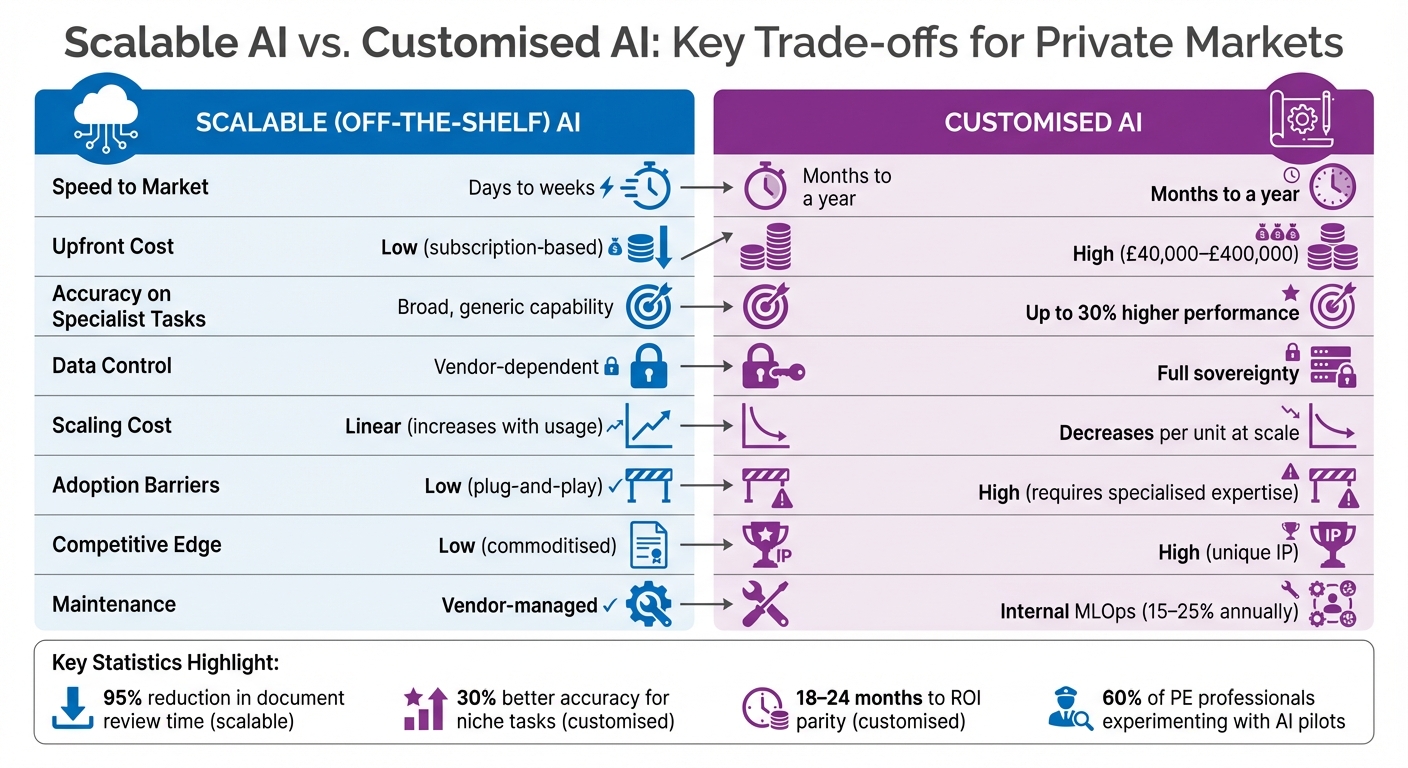
Scalable AI vs Customised AI: Key Metrics Comparison for Private Markets
Choosing between scalable and customised AI solutions is all about understanding the trade-offs and aligning them with your firm's specific needs. By comparing key aspects like speed, cost, and accuracy, you can better determine which approach fits your use case. Here's a closer look at how these two options stack up.
Speed to value is a major differentiator. Scalable solutions can be up and running in just days or weeks, while custom-built systems often take months - or even a year - to develop, validate data, and integrate into existing workflows 16. This time difference explains why many companies start with off-the-shelf tools to quickly demonstrate ROI before considering more tailored solutions as their needs evolve.
Cost structures also vary significantly. Scalable AI typically has lower upfront costs, thanks to subscription-based pricing, but expenses increase as usage grows. On the other hand, custom solutions demand a high initial investment, with labour accounting for 40% to 60% of the total build cost 16. However, they often become more cost-efficient over time, especially for high-volume operations, delivering better ROI within 12–24 months 1.
When it comes to accuracy, the gap becomes even more apparent in specialised applications. Generic models are great for covering broad use cases but often struggle with industry-specific terminology or logic. Custom AI, built using proprietary data, can deliver up to 30% better performance in niche tasks 16. For instance, in January 2026, Harvey AI’s legal models achieved an impressive 94.8% accuracy for document question answering, with lawyers favouring its results over GPT-4 in 97% of cases 6.
"Off-the-shelf systems get you to market quickly but risk delivering a generic, 'me-too' experience. A custom AI solution takes longer to ramp up but creates defensible competitive differentiation." – Dmitri Koteshov, Mitrix 1
Adoption barriers further highlight the differences. Scalable solutions are designed to be plug-and-play, requiring little technical expertise, which makes them ideal for firms just starting with AI. Custom-built systems, however, demand a higher level of expertise, such as machine learning engineers and data scientists, and ongoing maintenance costs of 15–25% of the initial investment. Additionally, in regulated industries where data compliance is critical, customised solutions often become a necessity to ensure data sovereignty 10.
Scalability vs. Customisation: Comparison Table
| Metric | Scalable (Off-the-Shelf) | Customised AI | Trade-off Implications |
|---|---|---|---|
| Speed to Market | Days to weeks 16 | Months to a year 16 | Scalable is faster; custom takes longer but offers precision. |
| Upfront Cost | Low (subscription-based) 10 | High (capital expenditure) 16 | Scalable is budget-friendly upfront; custom is a long-term investment. |
| Accuracy on Specialist Tasks | Broad, generic capability 16 | Up to 30% higher performance 16 | Custom is better for high-stakes, specialised tasks. |
| Data Control | Vendor-dependent 10 | Full sovereignty 1 | Custom is ideal for strict data regulations. |
| Scaling Cost | Linear (increases with usage) 1 | Decreases per unit at scale 10 | Custom becomes more cost-effective at scale. |
| Adoption Barriers | Low (plug-and-play) 1 | High (requires specialised expertise) 10 | Scalable is accessible; custom demands skilled talent. |
| Competitive Edge | Low (commoditised) 10 | High (unique intellectual property) 16 | Custom builds a stronger competitive advantage. |
| Maintenance | Vendor-managed 10 | Requires internal MLOps (15–25% annually) 16 | Scalable reduces operational effort; custom requires ongoing resources. |
This comparison underlines the importance of aligning your AI strategy with your firm's goals and resources. The next section will explore practical ways to navigate these trade-offs effectively.
How to Balance Scalability and Customisation
Top-performing private market firms don’t see scalability and customisation as opposing goals - they blend them using a hybrid delivery model. This strategy directly tackles the challenge of balancing speed with precision. The approach involves using off-the-shelf AI tools for general tasks like summarisation and drafting, while creating tailored systems for workflows that involve sensitive data or critical decision-making. In this way, generic AI handles routine processes, while bespoke AI solutions address unique challenges to gain a competitive edge.
To make this hybrid model work, begin by evaluating your current workflows. Map out these processes end-to-end to identify areas with high value but also high friction - such as covenant monitoring, CIM synthesis, or quarterly reporting. For these key functions, it’s often more effective to collaborate with specialised providers who offer tailored data infrastructure and taxonomies designed for private equity, rather than building everything from scratch. This method bridges the gap between generic tools and the specific needs of your firm.
One essential step is data normalisation. Private market data can be messy - think nested tables or inconsistent footnotes - and generic AI tools often misinterpret this complexity. To ensure success, establish a custom data foundation that can handle such challenges before scaling any AI initiatives. As Bryan Dougherty, CTO of Arcesium, aptly notes:
AI doesn't solve foundational operational issues: it magnifies them 5.
Treat data curation as a core activity in your AI strategy, not an afterthought.
The industry is also moving towards agentic AI - autonomous systems capable of planning and executing multi-step workflows while involving human oversight for critical decisions. This "decision amplifier" model ensures AI takes care of the heavy lifting, while human judgement remains central. For example, solutions like Axion Lab combine scalable frameworks with domain-specific customisation, offering AI-powered due diligence tools that provide traceable and auditable insights across legal, financial, commercial, and operational domains. This hybrid model delivers both the speed and precision needed for general partners and advisors handling complex deals.
To reinforce these advanced AI capabilities, firms can implement platform layering. This approach ensures better control by adding internal layers for governance, logging, and monitoring, reducing the risk of tool sprawl. With 91% of middle-market firms adopting generative AI but only 25% successfully embedding it into core operations 4, the ability to balance scalability with customisation often determines success. A well-executed hybrid strategy helps firms scale efficiently while maintaining the precision required for high-stakes decisions.
Conclusion
Deciding between scalability and customisation boils down to timing and strategic goals. Ready-made AI tools offer quick solutions for routine tasks, while tailored systems provide a competitive edge in complex workflows like covenant monitoring. The most successful firms leverage both approaches.
To put these strategies into action, start with pilot projects targeting high-friction processes. Demonstrating ROI within six months through these quick wins can build confidence and secure funding for larger, custom AI efforts. Focus on areas that involve extensive manual work, where AI can drastically reduce processing times 4. Ensure every AI output includes traceable findings - referencing specific source documents (e.g., page 47 of a credit agreement) - to build trust with stakeholders like the Investment Committee 45.
To manage risks effectively, take a gradual approach to AI integration. Begin with a minimum viable product, refine it using user feedback, and scale up once its value is clear. This step-by-step method reduces technical risks and allows teams to adapt. It's worth noting that 95% of corporate AI projects fail - not due to technology issues, but because of gaps between strategy and execution 2. Prioritising high-quality data is crucial, as AI amplifies the strengths or weaknesses of existing processes.
As private markets evolve, Limited Partners are increasingly using a firm's "AI maturity" as a benchmark for operational discipline 4. Moreover, custom AI systems can significantly boost exit multiples, potentially doubling them from 8× to 16× EBITDA 2. The real challenge isn't whether to implement AI, but how to strike the right balance between speed and precision to maintain and grow your competitive edge over time.


