

AI is transforming how businesses cut costs and improve efficiency. From speeding up due diligence to real-time performance tracking, AI tools are reducing workloads, improving accuracy, and helping organisations make better decisions. However, achieving results requires more than just technology - it demands rethinking processes, investing in infrastructure, and balancing automation with human oversight.
Key Takeaways:
- Due Diligence: AI tools like NLP and predictive analytics reduce manual effort, cutting costs by up to 80% and turnaround times by 71%.
- Portfolio Monitoring: Real-time dashboards flag issues early, reducing reporting delays by up to 60 days.
- Supply Chain Management: AI identifies inefficiencies, saving millions by optimising spend and supplier contracts.
- Challenges: High costs, integration issues, and data security are major hurdles. For example, AI projects often exceed budgets by 50%-100%.
- ROI Potential: AI can deliver 150%-300% ROI in the first year when paired with process redesign and strategic implementation.
The path to success lies in starting with small, well-defined tasks, testing results, and scaling gradually. AI isn't just a tool - it's a catalyst for change in how businesses operate.
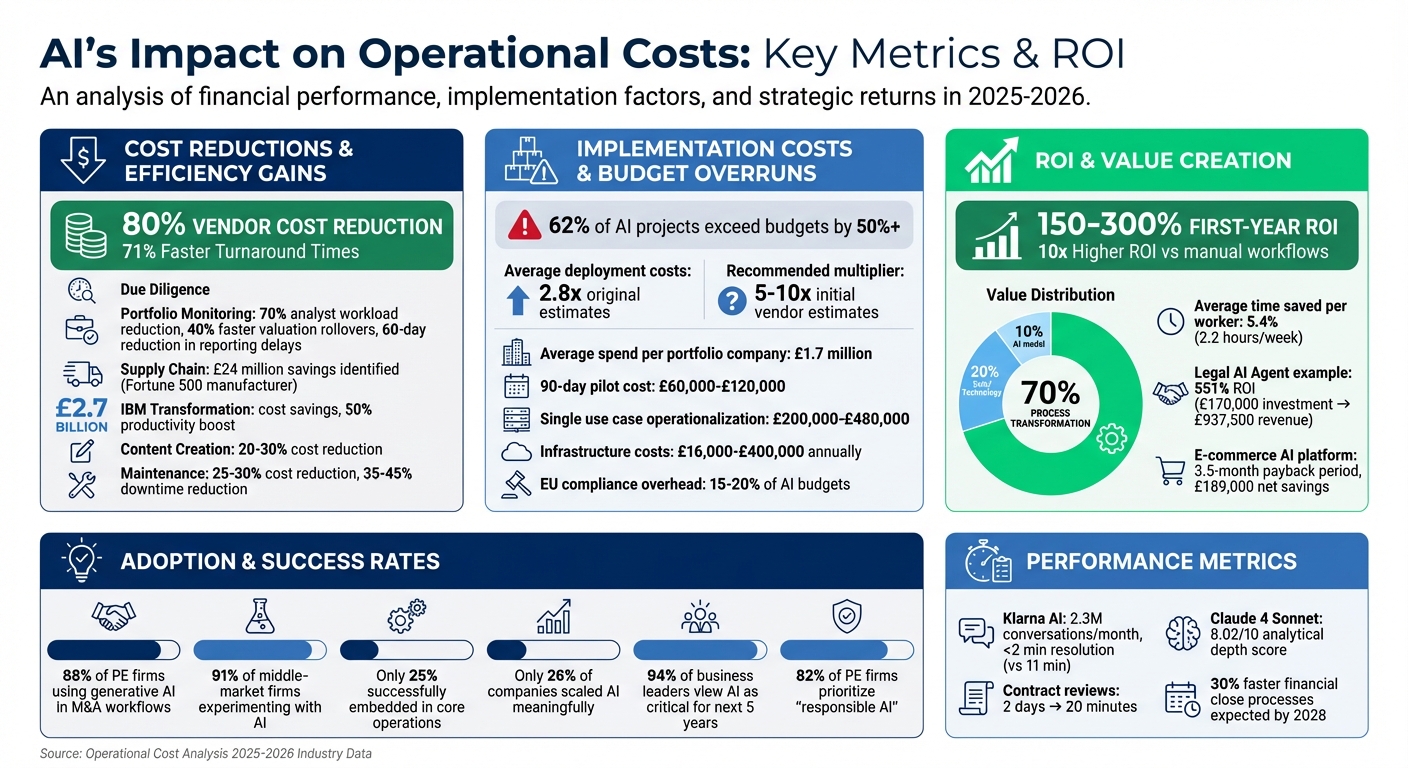
AI Cost Reduction Statistics and ROI Metrics in Operational Analysis
AI Use Cases in Operational Cost Analysis
Automation in Due Diligence
AI is reshaping how private equity firms manage the mountain of documents received during due diligence. Instead of manually sifting through countless PDFs, Excel files, and scanned documents, AI tools now classify and organise these into searchable formats. They even cross-check claims from confidential information memorandums against actual customer contracts and revenue schedules, flagging inconsistencies that might escape human analysts 67.
The impact of this shift is clear. Take the 2026 StackAI partnership as an example: the firm not only slashed vendor costs by 80% and turnaround times by 71%, but they also evaluated 33% more companies. This is a game-changer, especially considering that outsourcing manual due diligence updates typically costs between £1,600 and £4,000 per update 1.
AI systems can extract financial metrics - like EBITDA margins, revenue by customer, and add-backs - as well as legal details such as termination rights and liability caps, all in a fraction of the time it would take a human team 69. They also rank operational risks, such as high employee turnover or pending litigation, based on their potential impact on valuation 69. Using Retrieval-Augmented Generation (RAG), these systems link every insight back to its source document, ensuring the transparency and auditability that investment committees demand 67.
With due diligence now more efficient, AI is also transforming how firms monitor their portfolios.
Portfolio Monitoring and Performance Tracking
After a deal is closed, AI shifts gears to focus on ongoing portfolio performance. Instead of relying on traditional quarterly reports, firms now use real-time dashboards that flag anomalies in churn rates, pricing trends, or customer behaviour as they occur 914. This requires not only sophisticated software but also centralised data systems, where validated information feeds into a unified data warehouse or client portal 139.
Consider the example of a mid-sized private equity firm managing a £3.2 billion fund. In July 2025, they adopted Linedata's Cognitive Investment Data Management solution. The results were impressive: analyst workload was reduced by 70%, valuation rollovers sped up by 40%, and reporting delays were cut by 60 days 13. Their CFO commented:
"The blend of AI-driven automation with hands-on analyst expertise transformed our data workflows. We've cut reporting delays by over two months and freed up 70% of analyst time, enabling us to focus on strategic value creation" 13.
The key to success lies in balancing automation with human oversight. High-performing firms ensure that critical red flags are reviewed by analysts and financial figures are rigorously verified 68. This approach not only ensures data accuracy but also builds trust in strategic reviews. By streamlining financial reporting and identifying potential issues early, firms can protect portfolio value. With 88% of private equity firms now incorporating generative AI into their M&A workflows 14, those who excel in continuous monitoring gain a clear competitive advantage.
While real-time dashboards improve performance tracking, AI is also delivering major cost savings in supply chain management.
Supply Chain and Resource Allocation
AI is proving its worth in uncovering hidden inefficiencies within supply chains and procurement. By combining machine learning, Retrieval-Augmented Generation, and large language models, AI systems can clean up spend data, consolidate suppliers, and optimise demand-supply matching 1011. For example, in February 2026, a £12 billion Fortune 500 manufacturer used AI to identify £24 million in savings. This was achieved by reclassifying spend data, revealing duplicate suppliers, and tightening price controls 11.
Contract management is another area ripe for improvement. Poor contract oversight can cost companies nearly 9% of their annual revenue 11. AI tools, powered by natural language processing, can monitor contracts for risky terms, compliance issues, and auto-renewals that often lead to revenue losses 11. In July 2025, a German energy provider implemented a custom AI tool to automate payment reviews. Built in just 10 weeks, the tool scans invoices against contract terms and purchase orders, helping to identify overpayments and potentially saving millions of pounds 2.
Some AI initiatives go even further. Between 2023 and 2025, IBM used AI to overhaul its procurement, IT, and other support functions. This transformation resulted in £2.7 billion in cost savings and a 50% boost in productivity 2. However, these outcomes didn’t come from simply adding AI to existing processes. IBM restructured its operations from the ground up, ensuring that every system was designed to maximise the benefits of AI. This approach highlights the importance of integrating technology with broader organisational changes to achieve measurable results.
sbb-itb-6ca8558
Leverage AI for operational excellence and strategic cost management
Challenges in AI Implementation
AI promises efficiency, but its implementation comes with a hefty price tag and a steep learning curve. Surprisingly, the visible costs - like model development and cloud computing - make up only about 10% of the total investment. The bulk of the spending goes toward data infrastructure, integration, and reshaping organisational workflows 15. In 2025, 62% of enterprise AI projects surpassed their budgets by over 50%, with average deployment costs soaring to 2.8 times the original estimate 16. Experts now recommend multiplying initial vendor estimates by five to ten times to account for hidden expenses. For context, leading firms spend an average of £1.7 million per portfolio company on AI projects 151620. Even small-scale efforts can be costly - a 90-day pilot alone runs between £60,000 and £120,000, while operationalising a single use case, like accounts payable, can cost £200,000 to £480,000 17.
Infrastructure costs add another layer of complexity, ranging from £16,000 to £400,000 annually depending on system requirements 15. As a Gartner Finance Practice VP put it:
"Because AI is so new, CFOs don't really know what it costs, and cost estimates are running off by 500–1,000%" 5.
Klarna’s experience highlights how unpredictable these costs can be. The company initially anticipated £32 million in annual savings by deploying an AI assistant to manage 66% of 2.3 million monthly chats. However, by 2026, they were rehiring human agents after discovering the AI savings accounted for just 1.3% of total expenses and had negatively affected service quality 5.
Beyond financial considerations, ensuring data security and governance introduces further hurdles.
Data Security and Governance
For private equity firms, safeguarding sensitive deal data is critical. Security and governance add a significant overhead - European enterprises allocate 15–20% of their AI budgets to compliance, security, and auditability 161721. The EU AI Act, enforceable since late 2025, requires initial risk classification and legal reviews costing £8,000 to £20,000 per system 16. Building an audit trail infrastructure adds another £8,000 to £16,000 upfront, with ongoing maintenance costs of £400 to £1,600 monthly 16. Strengthening security for AI systems interacting with production environments, like ERPs, can cost between £16,000 and £40,000 per connection 16.
"Auditors expect immutable logs, SoD, approval thresholds, policy versioning, and evidence packets (inputs, match results, rationale, postings) attached to each entry." - Ameya Deshmukh, EverWorker 17
Critical safeguards include automated PII masking, tenant isolation, and encryption for data at rest and in transit. Private networking is also essential to shield sensitive information. Additionally, organisations must adopt "evidence by default", ensuring every AI-driven decision is accompanied by a detailed evidence packet outlining inputs, rationale, and confidence scores. This level of traceability is now a priority for 82% of private equity firms, who view "responsible AI" as a cornerstone of their strategy 19.
However, integrating new AI capabilities with older systems is often one of the toughest challenges.
Integration with Existing Systems
Integrating AI into legacy systems - like ERPs and CRMs - often costs several times more than developing the AI model itself, especially in financial services 15. These integrations are notorious for overshooting budgets, sometimes by a factor of three, due to unpredictable results and heightened security requirements 16. Many older systems lack modern APIs, forcing firms to invest in custom middleware or direct database connections. Depending on the complexity, integration costs can range from £88,000 to £344,000 1522.
Financial data poses additional obstacles. It is often messy, featuring scanned PDFs, nested tables, and inconsistent accounting practices that standard AI parsers struggle to handle 2023. Preparing and managing such data typically consumes 30–50% of the overall AI budget 22. As AEX Partners aptly noted:
"A beautiful model that doesn't connect to your fifteen-year-old ERP system delivers zero business value." 15
Although 91% of middle-market firms are experimenting with generative AI, only 25% have successfully embedded it into their core operations 20. Incremental adoption is key. Starting with narrow, well-defined tasks - like data standardisation - can pave the way for smoother integration. Firms should also set aside an extra 15–20% of their API budget for monitoring and tracing tools to ensure system reliability in production environments 18.
Measuring AI's Impact on Operational Costs
When it comes to gauging how AI affects operational costs, having a clear starting point is essential. Begin by evaluating task duration, throughput, quality, and cost per task. For the latter, calculate it by factoring in the hourly rate and task duration, including overhead expenses. This baseline is your reference point to assess whether AI is genuinely reducing costs or simply redistributing workloads.
As AI strategy consultant Alan Knox explains:
"If you ask a CFO what ROI metric they want from AI, the answer is almost always the same: 'Show me the time saved'" 24.
But here's the catch: saving time doesn't always equate to creating value. Organisations need to measure how employees use the extra time. Is it directed towards high-impact tasks, strategic planning, or does some of it slip away due to "productivity drift"? 24.
Cost Efficiency Metrics
To measure efficiency, track how AI reduces manual effort, speeds up timelines, and increases throughput. For example, Klarna's AI assistant managed 2.3 million conversations in its first month, slashing resolution times from 11 minutes to under 2 minutes - effectively replacing the workload of 700 full-time employees 24. Similarly, AI tools for contract reviews can cut processing time from two days to just 20 minutes 3.
Additionally, technical metrics like compute costs and API usage offer a broader picture of AI's efficiency. For instance, tracking per-request compute costs, GPU-hours per 1,000 responses, and API token consumption can reveal where savings occur 425. Smaller, fine-tuned models like Llama 3-8B often deliver similar results to larger models but at a fraction of the cost - about ten times lower for domain-specific tasks 426. IBM's use of AI in areas like legal, IT, and procurement led to £2.8 billion in cost savings and a 50% productivity boost across its operations 2.
It's also crucial to monitor the "Automation Paradox" - the balance between time saved through automation versus time spent on oversight or rework. A/B testing can help validate efficiency gains by comparing manual processes against AI-assisted workflows over a period of 6–8 weeks 24.
Operational Savings vs Long-Term Value
AI investments often follow a J-curve return pattern, where initial high costs eventually lead to significant long-term benefits. On average, about 10% of value comes from the AI model itself, 20% from data, and 70% from restructured processes 23. Experts suggest evaluating these investments over at least three years for an accurate picture. Short-term savings, however, can be realised through automation, such as reducing content creation costs by 20–30% 326.
Take the example of a London law firm with 50 associates. They invested £170,000 in a specialised Legal AI Agent for contract analysis. By automating first-pass reviews, they saved 20% of time per associate. Redeploying 50% of that saved time to new matters generated an additional £937,500 in revenue, delivering a 551% ROI 27. To convert "time saved" into tangible value, organisations often use a utilisation factor (typically 0.4 to 0.6) to estimate how much of the freed time is spent on value-generating activities 27. In another example, finance teams using AI-enhanced cloud ERP systems are expected to close financial processes up to 30% faster by 2028 28.
Examples of AI Cost Reductions
A Manchester-based e-commerce retailer with 20 support staff adopted the Agentic AI platform, which resolved 50% of its 15,000 monthly support tickets. This system, costing £73,500 in its first year, eliminated the need for 7.5 full-time employees, resulting in £189,000 of net savings and a payback period of just 3.5 months 27. AI-driven predictive maintenance has also proven effective, reducing maintenance costs by 25–30% and downtime by 35–45% 4.
Similarly, a global asset manager used AI to optimise customer support operations, cutting operating expenses by one-third - equating to around £80 million in savings 3. In private equity due diligence, a July 2025 study by ToltIQ found that Claude 4 Sonnet achieved the highest score for analytical depth (8.02/10), while ChatGPT 4.1 excelled in speed for gathering information 12. As ToltIQ's Alfast Bermudez noted:
"The results demonstrate that raw citation volume doesn't translate to better due diligence outcomes. Claude's ability to synthesise information... makes it function almost like a skilled research analyst" 12.
Studies show that AI implementations for cost reduction typically deliver an ROI between 150% and 300% within the first year 4. Companies leveraging AI often report a tenfold higher ROI compared to those relying on manual workflows 26. On average, workers using generative AI save about 5.4% of their work hours - roughly 2.2 hours per week 24. These metrics not only highlight immediate cost savings but also pave the way for transformative changes in organisational processes.
Conclusion: A Balanced Approach to AI Adoption
AI offers impressive cost savings - cutting expenses by 20–30% in content creation and 30–80% in automation-heavy areas. Yet, only 26% of companies have successfully scaled AI to deliver meaningful results 329. The key to success lies in rethinking traditional workflows and restructuring how work gets done.
The 10-20-70 rule sheds light on why technology alone isn't enough: just 10% of AI's value comes from the algorithm itself, 20% from data and technology, and a massive 70% from transforming business processes and people 23. Paul Goydan from BCG summarises this perfectly:
"Leaders will only capitalise on AI's potential if they have the discipline to change processes, reorganise people, and shape the culture to execute on the business case" 3.
This underscores the importance of moving beyond simply automating existing processes. Instead, organisations must reimagine and redesign operational functions from the ground up.
To implement AI effectively, start small and strategically. Focus on high-volume, rule-based tasks that can deliver quick wins - these successes can fund larger transformations 329. Run AI workflows alongside existing processes to test and validate results before scaling up 2. AI should never be treated as a standalone tool; instead, integrate it into workflows where it can tackle friction points and deliver measurable financial outcomes 4. It's not just about saving time - track how those efficiencies directly contribute to revenue growth or reduced staffing needs.
The risks of delaying AI adoption are significant. With 94% of business leaders viewing AI as critical to their success over the next five years 30, and 2026 expected to be a turning point for widespread deployment 29, companies that hesitate risk losing market share. However, rushing in without proper preparation can be just as harmful. A thoughtful approach - balancing upfront investments with phased rollouts, rigorous tracking of value, and a commitment to structural and technological changes - is essential for achieving sustainable operational gains. By adopting this measured strategy, businesses can position themselves to thrive in an AI-driven future.


